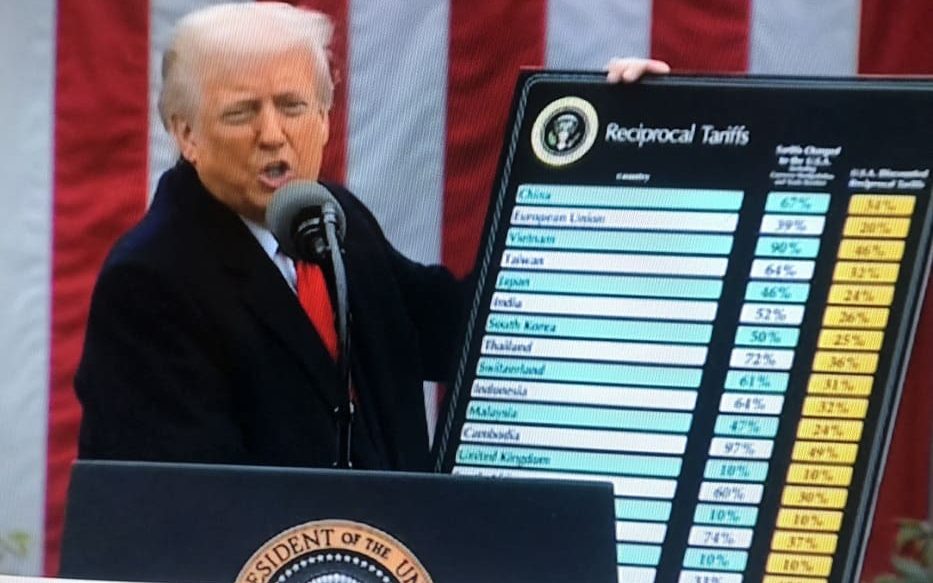
Donald Trump with his initial list of countries to receive reciprocal tariffs – now Australia is facing a new 12.5pc tariff.
AUSTRALIAN lamb, mutton and goat meat imports into the United States, and wool products from China, could attract a new 12.5pc tariff later this year, under proposals by the US trade representative ambassador Jamieson Greer.
The new tariff proposal has come into the lead up to the expiry of the current 10pc tariff on imported products on 24 July, after the US Supreme Court ruled that US president Donald Trump’s tariffs introduced under the International Emergency Economic Powers Act were illegal.
If the 10pc tariff does not expire, then Australia’s lamb, mutton, goat meat, and wool imports into the United States could attract tariffs of 22.5pc.
The office of the USTR has said it initiated 60 Section 301 investigations related to the failure of various economies to impose and effectively enforce a prohibition on the importation of goods produced with forced labour, determining that 54 economies have failed to impose and/or effectively enforce a forced labour import prohibition — including Australia, New Zealand and China.
The USTR has proposed that appropriate action includes additional duties on all products of the investigated economies, except as provided in an exemption list that includes beef, but not sheep and goat meat nor wool products.
For economies that impose a forced labour import prohibition and have taken on commitments through an agreement on reciprocal trade; or have imposed a partial regime with the effect of preventing the importation of certain forced labour goods, the trade representative has proposed a 10pc tariff as the rate of additional duties. For all other economies, including Australia, the trade representative is proposing 12.5pc as the rate of additional duties.
The trade representative has also proposed a textile mechanism that would allow for a certain volume of apparel and textile imports from certain economies to enter the United States at a reduced Section 301 tariff rate.
Ambassador Jamieson Greer said the failure of the US’s most important trading partners to address the importation of goods made with forced labour is unacceptable.
“This creates a dynamic where American workers are forced to compete globally on an unlevel playing field,” he said.
“We will no longer tolerate this disparity.
“Some trading partners have taken initial steps to prevent the importation of forced labour goods, including through USMCA and commitments in Agreements on Reciprocal Trade,” he said.
“However, each of our trading partners must do more to ensure that trade does not perversely encourage and entrench forced labour globally.”
The USTR is now seeking public comments on the proposed actions in the investigations and public hearings are due to begin on 7 July. To be assured of consideration, the trade representative has said interested persons should submit requests to appear at the hearings, along with a summary of testimony by June 22, 2026. Written comments are due by July 6, 2026.
Australia’s Prime Minister Anthony Albanese and Treasurer Jim Chalmers told media this morning the new tariff proposal was unwarranted and unjustified, and inconsistent with the free trade agreement with the United States.
Mr Albanese also told the ABC there is an ideological disagreement with the US on tariffs “where the United States administration has broken with what was a decades-long understanding that tariffs are not positive for the country that is imposing them.”
“They increase the cost of goods and services in the country that is applying them to its consumers, and … free trade is in the interests of the global economy,” the PM said.
A spokesperson for Trade Minister Don Farrell said Australia maintains its position that any tariffs on Australian exports to the United States are unjustified and inconsistent with our free trade agreement.
“Australia has robust, comprehensive and world leading legislation addressing forced labour and modern slavery.
“We continue to use every opportunity to advocate that US tariffs imposed on Australia are unwarranted,” the spokesperson said.
Tariff action underscores need for trade diversification
WoolProducers Australia chief executive officer Jo Hall said WPA understood the current tariffs imposed on woollen goods going from China into the US sits around 30-40pc.
“This has already seen a significant reduction in the volume of these goods going into America; however, it is unknown if this additional 12.5pc tariff will be imposed on top of the current rate,” she said.
“With nearly 90pc of Australian wool going to and around 50pc of that being exported in various forms to other countries, this further underscores the need for market diversification for some our wool clip.
“While China will always be a valued partner to our industry, the work that WoolProducers has been undertaking over the last few years investigating and building relationships in countries such as Vietnam, India and Bangladesh, is critical to mitigating our trade exposure,” Ms Hall said.
Sheep Producers Australia has told Sheep Central it will not be commenting on the US action, despite being asked what its expectations were of the Federal Government in fighting the tariff and whether it believed the US tariffs were fair on Australian sheep producers.
Labor must fight the proposed tariffs – Nationals
Nationals leader Matt Canavan said Labor must fight the Trump Administration’s proposed new 12.5 per cent tariffs.
Senator Canavan said the Trump Administration’s proposed tariffs on Australian goods are unjustified and a clear breach of the free trade agreement Australia has with the US.
“We are great friends with Americans but these latest tariffs are based on a fig leaf of a justification,” Senator Canavan said.
“Just weeks after the US Supreme Court struck out the Trump Administration’s first tariffs, the US launched an investigation of whether Australia fails to impose and effectively enforce a prohibition on the importation of goods produced with forced labour.
“Australia has strict laws against the use of forced labour and modern slavery,” he said.
The US investigation has not provided detailed evidence that Australia fails to stop products made with forced labour.
“Its report is a smokescreen to justify tariffs it clearly intended to put on in any case.”
Senator Canavan said Australian leaders should stand up for Australian trade and oppose the unjustified, unwarranted and unfriendly move.
“This is another impost and it will hurt our industries, especially our wine industry, because our wine is exposed to the US market.
“The (USTR) report indicates that the US Administration consulted with the Australian Government – we need to know the process and outcome of that consultation,” Senator Canavan said.
“I hope the Australian government pushes back on this decision, which doesn’t act within the spirit of the Free Trade Agreement we signed with the United States.
“The United States are a great friend and we have honoured that agreement, but we must ensure that it is reciprocated.”
Sheep Central has also sought comment from the Australian Meat Industry Council.
HAVE YOUR SAY