
ATTEMPTS to limit Australian and New Zealand lamb imports into the United States are continuing, driven by the belief that the imported lamb is holding back domestic production growth.
The actions include a legislative initiative to impose a 30 percent tariff on imported sheep and lamb products and a separate request by the American Sheep Industry Association and R-Calf USA to the Office of the US Trade Representative for a Section 201 global safeguard mechanism.
R-Calf USA chief executive officer Bill Bullard said the body had also requested the U.S. Department of Commerce impose tariffs on imported lamb.
“We are asking for Section 232 tariffs and Tariff Rate Quotas pursuant to the Trade Expansion Act of 1962 that authorizes such relief when national security is threatened,” he said.
“We think it prudent to seek redress in both branches of government, particularly if one branch is more inclined to assist than the other.”

R-CALF CEO Bill Bullard.
Last week, New Zealand Trade Minister Todd McClay was quoted as expecting the US government to announce the trade investigation in coming weeks and in an On The Ground podcast Meat & Livestock Australia’s regional manager North America Paul Da Silva said MLA and industry participants had prepared for the possibility of formal trade action.
This week Mr Da Silva said MLA is aware of the request for a safeguard investigation and is actively monitoring alongside locally engaged partners.
“MLA, in partnership with AMIC, Sheep Producers Australia and industry partners, has been working together closely to ensure Australian lamb and sheep meat are strongly positioned in the United States.”
Mr Bullard told Sheep Central the 30pc tariff bill HR7276 is waiting to be scheduled for a hearing in the House Committee on Ways and Means.
“The USTR keeps telling us they are very interested in initiating an investigation into lamb imports, but have not given us a time certain.
“I did hear from an ag publication reporter that he had heard that the call for a Sect. 201 investigation, the one we called for in August 2023, is ‘imminent’,” he said.
US lamb industry ‘severely contracted’
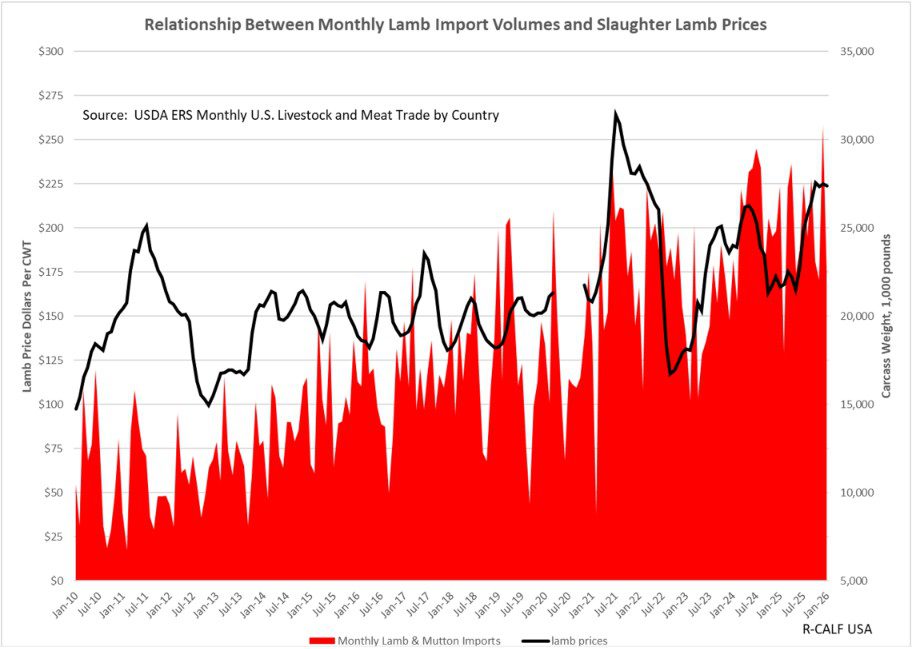
Mr Bullard maintains that increased volumes of imported lamb, particularly starting in 2012, have suppressed domestic lamb prices to levels too low to sustain lamb producers, the domestic sheep inventory, and processing of domestic lamb.
“Our industry is severely contracted.
“Even though lamb prices have increased above $200 per cwt recently, the market price remains volatile and because no changes have been made to the domestic market’s structure (i.e., TRQs, tariffs, reforms of anticompetitive buying practices) domestic producers lack confidence that they will be rewarded for their investment if they expand,” he said.
“Yes, drought and reduction in grazing opportunities are additional factors impeding expansion.”
Mr Bullard said Australia and New Zealand have demonstrated a lack discipline to be sustainable, supplemental suppliers to the U.S. market without US management.
“ANZ knows it has greatly contributed to the demise of the U.S. commercial sheep industry and (has) remained intent upon capturing as much of the U.S. market as it could,” he said.
“We now need to begin managing trade to meet the US goal of achieving at least near self-sufficiency in the production of lamb protein, which is a significant national security concern.
“If protected from excessive, lower-cost imports and anticompetitive buying practices, the U.S. sheep industry will be incentivized to expand,” Mr Bullard said.
Benefit of increasing imports tariffs might be short-lived
However, head economist with the Steiner Consulting Group Altin Kalo said previous econometric modelling on the impact of a countervailing duty indicated it would only have a short-term effect on the US industry.
“As we have argued in the past, a duty on imports does not address the structural issues that have impacted the industry over the decades.”
Mr Kalo believed a new 30pc tariff on lamb imports into the US would lower the amount of lamb available to US consumers.
“US lamb prices are trading at significant multiples to other proteins.
“They are also on par with beef prices, but not the same level of preference/demand,” he said.
“Also, domestic lamb is not positioned to replace imports in key retail/foodservice channels, hence the expected decline in consumption.”
In his May US Lamb Market Update, Mr Kalo said US lamb prices have kept pace with the price of beef in the last few months and the current price multiple is approaching the long run trend of 1.8x (i.e. value of the lamb cutout is 1.8x higher than the value of the choice beef cutout).
“But even as the lamb price ratio to beef is hovering near long run trend, the price ratio to pork and chicken has increased dramatically.
“This means lamb is now far less competitive with these other proteins at retail, implying foodservice needs to carry a larger share of demand.”
Mr Kalo said history showed that limiting imported lamb on the US market would benefit the domestic price of US-produced lamb in the short-term, “but at the expense of lower consumption and reduction in the penetration of lamb in the market.”
He believed the end result of an increase in lamb import tariffs would be a retail price increase that might limit lamb consumption, but whether this would lead to consumers switching to other meats needed more detailed econometric analysis of price sensitivity.
“But the biggest challenge for operators, be this retailers or foodservice, is product availability and product consistency given the fragmented nature of lamb production in the US.
“At the margin, some consumers are likely to pay more simply because they have very inelastic demand (religious reasons, ability to pay, holidays), but the footprint of lamb in the marketplace will be smaller as other consumers shift to other proteins.”
Mr Kalo believed the domestic US lamb production sector currently lacks the economies of scale to support the steady demand required by large retail and foodservice purchasing programs.
“US producers need to obtain enough value from the various parts of the animals to support their enterprise while large operators, be this retail but especially foodservice, are more focused on specific cuts and accumulating a large, consistent supply of domestic items is difficult in the current environment,” he said.
“There are significant structural issues at play that have caused domestic producers to slowly shift towards local direct marketing programs and other niche markets rather than service large commercial operations.
“This did not happen overnight but it is the result of many decades of secular contraction in the industry,” he said.
“Geographic fragmentation, logistics, inconsistent product quality and carcass sizing, and opaque pricing are significant challenges for large retail and foodservice operators.”
In his latest US Market Update, Mr Kalo said total lamb and mutton production has been running below year ago levels in the first three months of the year, largely due to the sharp reduction in finished lamb weights coming to market. Slaughter in March was estimated at 197,200 head, 1.1pc lower than a year ago.
“For all Q1, slaughter at 546,200 head was 4200 head (+0.8pc) higher. And yet, total lamb and mutton production in March was down 5.9pc and for the quarter production declined 2.7pc.”
Mr Kalo said total inventory of lamb and mutton in cold storage as of 31 March was 16.2million pounds, 3.2pc lower than the previous month and 14.6pc lower than a year ago.
“Inventory level at the end of March was the lowest since 2011 even as March imports were higher than the previous year.
“Good demand and lower domestic production appear to have negatively impacted the supply of lamb accumulated in cold storage.”
Mr Kalo said US sheep meat imports still face a 15pc tariff (in effect for 150 days from late February), but imports surged higher in early March. In the four weeks ending 25 April, total lamb imports were 8914 MT, 859 MT (-8.8pc) lower than a year ago. Australia accounted for 68pc of the import share compared to 72pc share earlier in the year. Total imports from Australia during the four-week period were 6063 MT, 6.3pc lower than a year ago while imports from New Zealand at 2699 MT were 15pc lower than last year, he said.
In the four weeks ending April 25, total mutton imports to the US were 1183 MT, 239 MT (+25pc) higher than a year ago. Imports from Australia accounted for 83pc of the total compared to 72pc a few weeks ago. Imports from Australia in the last four weeks were 985MT, up 16pc from a year ago. Imports from New Zealand at 197 MT were up 105pc versus a year ago.
US domestic lamb prices at record levels
Global AgriTrends analyst Simon Quilty said US domestic lamb price levels reached record levels this week.
A 65/75lb lamb carcase was this week priced at US$5.77.50/lb or A$17.10/kg.
“So right now heavy lambs in Australia are trading at A$11-$11.50/kg and in America they are trading at A$17/kg,” Mr Quilty said.
The previous highest price level was US$5.37.50 in August 2021, during COVID, or equivalent to A$15.80/kg.
He said Australian lamb exports in the 12 months to the end of 28 April, were 28,621MT — versus 27,544MT in the previous 12 months — with a significant fall in more expensive chilled volumes, possibly because of some price resistance at the price levels.
Mr Quilty said American was in the midst of a love affair with protein, whether it was because of advice from the government or doctors.
Mr Quilty said the import figures and price levels point to the fact that demand remains strong while American lamb does to record levels on domestic pricing “and yet Australia’s volume has increased mildly on last year.”
“So if Australia was detrimental to America’s pricing why have they gone to record levels on increased volume?”
Mr Quilty said he has not heard anything on the likelihood of an announcement on a trade investigation into lamb imports.
“But I just think that the strength of that argument couldn’t be weaker based on these trade numbers and record prices in America on the back of Australia increasing volume.
“It all points to consumers having a strong desire for domestic and imported lamb, and they can co-exist.”
Mr Quilty said there might be a backlash from some sectors of US retail and food service sectors if import tariffs were increased and volumes decreased.
“From CostCo for sure, Australia’s single largest buyer, without doubt.
“I think the argument is pretty strong that we’ve got record prices on lamb in America and increased Australian lamb exports and the two are co-existing and meeting stronger demand and consumer needs.”
Sheep Producers Australia CEO Bonnie Skinner said SPA is monitoring developments in the US.
“The US is one of Australia’s most important trading partners and an important export destination for Australian lamb and mutton.
“Australia consistently supplies high-quality lamb and sheep meat to global markets, supporting demand and complimenting local production,” she said.
“Sheep Producers Australia continues to work closely with Australian Meat Industry Council, MLA and the government to monitor this evolving situation.”
i have raised lambs for 40 years. Prices have bounced all over the place, but mostly inverse to the US supply. Imports help keep people eating lamb. I can compete with imports, but prices have to be low sometimes to decrease domestic supply to a profitable level. We continue to grow our business. Please, no more government ‘help’. Tariffs just increase domestic supply, thus reducing prices. Let supply and demand do its thing.