
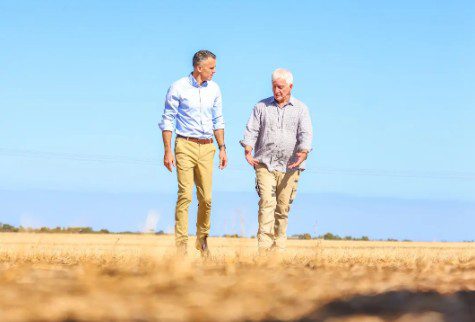
SA Premier Peter Malinauskas walks the walk with farmer John Lush this week.
SOUTH Australia’s Labor Government has defended its low interest loan scheme for drought-affected farmers, with Livestock SA claiming the program’s scope and eligibility is restrictive and would not reach all producers in need.
Premier Peter Malinauskas yesterday announced a new SA Drought Loan Scheme with a cap of $200 million, offering loans of up to $250,000 for 10-year terms for drought-affected grain and livestock producers in the state’s Murray Mallee, Riverland and Upper North.
Recipients would be granted a two-year loan repayment holiday in which no principal or interest payments need to be made, to give eligible farmers a significant benefit as they recover farm cashflow due to ongoing drought impact. Loans will have concessional interest rates for the first two years at 50 percent of the Commonwealth 10-year bond rate (currently 2.41pc).
The government said during the last eight years of the loan term the interest rate would be based on the 10-year Commonwealth bond rate (currently 4.83pc). Over the life of a 10-year loan term, this will be lower than the concessional interest rate of 5.18pc currently offered under the Australian Government’s Regional Investment Corporation loan scheme and commercial interest rates.
The program will open in March and be offered through to 31 December 2026.
SA Primary Industries Minister Clare Scriven said many areas of our state have received welcome rains and are on the road to recovery from the drought, but there are some where very little has changed.
“Areas such as the Murray Mallee, Riverland and Upper North have continued to suffer from drought and are facing significant challenges for the coming season.
“Providing access to working capital on discounted terms will support farmers while farm cashflow is recovering, including no need to make payments during the first two years,” she said.
Scheme’s scope does not match drought impacts – Livestock SA
Livestock SA initially welcomed the additional support for drought-affected producers, but said the structure of the scheme means support will be limited to a narrow cohort, despite drought impacts being widespread, prolonged and uneven across production systems.
The state producer body said the measure may assist some producers with short-term cashflow pressures, but is not a universal solution.
“The eligibility criteria and regional targeting mean there will be producers experiencing genuine drought stress who are unlikely to qualify under the current settings.”
Livestock SA also noted the scheme is highly conditional, with loan access dependent on specific geographic definitions, drought duration thresholds and financial assessments that may exclude mixed-farming and livestock businesses whose circumstances do not neatly align with program criteria.
Importantly, the loans remain an interest-deferral product rather than genuinely low or no-interest finance, with interest continuing to accrue during the repayment holiday period. For many producers already carrying elevated debt levels after successive dry seasons, this limits the long-term effectiveness of the support, the body said.
Drought doesn’t work to lines on maps – Tobin
Livestock SA chief executive officer Travis Tobin said the body welcomed any new measures that offer assistance to producers in need, but the package that was announced is limited to specific regions – essentially going back to lines on maps.
“SA has not made drought declarations for some time, and we have not been involved in any discussions with the government about reinstating this approach.
“Drought pressures do not stop at regional or administrative boundaries, so those producers outside the specifically referenced areas that are also experiencing severe drought conditions should be able to access the scheme to ensure regional equity and eligibility,” he said.
“Livestock SA believes drought support should be based on clearly defined climatic and production conditions rather than narrow geographic boundaries.
“Producers across a range of regions including mixed farming and livestock systems outside the announced areas are experiencing prolonged rainfall deficits and increasing financial pressures,” he said.
“The scheme also only has a nine-month window, which is a narrow response to the state’s most severe drought in living memory.
“A broader, more flexible approach would better reflect on-ground realities,” Mr Tobin said.
“Eligibility settings, geographic limitations, and the structure of the product itself mean some producers experiencing genuine financial and climatic stress may not qualify.
“This risks leaving gaps in support at a time when confidence and resilience across parts of the sector are already under strain,” he said.
Mr Malinauskas did not personally respond to Sheep Central’s questions on the scheme’s scope, but a SA State Government spokesperson said while many areas of the state have received welcome rain and are on the road to recovery, the Murray Mallee, Riverland and Upper North are still significantly drought affected, “experiencing the lowest on record or severe rainfall deficiency over the 24 month period and that is why these regions have been specifically targeted under this program.”
On the potential for the scheme’s criteria to exclude mixed farming and livestock businesses whose circumstances do not neatly align with program criteria, the spokesperson said the scheme will be to eligible grain and livestock farmers.
“This includes mixed-farming enterprises that include both grain and livestock production.
“PIRSA will work closely with the relevant industry associations in developing the guidelines for the scheme.”
Proposed SA rural finance agency to be election issue
Livestock SA said the announcement again highlights the structural gap facing South Australian producers, with the state lacking a dedicated rural finance and development agency to design and deliver timely, tailored financial tools.
“Other states have state-based agencies that can respond quickly, flexibly and in line with local conditions.
“South Australia continues to rely on reactive measures and federally designed products that do not always reflect our production systems or regional realities,” the organisation said.
While acknowledging the SA government’s willingness to adjust drought support settings, Livestock SA said meaningful assistance requires a coordinated, long-term framework, rather than ad-hoc announcements delivered late in the drought cycle
Livestock SA said the announced scheme should be seen as a stepping stone, not an endpoint and SA producers need certainty, consistency and financial tools designed for South Australian conditions.
Livestock SA is calling for the establishment of a South Australian Rural Finance and Development Agency, supported by a structured SA Drought Agreement, to ensure drought responses are proactive, equitable and fit-for-purpose when producers need them most.
Mr Tobin said it is Livestock SA’s view that establishing the agency with a clear and focussed mandate will result in more timely and targeted programs for producers throughout the drought cycle and will be important in supporting the growth, sustainability, adjustment and economic development for industries and regional communities.
The SA State Government spokesperson said the Malinauskas Government is happy to discuss Livestock SA’s finance agency proposal, “should we be fortunate enough to be returned to government after the election.”
Mr Tobin said a dedicated rural finance and development agency has been part of Livestock SA’s election asks, that were provided to the government and the opposition over two months ago.”
“We advised the government that no to low interest carry on finance loans were urgently needed 12 months ago.
“Since that time, it has become clear that structural changes are needed to ensure timely, targeted and strategic drought and other support to various industry shocks,” he said.
“We look forward to continuing to discuss such an agency, which will help all South Australian primary industries better navigate sustained volatility, with all parties seeking election in March.”
HAVE YOUR SAY