
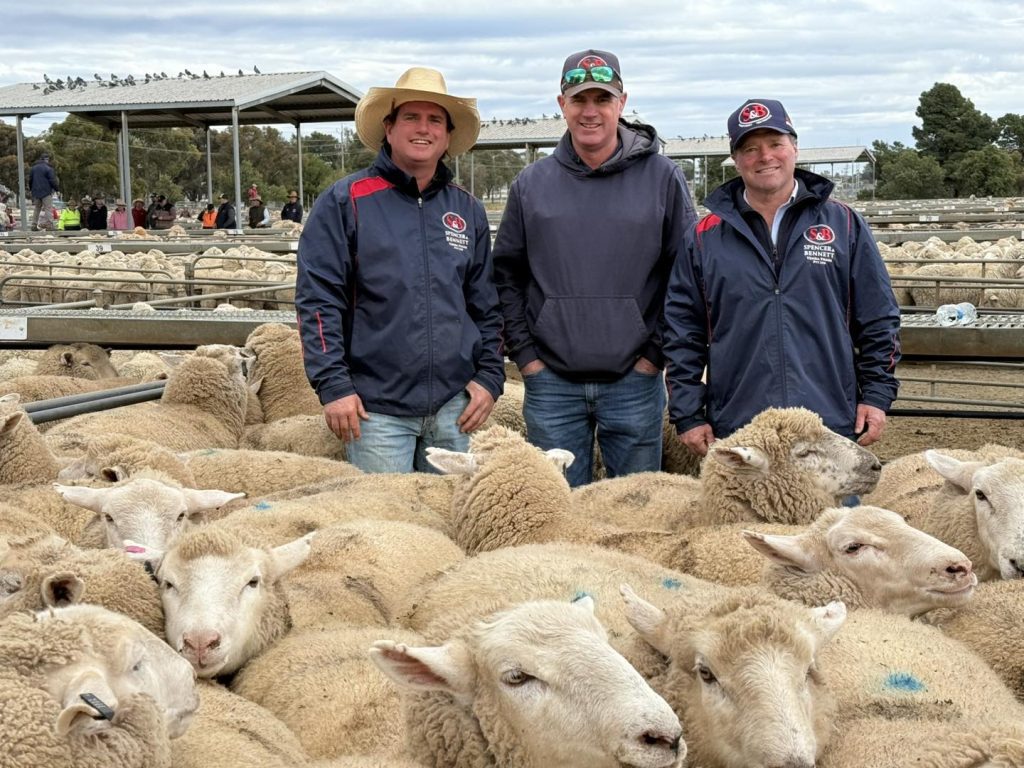
Spencer and Bennett agent Gavin Halden, left, with vendor Mark Tabain, Leeton, and Wayne Spencer, Spencer and Bennett, with the $479.50 lambs. Image – Spencer and Bennett Facebook.
AUSTRALIA’S heavy lamb price record was broken again today, with Griffith agents selling second cross lambs for $479.50.
The Spencer and Bennett agency sold 55 White Suffolk cross lambs for trader Mark Tabain from Leeton to Thomas Foods International at Tamworth for the record price.
The continued strength of prices is saleyards has closed the Meat & Livestock Australia’s heavy lamb indicator at just shy of 1245c/kg today. The trade lamb indicator finished slightly down at 1223c/kg.
Spencer and Bennett agent Gavid Halden said the Tabain lambs came out of first cross ewes and had an estimated carcase weight of 43 kilograms. They were sold to Thomas Foods International at Tamworth, who also bought the second run for $460.
The record at the Griffith Livestock Marketing Centre breaks the previous top price of $477.20 set at the Dubbo saleyards on Monday.
Mr Halden said lotfeeders with old lambs are starting to hit the dentition limit before they became hoggets.
 “That’s why we’re seeing big numbers for Griffith for this time of the year.
“They are stretching their lambs out as far as they can to put extra kilograms on them to get the maximum dollars.”
He said the dentition definition change allowing a lamb to have broken one permanent incisor (without wear) has been gamechanger for lotfeeders.
“It has just given us that extra four to eight weeks I guess.
“If they are doing 300-400 grams a day in liveweight, it’s a few dollars when you’re talking $11/kg.”
Mr Halden said the heavy old lambs are running and the price is bringing new season lambs into the saleyard for sale to mainly domestic buyers.
“They were selling suckers here today and they were only 21-22 kg (cwt), but they’re making $13/kg.
“Normally blokes wouldn’t sell them at 22kg, but the prices are bringing them out.”
Mr Halden said he didn’t want to see the market any dearer.
“We know what’s on the back of it.
“So hopefully we just see it level out a little bit.”
He said the prices would make it hard for restockers in the spring, with even the meat lamb value of the ewe portion of White Suffolk draft setting a floor for ewe prices.
“We don’t want it to get too silly, we want people to build on their flock number and keep doing a good job,” he said.
“We don’t want the numbers to slowly deteriorate.”
Mr Halden said even though some buyers did not operate at Griffith today, everything sold well.
“The top of the secondary lambs was very strong with buyers struggling to fill orders I guess.”
He said the high saleyard prices are dragging sheep away from consignment grids.
“These lambs today we would normally have sent them to Dubbo, when we get lambs that big, but because we didn’t really have enough … and the transport cost was going to be $12 a head … se we thought we would send them into Griffith and let them fight over them in there.
“We have seen it happen the other way, with lambs that carry the weight don’t get the recognition they should get.”
Mr Halden said Fletcher International Exports plant at Dubbo is well supported because it had an open grid with no discount for lambs dressing over 30kgs.
“It suits us, we can get lambs pretty big.”
Mr Halden said there are a few handy lambs around, though not as heavy as the lines today.
He would like to some decent long-term contracts be offered by processors, even at reduced prices.
“I’ve got some clients who would love to see some contracts for this year’s lambs.”
He said producers realised that $12/kg is only short-term and not sustainable.
“But we don’t want to see lambs making $5 0r $6/kg either.”
Mr Halden said for home-bred lambs $200/head is pretty good money.
“Anything around $8-$9/kg is pretty fair coin, but you also have to factor in your buy-in price too (if trading).”
Mr Halden said some lotfeeding clients are not prepared to buy back in until they see contract.
He is aware of October-November contracts at $10-$10.50/kg.
“We can go and spend $180-$190 on a store lamb and make it work.”
He said it would be ideal, but difficult for processors to offer contracts more than three months forward with the world trade situation.
“I’ve been doing this job for two years and it’s all about building relationships with producers and processors.
“They know what you’ve got, what you want to get to and the numbers you’ll have around you at certain times of the year and they can ste something up for you.”
He believed industry-wide producers and processors need to get closer together.
HAVE YOUR SAY