
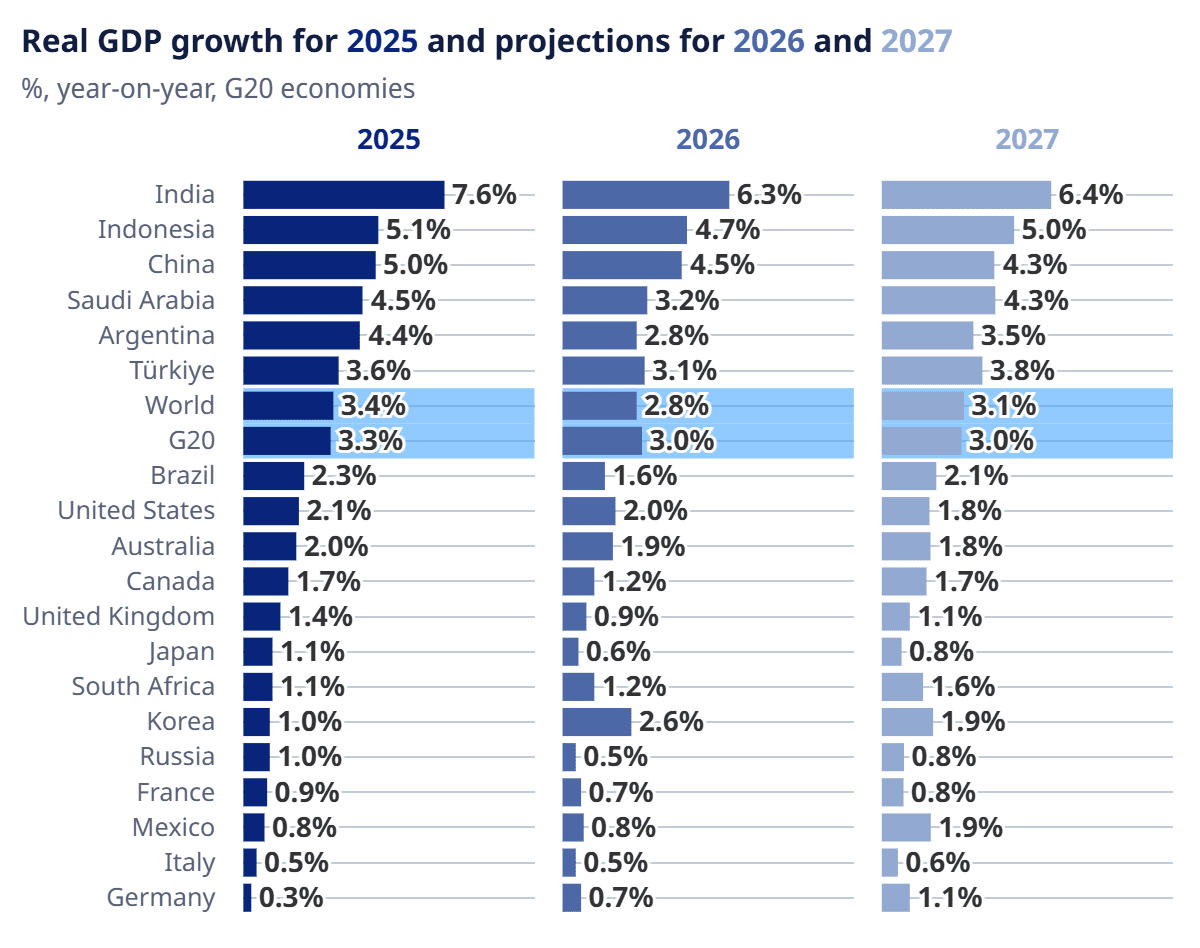
Source: OECD Economic Outlook. Click on image for a larger view.
THE evolving conflict in the Middle East has become the dominant force shaping global economic prospects, prompting an energy shock that is driving inflationary pressures and is projected to have adverse impacts on growth, according to the OECD’s latest Economic Outlook.
Due to the uncertainty around the evolution of the conflict, the Outlook sets out two scenarios:
- A time-limited disruption scenario, in which energy production and trade in the Gulf economies progressively return to pre-conflict levels starting mid-2026, leading to a gradual unwinding of the disruptions; and
- A prolonged disruption scenario, which assumes that the current disruptions to energy production and exports in the Gulf economies persist well into 2027, with higher energy prices, intensifying risks of supply shortages and a tightening of global financial conditions, all of which carry broader and more long-lasting consequences for the global economy.
Both have significant implications for demand and prices for Australian beef, in both export and domestic markets.
“The global economy entered 2026 with robust momentum, but the outlook has weakened significantly since the start of the conflict in the Middle East, with effects likely to be felt for some time,” OECD Secretary-General, Australia’s Mathias Cormann said.
“The longer the disruptions last, the larger the economic and social costs become.”
Any fiscal support that countries provide in response to the shock needed to be targeted towards those most in need and temporary, to avoid a further increase in public debt and preserve incentives to save energy, Mr Cormann said.
“More broadly, countries need to lay the foundations for stronger growth and productivity by improving the business environment, enhancing skills, and unlocking the benefits of AI and other transformative technologies.”
Under the assumption of a lasting resolution of the conflict – the “time-limited disruption” scenario – the OECD projects global growth slowing from 3.4pc in 2025 to 2.8pc in 2026 before picking up to 3.1pc in 2027.
GDP growth in the United States is projected at 2pc in 2026 before slowing to 1.8pc in 2027. Australia will track much the same.
In the euro area, growth is projected to remain modest at 0.8pc in 2026 before picking up to 1.2pc in 2027. China’s growth is projected to slow to 4.5pc this year and 4.3pc in 2027.
‘Prolonged disruption’ scenario
Under the second “prolonged disruption” scenario, global growth slows to 2.1pc in 2026 and 1.8pc in 2027, leaving a lasting mark on many countries, especially in Asia, Europe and developing economies most vulnerable to the energy and food price shock.
Growth in the OECD is projected at 0.9pc in 2026 and 0.5pc in 2027 (versus 1.5pc in 2026 and 1.7pc in 2027 under the “time-limited disruption” scenario).
Inflation
Inflationary pressures are rising in both advanced and emerging market economies, the report points out.
The energy shock is leading to higher commodity prices, while indirect effects are boosting prices across the economy, notably for agricultural inputs and food.
In the time-limited disruption scenario, annual consumer price inflation in the G20 economies is collectively expected to rise to 4pc in 2026, from 3.4pc in 2025, before easing to 3.1pc in 2027 as energy and food price pressures fade.
Inflation would rise significantly higher in the prolonged disruption scenario.
Throughout this uncertain period, central banks must remain vigilant, but the supply-driven rise in prices need not trigger a policy response, as long as inflation expectations remain well anchored, Mr Cormann said.
However, a monetary policy response may become necessary if broader price pressures intensify, or if growth weakens significantly.
Governments face multiple spending pressures and need to take stronger efforts to ensure long-term debt sustainability.
Energy price relief measures should be targeted and temporary and preserve incentives to reduce demand. Countries should also intensify efforts to diversify energy supply and improve energy efficiency to reduce vulnerabilities to future shocks.
“Governments have a range of near-term options for mitigating the effects of the energy supply crunch, particularly on the most vulnerable households and small firms,” OECD chief economist Stefano Scarpetta said.
“But this crisis also demonstrates that the need to wean our economies off the dependency on fossil fuel imports is increasingly urgent.”
- The OECD is a global policy forum that promotes policies to preserve individual liberty and improve the economic and social well-being of people around the world.
HAVE YOUR SAY