
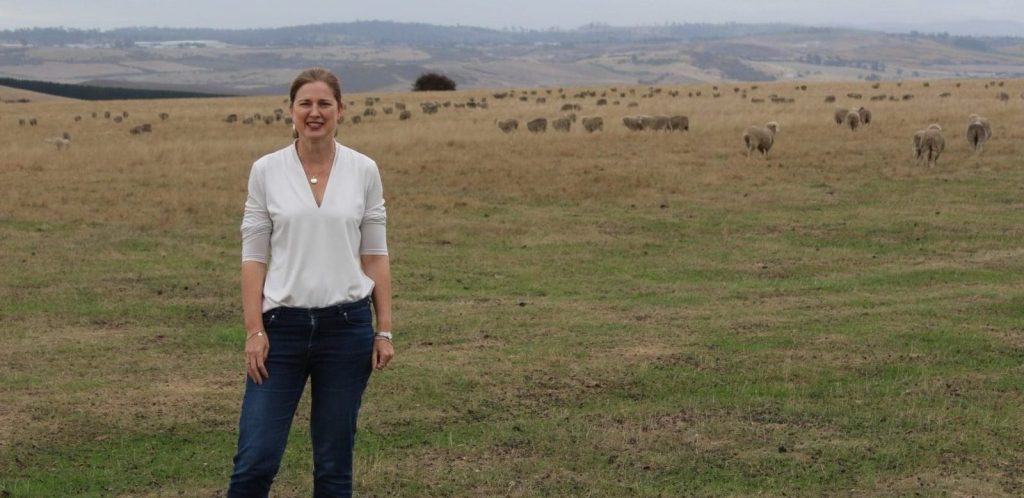
Minister for Agricultu0re, Fisheries and Forestry Julie Collins.
THE Albanese Government’s live sheep export transition process has been branded a failure by Western Australia’s two leading farm bodies after they were not invited to the latest release of funding details.
Minister for Agriculture, Fisheries and Forestry Julie Collins yesterday announced further details in the $139.7 transition package at the Muchea saleyards, but key WA sheep industry bodies were not invited to the event.
Even a Department of Agriculture, Fisheries and Forestry Zoom session on the package just prior to the announcement — attended by peak WA farmer, shearer, exporter and transport body representatives — did not disclose where Ms Collins would release the details.
The Australian Livestock Exporters Council was also not formally notified of the Muchea event and the venue for the announcement was not declared on an embargoed media release.
However, Sheep Producers Australia, which won a $50,000-plus contract to provide business administration services to the department relating to transition process was invited to attend the Muchea announcement. SPA chair Bindi Murray attended, along with Western Australia’s Minister for Agriculture Jackie Jarvis and the transition advocate Chris Rodwell.
SPA chair Bindi Murray — one of the few industry representatives invited to Muchea.
When Ms Collins office was asked why the minister did not invite WA industry leaders to Muchea, Sheep Central was initially told that Ms Collins had addressed this in an ABC interview yesterday.
In the interview, Ms Collins was asked by ABC reporter Belinda Varischetti why her office refuses to alert the farming sector and farm leaders to her plans to visit the state, “especially when you have a significant announcement like the one today.”
Ms Collins said it was her third or fourth visit to WA as a minister and she had listened carefully to industry and the sector. She said her department has met and held workshops in WA with industry and listened to feedback.
“The industry and the sector was briefed about the details of the package prior to my announcing it today.
“We want to continue to engage with industry, as I do every time I’m in Western Australia.”
Despite her office no doubt knowing who wasn’t invited to the Muchea announcement and being told that several WA industry leaders scrambled to get to the saleyards, Ms Collins said: “Well, I’m not sure which industry leaders you’re talking about, but I engage regularly with primary producers when I’m in Western Australia.”
“Each and every time I come, I obviously, of course, am also in contact with the State Minister on a regular basis, and we’ve got the transition advocate on the ground in Western Australia that industry have been able to talk to and contact.”
Ms Collins refused to explain to Sheep Central why she had not invited WA industry leaders to her Muchea announcement.
“Yesterday’s event was an opportunity to announce the government’s response to the co-design process which involved 16 workshops and over 300 participants,” she said.
“I have previously met with Western Australian farmers, including industry organisations, about the government’s sheep industry transition assistance package and will continue to do so.
“The Transition Advocate will also continue to be on the ground talking to farmers to help inform the rollout of the package.”
WAFarmers disappointed
WAFarmers president Steve McGuire said it was disappointing the farmer body was not invited to the Muchea announcement.
“It’s the second time she has been over and not made any attempt to contact us and catch up with us.”
However, he said WAFarmers had met with the minister previously and she was more empathetic than her predecessor Murray Watt.
Mr McGuire said the transition package is “too little and too late.”
“We think that trying to run this (transition) exercise from Canberra has failed.”
“The State Government got criticised for being involved, but really the Federal Government, they broke it so they should fix it, but the fact is that they haven’t been able to fix it, because there is no simple solution.
“It has taken way too long, there is not enough money and they haven’t found the answer – to be honest there is not answer.”
Mr McGuire said many sheep producers had left the industry after losing confidence. He said viable ewes were sold for as little as 50 cents last year.
“Guys bought ewes for $200 a head, two years later they were worth $20 a head
“You can only kick a dog so many times before it doesn’t come back.”
He said a significant amount of the package’s $139.7 million has never left Canberra, instead going to the department, consultants, planning and administration.
“It’s all being burnt up by people who are not farmers and this affected everyone downstream in communities.
“And let’s not forget this is purely for political reasons and to satisfy some animal activists in the government.”
PGA also not invited to Muchea
Pastoralist and Graziers Association of WA president Tony Seabrook said the body was not invited to the Muchea announcement by Ms Collins for Ms Jarvis.
“This government, going right back to Watt have just patently ignored us.
“They haven’t wanted to engage because they know they are going to cop a flogging and the grower organisations have not been involved in any way to the level that we should have been.”
He agreed with WAFarmers that the transition process has failed and believed Mr Rodwell had inherited “a poisoned chalice.”
“For all the people who are going to be very seriously hurt this (the package) is a drop in the bucket; it’s nothing.
“It’s farcical and it’s an insult.”
He said nothing will change his view that the phaseout should not have happened in the first place.
“The whole concept of it was wrong; to have trashed an industry and then think that you could buy your way out of an appalling political decision for $140 million is a joke.
“You caused the problem as governments do and now you think that by this so-called act of generosity – it’s public money that is being thrown around here – it will all be tickety boo, well it won’t be.”
WA Shearing Industry Association president Darren Spencer said the event was not mentioned by Ms Jarvis in a meeting a week prior and WASIA only found about the meeting from an exporter contact.
“We knew there was an announcement coming sometime but we didn’t know where.”
Mr Spencer said Ms Collins’ behaviour was consistent with the government’s approach to consultation leading up to the phaseout. He “definitely” agreed with an accusation that Ms Collins had tried to ‘go under the radar’ by not disclosing the announcement venue nor inviting industry bodies.
“To me it has always been that they haven’t wanted anyone to be able to ask questions.”
Mr Spencer took issue with Mr Albanese’s election victory speech when he said “together we will make our way forward with no one held back and no left behind” and said he told the PM when the phaseout legislation was passed that he had “thrown us straight under the bus.”
“Meanwhile he has left us behind, he’s gone to China, he floats all around the world.
“He doesn’t care about people on the ground and that showed through with this.”
What’s in the package?
Funding of $40 million to enhance processing supply chain capacity heads the Albanese Labor Government’s industry transition assistance package to support the phase out of live sheep exports by sea.
The package details released yesterday by Ms Collins also includes $30 million for producers to support transition for farm businesses and $4 million for grower groups to support new on-farm extension services.
Other components of the $139.7 million package include $2.4 million for financial counselling services, $2.2 million for shearers to seek new employment opportunities and training, and $1.5 million to support the transport industry.
The government has also allocated $5.8 million toward the implementation of a long-term industry strategy, including $0.8 million to develop the strategy and $5 million for projects developed in the strategy.
Ms Collins said the transition is industry-led, government enabled and the assistance package demonstrated this.
“I want to thank WA sheep farmers and those in the supply chain for taking part in our co-design process.
“We have consulted with farmers and representative bodies to deliver the best possible investments for the industry as they move away from live sheep exports.
“As I have said before, our sheep industry is a proud and important part of our agricultural sector.
“The assistance package announced today will ensure WA sheep farmers benefit from new markets and the ever-growing export opportunities before us.”
The government said the release of the package followed a series of industry co-design workshops held in Western Australia earlier this year. The 16 workshops involved more than 300 participants from the Western Australian sheep industry.
A media statement from Ms Collins said the package will assist individuals, businesses and communities to confidently plan and adapt to laws passed by the Australian Parliament to end live sheep exports by sea from 1 May 2028. It will also help farmers and the rest of the supply chain capitalise on the opportunities from this transition and the increasing demand for sheep meat domestically and globally, the statement said.
Shearing industry grateful for adjustment program funding
In a media release after the transition package details were released, the WA Shearing Industry Association said it was pleased to see the inclusion of its Shearing Industry Adjustment Program.
The WASIA said while it remains firmly opposed to the ban on live sheep export, the association is committed to finding a way forward.
“This is not the position we wanted to be in — but it’s where we are,” Mr Spencer said.
“We have been clear that the live sheep export ban will reduce sheep numbers and if we can’t keep our shearing teams employed then we will lose a lot of people out of our industry and our local towns.
“No one wants that,” he said.
“So how do we keep the contractors and shearing teams? The answer we settled on was by them having other work that aligns around the shearing seasons.”
WASIA said the aim of the Shearing Industry Adjustment Program is to retain contractors and shearing teams so that they are there for wool growers come shearing time by training shearers and wool handlers for broader agricultural work and diversifying contractor services.
Mr Spencer said the program was the result of extensive consultations with contractors, growers, grower groups, agricultural businesses and peak bodies and had received a very positive response.
WASIA executive officer Valerie Pretzel said while the association cannot yet disclose full details due to ongoing funding processes, the proposed program offers support for shearing contractors to professionally strengthen and diversify their businesses.
“It includes coordinating and providing formally recognised training for staff across a range of agricultural skill sets, enabling them to undertake a broader range of work whilst still being employed by the contractor.
“The program will provide confidence to farmers to access those contractors and trained workers and it supports our industry to make this adjustment over a number of years,” she said.
“Best of all it keeps people in their local towns.”
Mr Spencer said the industry has weathered many changes, booms, and busts, and these current ones won’t be the last.
“This program and funding will help keep a strong and more permanent local workforce and contractor businesses.
“We have the opportunity to provide additional training to expand our workforce’s skills and bring agricultural training to local towns,” he said.
“Farmers, shearing contractors, and shearing teams are already resilient, and we aim to help our industry become even more adaptable to all the challenges we face.
“The concept is a win-win for farmers, contractors, shearing teams and regional WA.”
Sheep Producers Australia chair Bindi Murray was asked to comment on the package.
What did they expect after the utter disrespect they showed at the inquiry hearing? Government works with constructive bodies not useless whingers.
How do I feel at the end of the day? Kicked in the guts, by my own country and the government they chose. Just keep the handouts going, you’re turning all of us into useless bastards and addicts- unable to stand on our own two feet. Way down down down in the valley of shame Albo. Claire
Keep the Sheep, keep up with work or we are all down going the tube.
What do you expect when the minister for our tens of billions of dollars agriculture industry finished Year 12 and did a TAFE course? Absolutely no experience and an embarrassment to our country. I do not understand how the so-called National Party sit and say bugger all. They need to change there name to the ‘Queensland Only National Party’ or hand it to Bob Katter.
This whole thing was set up by the Greens who are not in power. Weak albo, it’s a disaster for Australia.
What a farce this government is. They are not representing the Australian people who elected them. Who are they representing? I guess if you follow the party donations you will find out. If The Saudis and Qataris want to buy our live sheep, let them and let’s see if we can grow that market. That transition money should have been used to improve the efficiency of the supply chain and a marketing program in the client countries. What a pack of idiots this government is.
Governments applying logic to decisions is like ‘a mob of sheep refusing to go through an open gate into new lush pastures’.
So I was having a good day, but I just thought I’d read this article. This is a slow bleed for sheep and wool producers all over Australia; the Federal Government’s piss-weak attitude and not getting the $ to producers in compensation for their incompetent ignorant political decisions. It’s cost me dearly and I’m in South Australia. It’s got me stuffed why we can’t have demonstrations coordinated in all capitals and really help Albo feel our pain. Don’t wait for diplomacy to slowly bleed us till there is no fight left.
Steve McGuire, you dont have to be an ‘animal activist’ to want this cruel trade phased out. Most people are sick of seeing the horrific images of suffering sheep on the journey and arrival in the Middle East. The aggressive ‘Keep the Sheep’ campaign at the last WA state election was unsuccessful, so accept the decision of those who care and move on.