
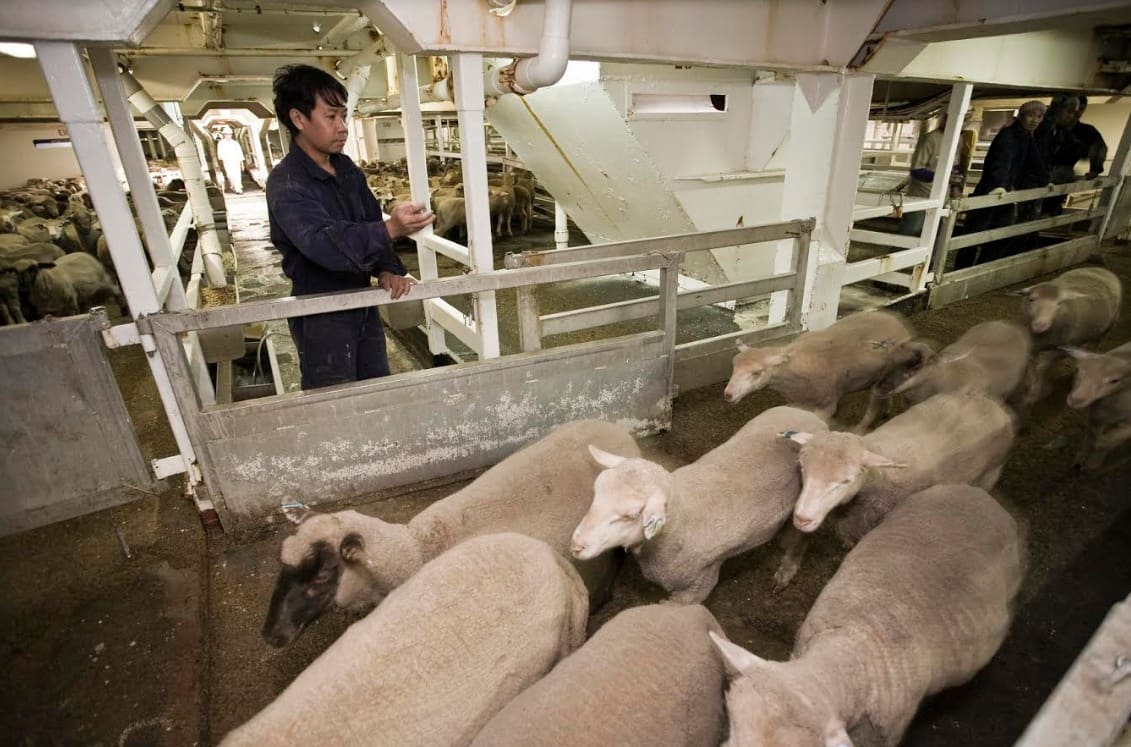
Loading sheep for live export.
RECENT campaigns centred on `heat policy’ and petitions to both Federal and Western Australian parliaments are just the latest examples of the blatant mistruths being perpetuated by activists and the Animal Justice Party about Australia’s world leading live export industry and by implication, the hard-working livestock producers of WA.

Mark Harvey-Sutton
The language used is emotive and simplistic, designed to create fear and outrage rather than objective understanding. Complex scientific and operational issues are reduced to slogans and social media graphics. Nuance is abandoned in favour of headlines.
The implication pushed by these groups is that animals are routinely subjected to uncontrolled and dangerous conditions, with little to no regulation or accountability. That is demonstrably false.
Australia’s live export industry is one of the most heavily regulated agricultural sectors in the country. Every consignment is subject to extensive independent regulatory scrutiny including strict requirements under the Australian Standards for the Export of Livestock and Exporter Supply Chain Assurance System.
Export voyages are assessed against weather conditions, ventilation capacity, stocking densities, animal condition, route planning and risk management measures long before a vessel leaves port.
Heat risk management is not a new concept suddenly `discovered’ by activists. It has been a central focus of the industry, regulators, veterinarians and researchers for decades.
What the activists don’t want you to know is that the overwhelming majority of voyages are completed successfully under stringent regulatory controls.
Nor do they tell you that the industry has continually evolved over time, implementing stronger safeguards, enhanced reporting requirements, improved vessel standards and more rigorous compliance systems.
They also don’t want you to know that animal welfare in the markets we service has improved incredibly because of our industry’s presence. If Australia is not in these markets these improvements don’t happen.
The truth doesn’t suit their narrative or their business model and it undermines their broader political objective of ending livestock industries altogether.
As I said many times while campaigning against the Albanese Government’s ridiculous live sheep ban, I am extremely proud to work for the live export industry and do all I can to give it a voice. Our industry’s arguments are always based on fact and scientific evidence.
However, the uncomfortable truth is our leaders, and policy makers are now more willing than ever to accept the unchecked lies of activists and their political allies. This is a precedent that should alarm the entire agricultural sector.
The fact that Stop Live Exports’ latest campaign has failed to gain any real traction is beside the point, it’s the way they are approaching the campaign that is cause for concern.
They now clearly view lying as a legitimate strategy for success, both politically and financially. This matters because misinformation has real-world consequences.
They’re felt by livestock producers, regional workers, transport operators, feed suppliers, veterinarians and rural communities whose livelihoods depend on agriculture and trade.
They’re also felt by our international trading partners, many of whom rely on Australian livestock to support food security, breeding programs and local supply chains.
No industry should ever be above scrutiny, and the live export sector accepts that responsibility. Continuous improvement is both necessary and expected. But scrutiny must be grounded in facts, not ideology masquerading as science.
Australians deserve an honest conversation about live export. One that recognises the strength of Australia’s regulatory systems, the professionalism of the people involved and the importance of maintaining sustainable agricultural trade.
Agricultural advocacy groups must also heed the warning that simply telling the truth may no longer be enough. While we should never shift away from the truth, we must become more politically savvy and active to fight this scourge on our collective industries.
HAVE YOUR SAY