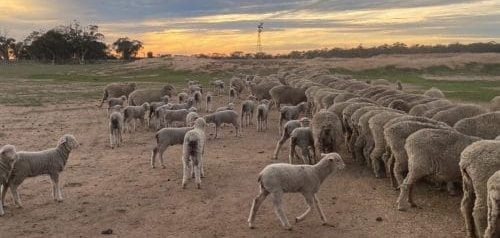
Mulesed Merino lambs with their mothers, Image – The Livestock Collective.
AUSTRALIAN Wool Innovation has been unable or unwilling to detail an estimation of the productivity benefits associated with non-mulesed wool production, despite a report claiming growers could be $120 million better off within seven years by transitioning away from mulesing.
FOUR PAWS Australia programs lead Louise Ward said a Pegasus Economics Report it commissioned shows that breeding plain-bodied sheep means farmers could improve productivity to the tune of $120 million.
“The Pegasus Economics Report further identified that, non-mulesed wool is attracting price premiums (typically 9-13 percent, higher under certification), with demand for certified wool rising fast,” she said.
AWI could not produce a non-mulesing productivity estimate
Sheep Central asked Australian Wool Innovation chief executive officer Bryan Fry and AWI chairman George Millington if AWI agreed there were productivity benefits in transiting to non-mulesed wool production.
AWI was also asked if the report’s estimation of how much Australian wool growers and the industry could benefit by moving to non-mulesing accorded with AWI’s own estimations, what is AWI’s calculation of the productivity benefits of growers moving to non-mulesed flocks and what programs is AWI implementing to assist growers to access productivity benefits.
An AWI spokesman said AWI does not tell wool growers how to run their farming business.
“In addition to research, we provide the tools on how they can best manage flystrike.
“Our flystrike extension program offers a range of tools to equip wool growers on how to best manage flystrike,” he said.
“This includes practical information in the lead-up to high flystrike periods, information and tools on managing chemical resistance in blowflies, workshops on how to develop property specific flystrike management plans, workshops on developing property specific strategies for moving to a non-mulesed enterprise, one-on-one coaching, and workshops on breeding for flystrike resistance.
“Additionally AWI does not form nor lead industry policy.”
Social licence risk with mulesing
FOUR PAWS also said one of the biggest threats identified in the report was that of ‘social licence,’ where mulesing threatens the industry’s “social licence to operate”, raising the risk of consumer boycotts, trade barriers and loss of market access including spill-over impacts on sheep meat exports.
Pegasus utilised the cost-benefit analysis model developed by Munoz, et al., (2022) and applied it to a plainer and non-wrinkled Merino wool flock that would not require or have (i) additional crutching, (ii) additional chemical/insecticde use, and (iii) wool loss from increased dag score and crutching coupled with the assumption of no price premium from the sale of non-mulesed or ceased mulesing wool.
It was found there would be a positive cash-flow benefit over a seven-year period of:
- $3.25 per DSE (dry sheep equivalent) for a winter-dominant Merino wool flock,
- $4.14 per DSE for a uniform rainfall Merino wool flock,
- $9.17 per DSE for a summer-dominant Merino wool flock.
Pegasus then extrapolated these results across the country, suggesting that Merino sheep growers would collectively be around $120 million better off over a sven-year period through adopting plainer and non-wrinkled Merinos. On this basis, the development of a plainer and non-wrinkled Merino wool flock should be cash positive for Australian wool producers, the report said.
Animal Justice Party MP Georgie Purcell said if the blatant animal cruelty alone wasn’t enough to make the Australian wool industry act, the economic impact identified in the report should.
“It’s galling that the industry isn’t listening to the growing calls to end this mutilation on lambs,” she said.
“This would be a crime if it was done to a cat or dog. But once again, farming industries are given loopholes to get away with unfathomable cruelty,” she said.
“If governments don’t act on the wool industry’s broken promise, then they are complicit in lamb suffering too,” said Purcell.
FOUR PAWS said the report comes as Australia’s wool industry is facing a growing economic threat, with more than 330 global fashion brands, including H&M, Kathmandu, Nike, Myer, Hugo Boss, Burberry, and Zara moving away from mulesed wool, with exporters, brokers and buyers warning that Australia risks losing access to premium markets.
FOUR PAWS said Australian Wool Innovation has wasted over $48.5 million of taxpayer funds and compulsory wool producer levies pursuing a string of failed and impractical “alternatives” to live lamb cutting (mulesing), from clips and liquid nitrogen to vaccines and sterile fly research, none of which have delivered real-world, industry-wide solutions.
Instead of backing the proven transition to plain‑bodied sheep, AWI has funnelled resources and decades into dead-end experiments, delaying progress and entrenching a problem that already has a clear, effective answer, the organisation said.
FOUR PAWS said according to an independent BG Economics Report, transitioning away from live lamb cutting is feasible within 3-5 years.
Parkdale Merino Stud owner and operator Don Mudford said the Parkdale Merino Stud specifically selects for higher lamb survival and less flystrike problems, and now 40pc more lambs survive.
“Not only this but in comparison to our previous wrinkly sheep, back then we had a lambing rate of 95pc, now we are at 135pc.”
“It took us five breeding cycles to phase out mulesing since we had to breed the sheep from scratch,” Mr Mudford said.
“For years, Australian wool industry leaders have dropped the ball on mulesing.
“It’s obvious they’re stuck in a conflict of interest and can’t lead the industry away from this practice,” he said.
“They’ve also wasted wool grower and taxpayer money looking for a flystrike solution, even though we’ve had one for over 20 years,” he said.
I am with AWI on this topic. Let the market sort this one out.