
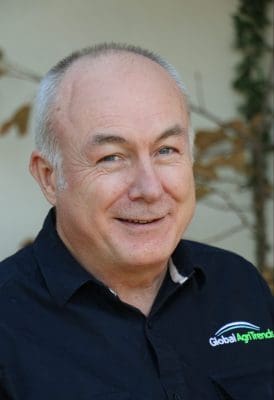
Global AgriTrends analyst Simon Quilty
TRADE and heavy lamb prices are forecast to reach $13.50/kg carcase weight by mid-2026, but drop back to around $9.50/kg after this as supplies increase, according to Global AgriTrends analyst Simon Quilty.
Mr Quilty also believes Angus feeder steer rates will lift to $7.50/kg liveweight by October next year and then come back to a “new norm” of $5.50/kg.
“I still think firmly that we’ve got $13.50/kg for lamb in next July-August (2026),” he said.
“So much of the lift today in pricing has been driven by the strong demand and particular North America, but as we go into a tightening of supply and a rebuild, that just exacerbates the problems.
“I think over the next two years (as with cattle) we see the lift in prices for lamb to $13.50/kg, but they are not sustainable,” Mr Quilty said.
The analyst sees the “new norm” of $9.50/kg for trade and heavy lambs will persist from 2028 to probably 2033.
Mr Quilty said with the general global animal protein shortage, and as the world went into a sheep flock and cattle herd rebuild – in Australia, North America and Brazil – the supply situation would tighten over the next three years.
“And there is a relationship between beef and lamb prices; the higher beef prices go it supports lamb prices, I believe.
“It’s a clunky relationship, but it’s there, with a delay of about six months,” he said.
“Global protein demand looks strong, but the rebuild period would tighten supply and the prices would become unsustainable.
“But we’re talking ‘unsustainable’ over 2-2.5 years – prices were up 30 percent and they will go down 30pc — to $9.50/kg, as the long-term average for lamb from 2028-2033,” Mr Quilty said.
“It’s important to understand that we’re not going back to October 2023 – that was an anomaly.”
Boom-bust cycle set for change
Mr Quilty said the lamb industry has traditionally responded quickly to demand and price changes, lifting or reducing production within a two year cycle, and processor workers are unable to be kept on.
But he said this time round things may have changed and the boom-bust cycle in lamb – oversupply impacting demand and prices — that might normally have occurred by 2028, might not occur. He listed three factors that underpin a more sustainable supply/price situation for producers.
Firstly, the processor capacity in Australia is much greater than in the past – in both ‘bricks and mortar’ and tech, and numbers of workers, he said.
 He said today in Australia there are just under 120,000 457/482 visa workers in Australia, many of whom work in meat processing plants, whereas when lamb and beef prices were crashing in November 2023, there were 76pc fewer workers, just under 68,000.
“So not only do we have the bricks and mortar but we also have the workers available today that weren’t there back in 2023.”
“The second thing is that thanks to some key processors in Victoria and New South Wales, but particularly in Victoria, the development of the light lamb carcase trade into the Middle East has been crucial,” Mr Quilty said.
“And in 2023 that did not exist to the same extent it does today.”
Adding in the improved sheep meat access for several plants into China and improved air freight availability, Mr Quilty said all this creates an important ‘release valve’ during dry times when light lambs are plentiful and have to go off farms.
Mr Quilty’s third limitation on a sharp boom-bust cycle is the exodus of wool growers out of the sheep industry.
“And I think that that will be substantial and will have an impact on the availability of lamb as well.”
The Australian Wool Production Forecasting Committee said it has estimated 63 million sheep will be shorn in 2024/25 for 280.1 Mkgs of greasy wool, 11.8 percent lower than in 2023/24. The AWPFC’s forecast for the 2025/26 season is 251.5 Mkgs greasy, down 10.2pc on the 2024/25 forecast.
Shorn sheep numbers are forecast to reduce by 8.1pc to 57.9 million by 2025/26, the lowest number of sheep shorn since 1904, when 56.8 million sheep were put across shearing boards nationally.
“Part of that is seasonal conditions, but part of it is also people exiting the market.”
But he expected once dedicated sheep producers overcame their cash or debt issues the value of breeding ewes would jump again.
Beef sector moving to rebuild
Mr Quilty believes the beef sector, particularly in southern Australia, is moving quickly to a rebuild situation.
“And once again I think we are going to see prices move 30pc higher than where we are at today, which in turn will lead to prices rallying 30pc higher and then fall 30pc over the next two years.
“I see the new norm in the Angus feeder steer price settling at $5.50/kg a year or two after rising to $7.50/kg in October next year.”
Mr Quilty believed that reports of sheep flocks still liquidating could be at least partially due to producers attempting to overcome cashflow and debt issues due to drought conditions.
“What we’ve learned from the past is that livestock liquidation often continues up to six months after the rain comes because of the need to pay down debt and I don’t think anything is different this time around.”
Mr Quilty said Queensland is probably the first state to look to do some sort of rebuild of its cattle herd.
“It’s a matter of how much debt you are carrying determines how quickly you start to get into rebuild.”
Mr Quilty said the advent of limited cattle and lamb supplies causing processers to be in “short-bought” situations and buying hand-to-mouth, but in October-November the markets might rally significantly “because the numbers are simply not there.”
“The fact that the Australian lamb market had reached levels of $9.50/kg-plus without a tightening of supply is the reason why we see this as the new norm.
Australian beef and lamb processing in good hands
Mr Quilty sees Australia’s cattle and sheep processors are in strong ownership hands.
“They know how to manage this risk, they know how to manage the risk and the cashflow, and I think they might effectively go into their own holding patterns for a period.
“But I see the rebuild this time round differently, because from the herd rebuild in North and South America there is going to be a 20pc rise in protein prices anyway, and that therefore enable both sheep meat and cattle producers to enjoy some of that further upside, even though there is tightening on our end, it’s going to buffer us,” he said.
He expected the industry dynamics would help processors maximise their margins.
“So instead of a challenging two years for processors, I’m expecting probably 12 months or less of challenges, because of the uniqueness of three livestock cycles (in the three countries) moving into synch.”
Mr Quilty also noted that Australia and New Zealand provide 80pc of the global sheep meat exports, but the NZ flock continues to fall and in the last 22 years had dropped more than 40pc, from 39.3 million to 23.36 million.
“And in the coming season for 2025-2026, they are forecasting a 1.5pc fall in the lamb kill, so it’s not just Australia, our other competitor in the market is also quitter in terms of supply which just further supports my thinking.”
HAVE YOUR SAY