
 AUSTRALIA’S wool production is forecast to fall to levels not seen in more than 100 years, sparking calls for action from some industry figures.
From 1921 to 1924, greasy wool production fluctuated between 248.3 million kilograms to 290.4Mkgs.
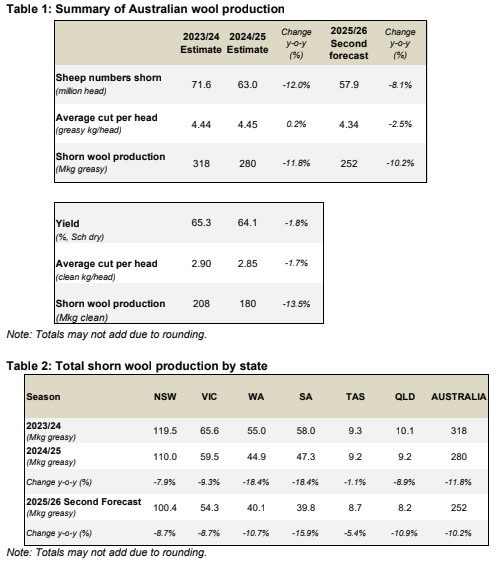
Today, the Australian Wool Production Forecasting Committee said it has estimated 63 million sheep will be shorn in 2024/25 for 280.1 Mkgs of greasy wool, 11.8 percent lower than in 2023/24. The AWPFC’s forecast for the 2025/26 season is 251.5 Mkgs greasy, down 10.2pc on the 2024/25 forecast.
Shorn sheep numbers are forecast to reduce by 8.1pc to 57.9 million by 2025/26, the lowest number of sheep shorn since 1904, when 56.8 million sheep were put across shearing boards nationally.
AWPFC chairman, Stephen Hill said 0the 2024/25 estimate reflects the continued drought conditions in western Victoria and South Australia and the variable season in both New South Wales and Western Australia.
“Fewer sheep are expected to be shorn in all states as producers take advantage of the current strong sheep meat prices,” Mr Hill said.
“This remains a key downside risk to a recovery in shorn wool production despite the favourable seasonal outlook in key wool producing regions.
“Rainfall from now leading into spring and pasture feed availability will be key factors influencing producer decision making.”
Call for industry to unite around clip certification
The dire production estimates have prompted New South Wales broker and Australian Wool Exchange director Marty Moses to call for all industry bodies to highlight the unique Australian wool story to the world.
This would require the industry service providers, industry bodies and growers uniting around certifying clips under the Australian Wool Sustainability Scheme for better market access by “telling the Australian story”, he said.
He said with the eBale, WoolClip and the world’s benchmark wool classing standards all digitally linked through the AWSS to the Australian Wool Traceability Hub the national clip would have full “market ready” traceability and validation. He believes with these tools and systems Australia can become a world leader in wool supply, quality, traceability and sustainability.
“It is D-day; if we keep doing what we’re doing, in two years’ time it (wool production) could be 20 or 30 percent less, there is just no leadership, we’ve got to pull together as an industry.”
Mr Moses believed prior wool production estimates, especially in 2023, were elevated by producers shearing sheep before sale, and in 2024 with the drought and rising livestock prices, more sheep were sold in the wool. But he believed the latest figures reflected the drop in Merino sheep numbers on farms and producers need to be considering their ability of their sheep to maximise meat returns as well as from wool.
He said there has been a glimmer of some positive global economic signs and he has been told large Chinese processors are investing in automation to try to future-proof their labour costs and were still able to settle everything at a price.
“Australia is still the largest producer of apparel wool in the world, but we’re going to lose that pretty quickly unless we show someone some money.”
But Mr Moses said he feels the wool market will turn around.
“I reckon it could add 1000c/kg for the 17 micron price guide – what’s going to stop it?
“There is no demand for superfine and ultrafine wool wool at the moment and you’ve got mills that have turned to crossbreds because it lowers their cost of production,” he said.
Moses and Son will be hosting a sheep producer forum at the Temora Town Hall Theatre on 28 August with a broad range of broker, exporter, industry services and grower body speakers. Click here for more details https://www.facebook.com/Mosesandson/
50pc-plus lift in wool prices over more than two years needed
WoolProducers Australia general manager Adam Dawes said the nation had seen substantial reduction in wool production year-on-year of late.
“In order to turn production around, we need something in the order of a 50pc lift in the market to be sustained for a reasonable amount of time (>2 years).
“This is an issue that the global supply chain needs to understand and address, if we don’t there won’t be enough wool to keep the downstream processors running,” he said.
“While seasonal conditions are no doubt having an impact on wool production and wool grower decisions to downsize, we are also seeing growers reacting to an extended period of depressed prices that are driving lowered profitability.
“The disparity between meat and wool prices is an increasingly influential driver of farm-level enterprise decisions,” he said.
“Some growers are placing a foot on each side of the fence at the moment, retaining their core Merino ewe base, while joining increasing proportions to terminal breeds.
“These decisions are not likely to significantly impact wool production this year; however, they will have a lasting impact across future years,” Mr Dawes said.
“We know that the price of wool is largely influenced by macro-economic factors, however at some stage the laws of supply and demand have to start to play a part in lifting prices.”
Negative sentiment underpins latest forecasts
The AWPFC said the May 2025 Sheep Producer Intentions Survey indicated continued negative sentiment among wool producers due to challenging seasonal conditions, increasing input costs, workforce shortage as well as supply chain and market pressures. These factors continue to impact sheep producers’ decisions regarding their overall livestock enterprise mix and the breed composition of their sheep flock.
The committee has estimated a year-on-year decline in shorn wool production in 2024/25 for all states ranging from -18.4pc in Western Australia (44.9 Mkg greasy) and South Australia (47.3 Mkg greasy) to -1.1pc (9.2 Mkg greasy) in Tasmania. New South Wales produced 110 Mkg greasy (down 7.9pc), Victoria 59.5 Mkg greasy (down 9.3pc) and Queensland 9.23 Mkg greasy (down 8.9pc).
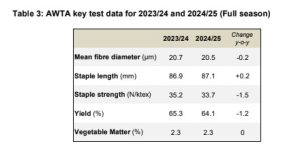
Average cut per head was comparable with 2023/24, at 4.45 kg greasy (up 0.2pc). AWTA Key Test Data for the 2024/25 season show small year-on-year reductions in mean fibre diameter (down 0.2 microns), staple strength (down 1.5 N/ktex) and yield (down 1.1pc) with a small increase in staple length (up 0.2 mm) and no year-on year change in vegetable matter (2.2pc). These data reflect the difficult seasonal conditions in many states during 2024/25 and the continued dampening impact of the season on average cut per head, the committee said.
 AWTA wool test volumes for the 2024/25 season were down by 11.7pc on a year-on-year basis. First-hand offered wool at auction during 2024/25 was down by 13.2pc.
Sheep slaughter for 2024/25 was up 13pc to 11.7 million head with lamb slaughter at 26.1 million head (down 4pc) compared to 2023/24. However, the 2024/25 sheep and lamb slaughter were both higher than the five-year average by 51pc and 17pc respectively.
The August AWPFC estimate includes a clean wool estimate for average cut per head shorn wool production. For the 2024/25 season the yield (%, Schlumberger dry top and noil yield) from the AWTA key test data was used to calculate the clean average cut per head and clean shorn wool production (Table 1).
In the 1980s and 90s we used to mules our Merinos. I was very quick at mulesing; doing 1000 per day, or more when mob sizes and mustering permitted. We started the SRS classing during the 90s with no thoughts or intentions of stopping mulesing. What eventuated was there is no need to mules Merino sheep that are classed this way. We were putting on eight pallets of Click annually, 32 drums per pallet, to keep flies at bay. We now buy one drum at a time at lamb marking. The first cull we had to do was cull the classer. Unless there is a will to change, it won’t happen. We haven’t mulesed a lamb since 2004. It’s easy to get staff for on-farm work, they’re not chasing flies. It was easy to get shearers right through COVID,. We’ve had seven world record attempts with five successful, using our sheep. The sheep are two microns finer, are cutting the same clean fleece weight and producing 40 percent more lambs. We are buying land for the next very keen younger generation.
Martin is right!
I own a wool testing business in Europe. European wool industries are promoting their wool as ‘unmulesed’ including narratives on what mulesing is and that Australians continue to mules. While the market share they are stealing from Australia might not be significant, the customers receiving this messaging are significant. The fact European producers don’t need to mules is irrelevant to the consumer. I might add that their media are running with this spin, such as a recent documentary by Dahl TV.
The reason there is little premium for Australian unmulesed wool is that in the eyes of the global markets, the whole Australian clip is tainted by the mulesing reputation.
The details in this report are of no surprise, but it didn’t need to be like this.
The leadership in the Merino industry has been in the dark ages, living in the past and worshipping the traditional sheep.
The market has been demanding ethically produced wool; non-mulesed.
Australian Wool Innovation has been silent on this, failing in their marketing charter.
As the industry has fragmented and fallen apart, producers have opted out.
However, hope does exist with groups producing a modern Merino, plain bodied, highly fertile and with increased survival levels, easy to shear and no need to jet for fly prevention.
At the same time, they are still paying wool tax to AWI which is ineffective.
imagine the progress that could be made with those levies if being used in the further development and promotion of the Modern Merino?
Hope still exists to make the Merino great again; the modern Merino is capable of doing it.
Obviously wool customers don’t want our product.
They won’t pay so farmers are voting with their feet.
‘certifying clips under the Australian Wool Sustainability Scheme for better market access by “telling the Australian story”, he said.’
That story is mulesing … Have you not been listening to customers?