
The use of WoolClip surged in 2022. Photo – Melanie Kate Photography.
PEAK industry body Wool Industries Australia has called for united action to strengthen wool traceability through Property Identification Code declarations on clip specis.
Wool Industries Australia is calling on growers, classers, brokers, and selling agents to work together in a final industry-wide effort to lift PIC declarations ahead of significant traceability requirements commencing on 1 January 2026.
From this date, a valid PIC will be required as a condition of testing for the certification of Australian Wool Testing Authority test results on all grower lots and interlots.
“Quite simply, no PIC will mean no test certificate,” a WIA statement said today.
“This mandate is an industry-led initiative, driven by WIA in alignment with the International Wool Textiles Organisation (IWTO) regulations, and implemented by AWTA.
“Supporting strong traceability and industry resilience,” WIA said.
WIA Chairman David Michell said having a PIC improves traceability and builds industry reliance.
 “A PIC is already central to Australia’s livestock traceability system.
“Extending its consistent use across the wool sector will significantly strengthen national preparedness for Emergency Animal Disease (EAD) responses and enhance confidence in the origin and traceability of Australian wool throughout domestic and global supply chains,” he said.
Mr Michell said the Australian wool industry’s goal, through WIA, is to achieve PIC declaration on more than 90 percent of Australian wool bales, ensuring the industry remains robust, trusted, and resilient in the face of future challenges.
“Recognising progress and the need for a final push Growers and their agents have already made an encouraging voluntary start in transmitting PICs with their wool on around 70pc of all lots, which is a strong foundation and clear demonstration of goodwill across the sector; however, this is below the industry’s target.
“Therefore, a final collective push is now required to lift this to at least 90pc by January 2026,” he said.
“Failure to achieve this uplift will increase the likelihood of trade disruption across auction and private treaty markets, highlighting the importance of immediate action.”
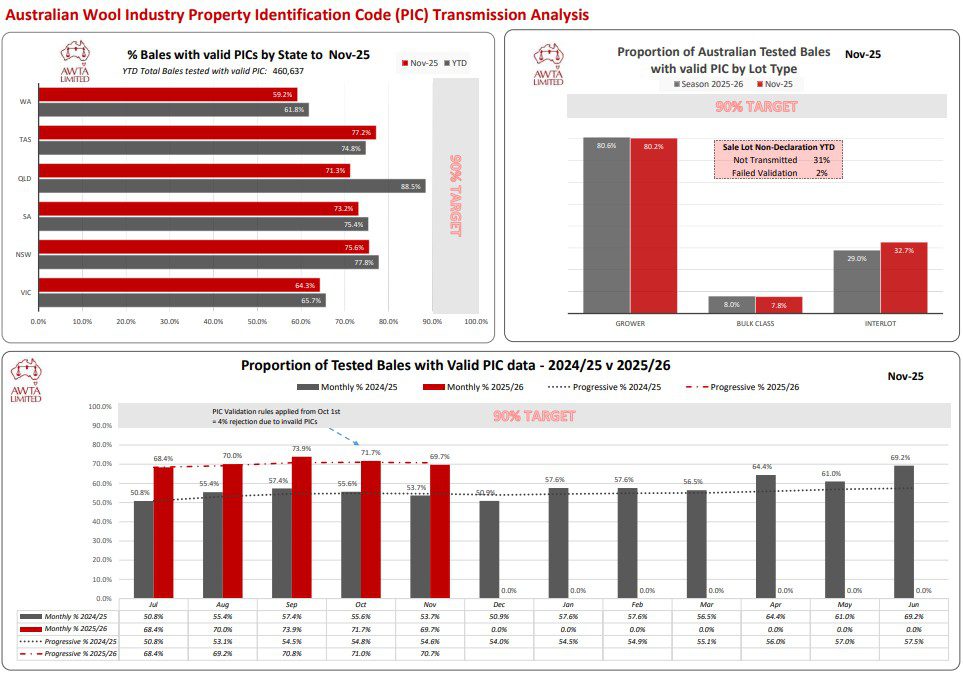
For more information on declaration statistics: https://www.awtawooltesting.com.au/index.php/en/statistics/declaration-rates)
What industry participants must do
- Growers must provide their valid PIC to their broker, which is easily done though the National Wool Declaration (NWD).
- Brokers and agents must accurately capture and transmit PICs to AWTA. AWTA is actively validating the presence, format, and currency of PICs and notifying brokers and agents of any non-conformances so they can update their systems quickly. Importantly, PICs stored in AWTA’s database are strictly protected.
WIA said PICs are only released to government under direction from the Chief Veterinary Officer, are never made public, not printed on test certificates, and not included in test data shared with industry.
WIA said the PIC enters the system for traceability purposes only; it does not flow downstream.
“Shared responsibility for a stronger industry WIA encourages all stakeholders to revisit the requirements of PIC registration and relevant state-based rules (see https://awth.com.au/industry),” WIA said.
“As the global demand for fibre integrity strengthens, comprehensive PIC adoption is essential to ensuring Australia maintains its position as the world’s most trusted wool supplier.
“United action today will safeguard the industry’s reputation, continuity, and future market access,” WIA said.
WIA acknowledged and thanked the growers, brokers, classers and service providers who have already embraced this initiative — and urges the remainder of the industry to act now.
“Together, we can secure the future of Australian wool,” the body said.
Source – WIA.
What a waste of time; once wool is scoured it could have come from anywhere.
It’s just another scheme to push prices down, like mulesing, no-one in the world can tell mulesed wool from unmulesed once it is off the sheep.
I don’t believe many consumers ever ask about it and the sales assistant wouldn’t know what you were talking about