
WESTERN Australian processor V&V Walsh sees a big future for Merino sheep meat in the state and recently released the state’s first $10-plus forward lamb contract for all breeds.
But the contract is only one part of meeting the challenges and opportunities facing the WA sheep industry as it meets the strong global sheep meat demand.
The Bunbury processor is the only WA operator that does not discount Merinos on its grids due to its market spread and V&V Walsh head buyer Paul Gault believes in 12-18 months’ time when wool prices kick and young cull Merino ewes are a valuable item, the breed’s value will resurge.
He said if Merinos purportedly take long to finish then the lotfeeder has already worn a discount and shouldn’t cop another discount at the point of sale.
Mr Gault is aware of some producers in southern WA who had pivoted away from self-replacing Merinos to joining British bred rams and then to shedding sheep, but were now “going back full Merino just seeing the potential that is coming.”
He said the negative press about Merinos and their value to processors and in lotfeeding was disappointing.
“Obviously our supermarket lamb is more of a crossbred product, but that is only part of our business and we do feed a lot of good Merinos.”
He said V&V Walsh had always taken the same quality of Merino lambs that was previously exported live and provided an outlet for cull Merino ewe lambs.
“So we did actually have that side of things covered and it was not really reported as such.
“That was disappointing, because I will happily feed a well-bred Merino any day of the week,” he said.
“They’re not like the old school long neck long leg thousands of wrinkles set any more; they’re bred nice and plain, bred for growth as much as they are for anything else now and they do feedlot well if they’re a good sheep.
“I feel like Merinos have still got a very very important place in WA.”
He said the state’s lamb processors were still some time off having all the tech to measure all the carcase and cut eating quality traits.
“But it’s definitely coming, EID is coming at the start of next year and that’s going to be a huge benefit to everybody that’s backgrounding and feedlotting.
“Processors are going to be able to really track genetics and quality – it’s going to be good.”
Contract is getting good support
Mr Gault said the processor’s forward contract of $10.20/kg was put out about a month ago for delivery from late July to the first week in October for 22-30kg lambs, reflecting improved demand, with 18-22kg and 30-40kg lambs priced at 9.80/kg.
And despite the activity of eastern state lamb buyers in WA, he said the contract is getting support, although it was not yet full.
“We certainly have a ratio in mind that we would work to and there are certain weeks toward the end of that (contract) period that are full because that’s when numbers are starting to come on.
“But there is still probably a bit of room in the earlier weeks,” he said.
“We do have a limit where we will pull up, but I don’t know we are going to hit it, because I think the lambs are probably running late enough in WA this year that it will attract whatever is ready, but it might not necessarily be to the point that we will have to close it off.”
He said some of the earlier new season lambs this year have been from shedding breeds, with some eastern wheatbelt crossbreds starting to appear, at 22-28kg cwt. Old lambs from Muckinbudin the state’s north-eastern wheatbelt sold for a WA record of $400 this week at the Muchea saleyards and new season lambs from the region are only a few weeks away, he said.
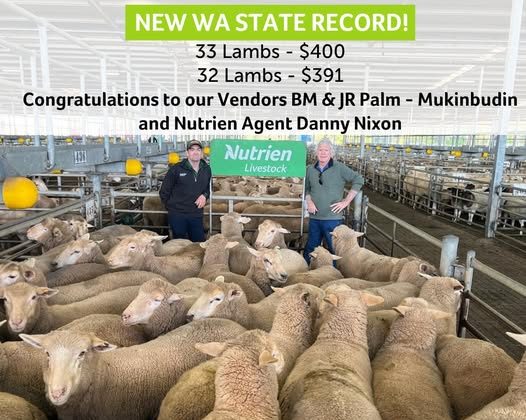
Nutrien Livestock agent Danny Nixon (left) with Mukinbudin producer Barry Palm and his $400 lambs.
Will there be enough sheep and lambs to service abattoirs?
Mr Gault said the WA flock has certainly lost some sheep.
“But we were also coming down from an inflated number as well, unfortunately we probably didn’t quite stop at a happy medium, we’ve probably gone past that, so we will see a tight supply.
“There is enough livestock in WA to support WA – the big unknown is how much pressure comes from the east to take sheep out of WA, that’s what will be the defining factor.”
Mr Gault indicated the eastern states’ demand was a concern for lamb and mutton supplies to WA processors, while recognizing that east coast demand for breeding stock is constant in most years.
“It will certainly be more intense this year after talking to some of the east coast agents that are operating here at the moment.”
Mr Gault expects an impact on the WA flock when South Australian producers who have put future breeders into feedlots and sold them as trade lambs, look to replace those numbers if the season allows it.
He said east coast lamb buyers with contract coverage until November are also in Western Australia sourcing supplies.
“There are agents here now trying to fill some contracts they’ve got on old season lambs with some of the bigger processors over east.”
Mr Gault believes the flow of sheep off WA farms has been stemmed, but this was late coming.
“I think as big an issue as anything over here is that the cropping side of things over here has been very good for the last 4-5 years; not only good yields, but good prices at the other end.
“When livestock prices were depressed here it was a little bit hard to stack up,” he said.
“It definitely stacks up now, but we’ve probably lost a little more breeding system than we’re comfortable with.”
However, he hoped the cropping resurgence might mean more grain available for lotfeeding of lambs.
“We definitely see feedlotting and backgrounding as huge parts of the solution, because the biggest hurdle we have here is that it is such a short selling season for lambs.”
He said the state gets a big run of lambs and store sheep from October to early December.
“It seems that some people that were running Merinos have exited altogether, others have pivoted more to crossbreds, so potentially people that we used to be able buy good Merinos for feeding after New Year are now producing crossbreds that are for sale before Christmas.
“So the trick is to keep our plant going through the winter months; we need to be putting sheep into our feedlots right up until June and July until the new season lambs come along.
“If the majority of sheep for sale are now being sold prior to Christmas that’s a hell of a gap to fill.”
Mr Gault said the issue needed to be tackled with forward pricing to encourage the backgrounding or finishing of lambs, “if we can get that coverage from our markets.”
He said the company and some supplies have become fairly good at lotfeeding lambs over the last 7-8 years.
“And that makes up a big part of the second half of our season, and particularly in our autumn and winter months, we really rely heavily on our feedlotting partners.
“The bit in the middle that helps bridge that gap, and that’s the backgrounding, I think that’s the bit that WA is a little bit new to.”
He said one key is finding farmers prepared to set land aside for fodder crops – like vetch and serradella – to background sheep out of season, rather than simply run sheep and lambs on stubbles after harvest.
“If somebody is able to buy a 30kg (liveweight) lamb now for $4/kg, even if the price of stores doesn’t increase in that period, which it traditionally does, and even you were to say that the price is still $4/kg in 10 weeks’ time when they decide to put them into a feedlotter, if they put on a kilogram a week for 10 weeks there is $40 gain there without even any change to the market.
“To me it’s a huge opportunity for people who are willing to have a crack at it, it’s just something that we need to be more involved in and develop.”
Mr Gault said V&V Walsh is trying to put some science to backgrounding by running store lamb-crop trials in various soil types across the seasons with various breed types.
“We actually want to say you can do this and these are the sort of numbers you can expect to see if you do it.”
Mr Gault said V&V Walsh’s feedlot program already works on a 42-day price cycle.
“So whatever price our key feedlotters are paying for store lambs on any given day they know what they are going to get 42 days later.”
High price resistance evident
Mr Gault said the market is also seeing some resistance to the high saleyard lamb prices, with smaller WA butchers seeing a drop off in sales and export sales have stalled “quite considerably.”
“It’s that funny time of the year when people tend to wear that bit of extra cost knowing that there is a bit of adjustment coming in the spring.
“But I feel like if they start to see that there isn’t that adjustment in the spring then there will have to be some decisions that come into play.”
He said WA processors are also hearing the same news of Costco in the United States not releasing tenders.
“It is a concern if we have gone past the comfort zone of the market that it is going to have some impact.”
Mr Gault said a major part of V&V Walsh’s business is underpinned by the two major supermarkets which to a degree can’t go without the meat on their shelves, although their sales are price-sensitive.
“They have different ways of marketing; they don’t always pass on the increases and decreases, and they often use meat as a magnet to walk people past other products that they’re looking to sell – it doesn’t always reflect what’s going on in the livestock and processing side of things.”
HAVE YOUR SAY