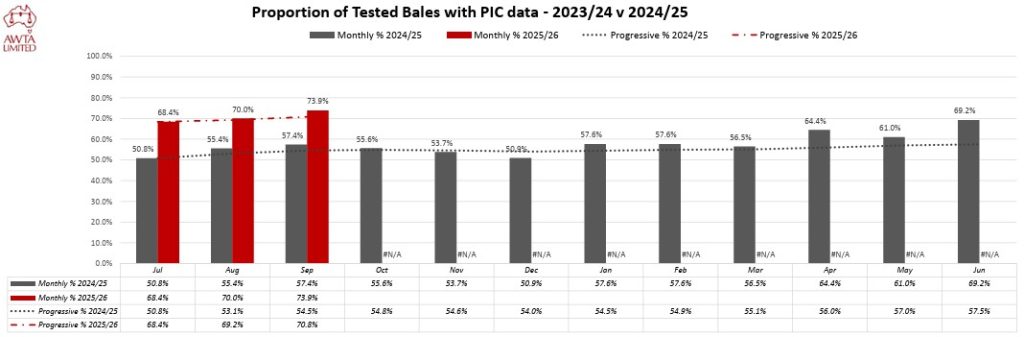
QUEENSLAND’S wool sector is the top performer in a bid to have 90 percent of bales consigned nationally declared with a Property Identification Code by 1 January 2026 through the Australian Wool Traceability Hub.
Australian Wool Innovation and the Australian Wool Testing Authority Limited (AWTA Ltd) recently announced the formal transition of the hub to AWTA Ltd’s full ownership and operational control.
On 1st October 2025, AWTA assumed full responsibility for the platform’s governance, maintenance and further development to support emergency animal disease preparedness and commercial traceability within the Australian wool supply chain.
AWTH program manager and AWTA raw wool data processing manager John Billing said the platform remains subject to industry oversight through the Wool Industries Australia steering committee and its publicised project charter, ensuring it stays aligned with industry goals and receives collaborative input from all stakeholders.
“Our immediate priority remains the strengthening of Australia’s Emergency Animal Disease (EAD) response capabilities by broadening the use of the Hub across the domestic wool supply chain.
“We continue to work closely with all industry stakeholders, including brokers, exporters, and processors, to promote the use of AWTH services to increase the declaration of Property Identification Codes to meet the targeted 90pc declaration rate by Jan 1st 2026,” Mr Billing said.
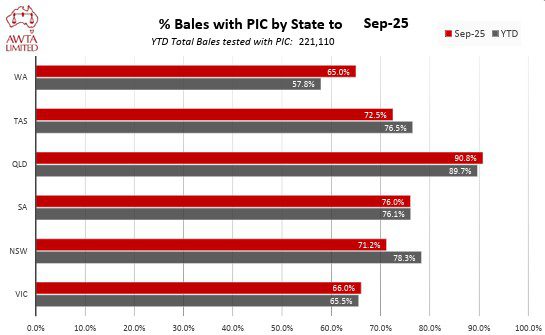
Since the Australian wool industry the industry gained permission in June from the International Wool textile Organisation to mandate that growers provide their Property Identification Codes with all clip test certificates, 89.7 percent of bales out of Queensland have had PIC data. The state was followed by New South Wales on 78.3pc, Tasmania 76.5pc, South Australia 76.1pc and Victoria 65.5pc and Western Australia 57.1pc.
The source identification of wool lots is fundamental to traceability via the Australian Wool Traceability Hub, and especially for management of the impacts of emergency animal disease incursions on the industry.
Mr Billing said the AWTA continues to work closely with AWEX in promoting the adoption of eBaleID tagged bales, as well as WoolClip and its AWSS programs.
“These tools are critical to strengthening the AWTH data that underpins commercial traceability and provenance, certified integrity schemes and national biosecurity goals,” he said.
AWI chief executive officer John Roberts said the transfer of the Australian Wool Traceability Hub to AWTA represents a natural next step in ensuring the platform’s long-term stability and operational excellence.
“AWI remains strongly committed to the broader vision of improving data connectivity, transparency and efficiency across the wool supply chain.
“We will continue to support the Hub’s strategic direction through our active participation in the Wool Industries Australia steering committee and the AWTH Working Group,” he said.
AWTA managing director Michael Jackson said AWTA is proud to assume ownership and operational responsibility for the Australian Wool Traceability Hub.
“The hub is an essential tool for ensuring the integrity, biosecurity and traceability of Australian wool from farm to mill.
“We look forward to continuing collaboration with AWI and industry stakeholders to enhance the hub’s functionality, deliver measurable industry benefits and build confidence with domestic and international trading partners.”
HAVE YOUR SAY