
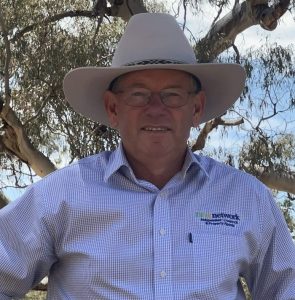
RMA Network CEO Chris Howie.
QUALITY sells and the importance of doing the job well on your lambs and sheep is really paying dividends.
Watching the Bendigo and Wagga sheep and lamb sales last week, store lambs were making $150-$220, with bag lamb orders starting to reappear in the south, but Wagga north store demand is too strong.
Good trade lambs are making $200-$300 and extra heavies $300-$380. It is important to understand the extra heavy lambs are seriously good with most 27kg dressed and better.
Fresh tight skins get a premium; however, most are now shorn or will need to be shorn once purchased. The current sale yard prices are hard to pass up, although processor contract prices are open to discussion on larger lines in most instances. Isaac Hill at Wagga Regional Livestock said the quality at Wagga had fallen away last week with many lambs showing the season. Last week Wagga was a bit softer on most heavy and trade but stores were still eagerly sought after.
Gary Wilson, Wilson Livestock at Kadina in SA told me three months ago he had not contracted forward and was feeding towards $350. At Dublin sale on Tuesday he rolled the dice and got his money. Well done.
Mutton continues to be the backfill for unfilled lamb space. Rates are as good as any have ever seen. Especially those that remember selling old ewes for five cents. Don’t overthink the market; if you are able to shear them and allow six weeks before sale the presentation benefit will reward you.
First cross ewes sales have kicked off, with the best ewes topping at $540 on a repeat buyer order. Over the spread of 1.5 year olds at Naracoorte and Bendigo the main pricing band was $400-$480 on joinable ewes. Ewe lambs that are joinable ranged from $325-$400.
Be aware of grass seed
Make sure you are seed-aware in your paddocks and don’t ruin your returns through negligence on the way to the yards to load. Also, if your lambs have seed, be up front and work out the price with a processor in advance, not try to argue the penalty afterwards.
An October break
October was a month off and a trip to Singapore for my wife and I. Just a great place that shows how some society discipline helps everyone. Mandatory military service for 18-22 year-olds, no litter, no homeless, no gangs, no graffiti, driverless trains on time, limited police presence and the cane still a tool for discipline.
Visiting the wet markets, it was good to see the amount of Australia lamb and beef. Legs of lamb being cut up into curry pieces with old mate puffing away on a dart made me smile. This brought back memories of times past when we weren’t so woke and no one had an allergy other than the odd penicillin or bee sting bracelet. The Changi war cemetery drove home what was sacrificed so we could live as we do today. I hope we stop wasting the privilege pretty soon.
Recently, I caught up with Nigel Starick, Elders Bendigo at the lamb sale. After a bit of price chatter, we spoke about what’s been happening. The good part for me was Nigel’s story about being given the coaching role for an under 15 and an under 17 basketball tour to the USA in January next year. It easy to overlook the amount of time a lot of stock agents (rural people) put into their local communities.
Think safety
Every year I raise the need for us to be mindful of the busy season with livestock, whether on property, in the saleyards or transporting. Long hours, hot weather and many that are new to the game.
Fatigue is a real issue and it is the responsibility of all of us to keep an eye out for each other. Safe Work Australia has just introduced a code of practice on fatigue. These are now the terms of reference if something goes wrong and an injury or worse occurs.
The ‘she’ll be right’ attitude does not cut it anymore and as employers, managers and work mates we need to ensure the training and inductions are done. Fines to company, directors and individuals are applied under the chain of responsibility including jail time if you don’t get your head in the game and an accident happens.
Seasonal conditions are diverse
Areas that were good have packed up with wind and heat and drought areas in June are now a sea of grass. Adelaide to Melbourne is exceptional with a very mild spring.
Surface water is still an issue for some with Andrew Whan from Miller, Whan and John at Mt Gambier saying the grass position is very good, but the subsoil moisture is lacking. Any form of heat could fold up the season very quickly.
Dropping into Bendigo on Monday last week, I spoke to Rupert Fawcett from Ellis Nuttall and Co. Rupert said north of Bendigo is below average and set for the long haul to next April.
Driving through it on the way to Albury the paddocks look like February not December. The areas around Yass, Holbrook and Cooma missed the spring rain and are now in sell mode. Will Dixon, Monaro Livestock and Property has been selling lambs straight off mum and cows and calves are the next item to go. Nick Hall, Allied Marketing at Walcha said the New England is very good with excellent weight gains across sheep, cattle and some barbers pole the size of a good tiger snake. Queensland seems to be right although most pastoral operations have pulled up with heat. The good sale season has also seen many holding numbers back for the expected demand next year which contributed to the supply hole we are currently experiencing. Patrick Underwood, principal of ACE Live export in Darwin said NT have started with an early cyclone.
The Darwin cyclone that tracked into the Kimberley and dropped some good rain with the potential to set the region up, touch wood, for a good wet. Peter Wardle, Wardle and Co Broken Hill said areas north of the towns of Packsaddle and Tibooburra were in a serious position, with many stations destocking after missing out on the storms that flowed through.
Beef and steer trials
Lardner Park at Warragul had its 50th year of the renowned steer trial, supported by local agents Alex Scott and Staff as well as Everett, Seely Bennetts.
The keynote speaker Simon Quilty provided one of his best insights yet getting into the nitty gritty about tariffs, supply and Australian value for money internationally. The balance of the presentation highlighted the beef opportunities next year, but were tempered with the easing of prices in 2027 back to today’s rates.
I agree with Simon and suggest making every post a winner next year – weight and weight and weight, let price manage itself.
The involvement of Coles at an educational level in this event was very well received. This session was aimed at providing insights into meat preparation demonstrations, animal health.
Coles procurement manager Stephen Rennie and his team provide this competition the end result consistency for scoring through the Coles system that we all look for. Being my first time, I noted this event is held in the right spirit without individual company promotion. Steve’s willingness to pass on insights and experience was very well received by the participants and attendees. If I was a stud or commercial breeder I think the Lardner Park trial is an exercise that is well worth the time.
Live export from Darwin is hitting it straps
With the floodplain tenders driving price and the upcoming Indonesian religious festivals in February exporters need to get cattle on the water and onto feed in Indonesia. The filling of permits always hangs over this trade but at present demand is excellent with prices ranging from $4.40-$4.70/kg for high quality Brahman. Volume does bring a premium with larger lines keenly sought. It was noted that the cow prices with processors have dragged big numbers away from live export this year adding to the demand vs supply dynamics. Cloncurry prices for Queensland cattle have been in the $4.50/kg range.
Cows and bulls
The southern cow job is very solid with score 2 British bred improver cows making $3.60/kg lwt at Barnawartha and best cows topping at $4.42/kg. With cows in this range cows and calves need to be considered a very viable split option to maximize returns. Bulls are only ever sold in 1 & 2’s so trucking them any distance is not really an option. However the difference in prices from the South to the Riverina has been close to $1.00 a kilo on some sales. Nearly pay to put the old boy on a tandem trailer and have a couple of days in the south on the difference.
Weaner sales are upon us with the southern feed situation far better than the last two years. In turn this may hold the northern orders out as the freight component makes the buy price plus freight prohibitive. Speaking to a QLD feed lotter he has been buying XB feeder heifers at $4.40 – $4.50 locally. With current heifer prices in the south on good runs ranging from $4.50 – $4.70 the numbers struggle to work. Jamie Gray, TDC Naracoorte gave me a quick report of the first Naracoorte weaner sales. Angus steers 300 – 350kg $5.70 – $6.20, less 30 cents for colour. Heifers in the same range were not as eagerly sought and made $4.30 – $4.70. 250 – 300 kg calves were in the high $5 to low $6 bracket. Any EU calves drew a lot of attention with a significant premium. The discount on unweaned calves was up to 50 cents per kilo. Local buyers were the strength with support from Western Districts of Vic, Ballarat and a significant commission buyer.
Don’t ignore animal health
Animal health continues to be an ignored part of many operations until it is too late. I heard of one significant steer loss off white clover because they were not vaccinated for pulpy kidney. Many of us have been banging on for years about the benefits achieved which have been proven time and again not by trials, but by old fashion, delivered alive sales to feedlots and processors. We saw the discount for unweaned calves at Naracoorte, which is serious money not in the bank. Vaccinations and especially IBR on calves heading to feedlots is absolutely critical these days. Also wean your calves; it will cover the cost of the hay plus more.
Cash is king
My old boss Malcolm Jackman at Elders lived by this motto. Currently every B Double load of livestock is worth over $200,000, which very quickly absorbs the working capital of a business. Having a line of credit in place to meet the future needs, using a specialist livestock financier and being diligent on invoicing is very important in the current market. One slow payment quickly creates a knock-on effect like a traffic jam. Speaking to one processor, his kill for the day was 1000 cattle with an average of $3750.
We played Cattle Baron for the first time last weekend. Bloody hell with a couple of bottles of red wine in play I realise why we don’t have bars at saleyards anymore. Fun game and worth buying for Christmas if there are any left.
My sister in law has cracked me off as her agent though as my advice may have caused her some issues.
Opportunities
Create a safe workplace – do your inductions
Cows and calves to split
Heifers again – why not?
Sell your stubble lambs by the third week of January and then reset.
If they are ready – take the money. Don’t let greed influence you.
Get your livestock finance sorted.
Give your kids a hug – whether they are one year-old or 31, It means a lot.
Enjoy Christmas and see you next year.
HAVE YOUR SAY