
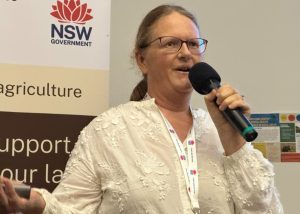
Gundagai Meat Processors’ supply chain manager Michelle Henry.
GUNDAGAI Lamb will soon give producers the ability to match carcase eating quality and health feedback directly to electronically tagged lambs as part of the company’s unique feedback offering.
Gundagai Meat Processors supply chain manager Michelle Henry announced the coming development of the GL producer portal at the first Southern Beef and Lamb School in Wagga Wagga yesterday.
The company already uses hook tracking to provide carcase feedback and analysis to producers on the day of slaughter, include on eating quality traits and disease impacts.
Like all processors, GMP records the ear tag EID of each lamb as it enters the plant, but GL has taken this one step further by pairing the EID of lambs before slaughter to their individual carcases.
Ms Henry said it has taken the GL team some time to get the system right, including GL supply chain officer Claire Marriott, who said the company had to make sure it was “110 percent” because people are making important decisions based on the carcase data.
Ms Henry said the development is exciting. It has not been released to all GL producers yet, while it is completely validated.
“But that’s something we are going to do really soon,” she said.
“It will be in a matter of months.”
She said with producers recording information on farm and linking that to EID, GL can now link that on-farm information to carcase data “and start to really understand what is most profitable within your system.”
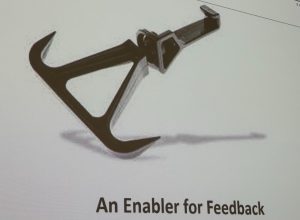
Gundagai Lamb’s feedback enabler.
This would enable producers to assess which carcases, or which strategies they might have used on farm, are actually working best for profitability, she said.
Prime lamb producer and Poll Dorset Isabelle Roberts said linking the lamb’s EID tag to its carcase qualities and data would enable her to overlay of on-farm data on how an animal was produced.
“Basically I can replicate the results again, or if I would like the results to be different, I can figure how to change my system on farms to achieve better results.
“From a seedstock point of view, it means that individual genetic lines can be analysed as well, and that’s a much faster way of be able to do that relative to what we had before,” she said.
“But it does rely on producers knowing what they’ve done on their farm in the first place.
“We can’t just say this little linkage between EID tag and the carcass will give you everything, that’s just the bit that binds it all together,” Ms Roberts said.
“The really important part is that we’re actually collecting production information and understand what our system has been able to achieve because of the carcase results.”
Ms Henry said the company is also developing an ability for producers to compare the feedback of different lots and a new functionality to give insights into the cost of animal disease and health issues, and carcase defects.
GL also is part of a Meat & Livestock Australia co-funded project to work with producers and livestock agents to improve their understanding of feedback through peer-to-peer learning.
The four-day inaugural Southern Beef and Lamb School at the Charles Sturt University campus at Wagga Wagga was an initiative of Riverina Local Land Services.
HAVE YOUR SAY