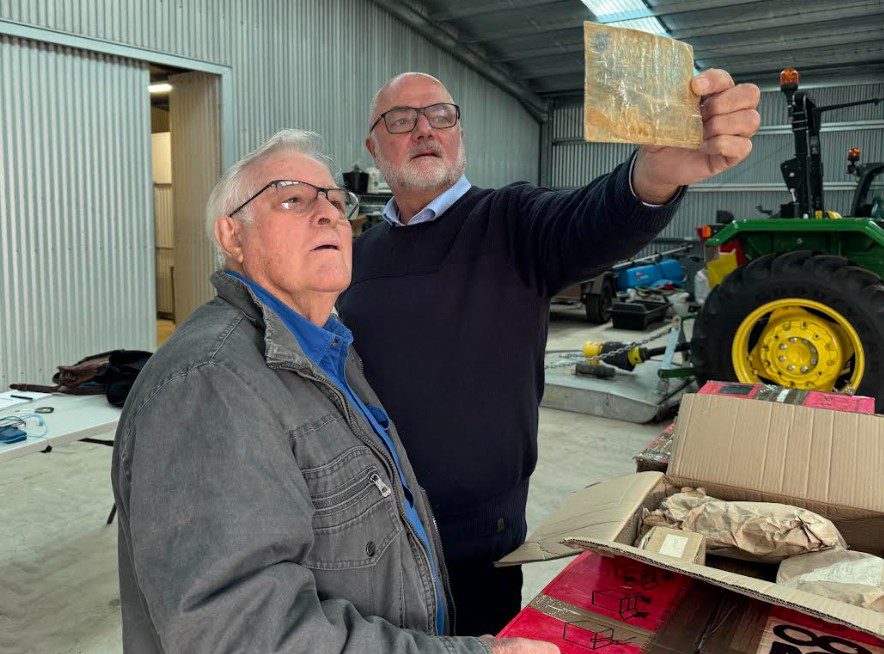
Dr Peter Howe, left, and Dr Paul Swan look at a wool sample from the Carter archives at RIST.
WOOL scientist, researcher and consultant Paul Swan always thought esteemed Australian wool scientist H.B. Carter had the world’s greatest job.
“Because he was paid to travel the world and collect samples from sheep – through Africa, through Asia – he travelled the whole world,” Dr Swan said this month.
“It’s not good to suffer from jealousy, but I was always jealous of what a great lurk Carter was on, because his research was collecting samples from all around the world; what a wonderful thing.”
On 6 and 7 June, Dr Carter’s archives – one tonne of wool samples, skin slides, diary notes, note books, letters and maps in two crates — were opened at the RIST headquarters near Hamilton in Victoria, after being shipped back from the United Kingdom.
Dr Swan and New South Wales veterinary consultant Dr Peter Howe got their first look at the historical treasure trove after the shipment was organised by Western District sheep producer, Peter Small and retired industry executive Dr Peter Morgan with $14,000 in funding from Australian Wool Innovation and private donors.
Dr Swan said while he was in Australia, Dr Harold Burnell Carter was warmly welcomed by the stud industry in the 1960s. He visited and collected samples from several famous studs as part of a project to characterise the species, including several that were the parent Merino studs of the current wool industry – Wanganella, Barunah Plains, Winton, Boonoke, North Bungaree, Chatsworth House and Nareeb Nareeb.
“There will be things in here that will relate to his original surveys, and that’s pretty amazing.”
Dr Swan said it is hoped that students, researchers and institutions will have an opportunity to look at material in the archives and link it back to some of the most important projects in the field of wool skin histology – the basis of wool production.
“This is a link to a really important part of the part of the past and it can’t be replicated.
“It would be wrong to call him the godfather, but he was that sort of guy,” he said.
“In science, you have a relatively small number of people who have an impact and then you have a whole lot of people who build on those foundations.
“Carter was one of the guys that laid a platform,” Dr Swan said.
“What’s the saying – ‘If I happen to see further than you it’s because I am standing on your shoulders’ — so Carter laid a platform and behind him came the Neville Jacksons, the Jim Watts and others.”
He said Carter’s work included relating the processing performance of different Merino wool back to the follicle structure in skin.
“So if you think fleece, follicle, genes – everyone else had just gone from fleece to genes – this work made the link to fibre attributes.”
Dr Swan said Cr Carter’s work had a huge impact on his life and career via his post-graduate work with Neville Jackson and later work with WRIST’s ‘Elite Wool – From Fibre to Fabric’ program with SRS Merino founder Dr Jim Watts.
Dr Harold Burnell Carter, (1910-2005) has been recognised as making a significant contribution to the development of the Australian Merino by defining the unique characteristics of the Merino’s skin and the capacity of the Merino to produce large quantities of fine soft fibres; fibres keenly sought after by the world textile trade. Dr Carter’s daughter-in-law Margaret Carter stored the archives at Orpington in Greater London since Dr Carter’s death. Dr Carter back to England in 1955 to continue his work on Merino wool and skin follicle histology and apply it to animal genetics.
Carter did the foundation work that others followed
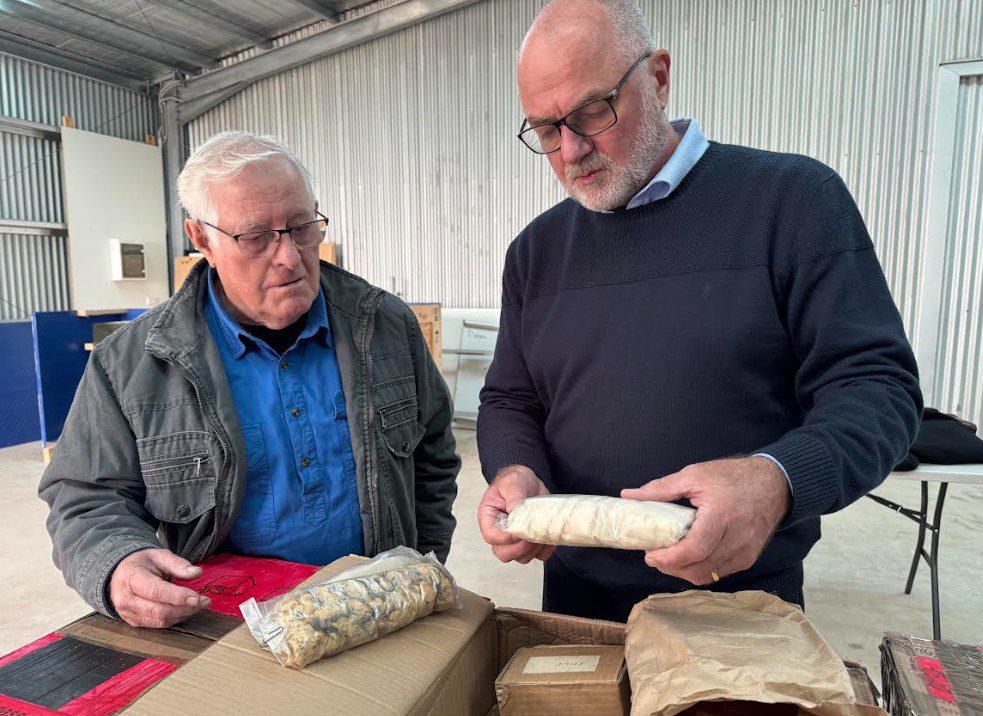
Dr Peter Howe, left, and Dr Paul Swan, check and catalogue the Carter archives.
The archives includes hundreds of skin histology slides, and Dr Howe said it might be possible to compare these with samples from modern sheep to see what changes have been made in the past 60 years.
“This is where it all started, people didn’t understand where wool came from,” he said.
“Even to this day, I don’t think people know that the skin is the wool factory.”
“For me, Howard Carter did some of the foundation work, but he was only held up there and revered by a very few … it’s a measure of where we’ve come from.”
Dr Swan said he and Dr Howe would verify the contents and state of the archives. He said there were professional archivists, museums and universities who might be interested in examining, storing and utilising the archives.
‘Very chuffed’ that persistence paid off
Wool grower Peter Small with his front-seat collie Jock.
Mr Small said the view to date is that the archives are so valuable that they need to be where research workers would have access to them.
“Which really means that they need to be at a university, especially one that has a wool research function and there not many of those left these days, but we haven’t approached any of them at this stage.”
He said he and Dr Morgan were satisfied their persistence had paid off with the successful rescue of the archives.
“Peter and I feel very chuffed about it.
“I think our persistence in getting the archives to Australia has been verified,” he said.
“The collection is significant, there is stuff going back 200 years, including a magnificent skin and wool samples of sheep, particularly of the Australian Merino, but also of other breeds; it really is of historical significance.”

Dr Peter Morgan.
Dr Morgan, former executive director of the Australian Wool Exporters and Processors, first became involved in Peter Small’s mission three years ago and used his Federal Government contacts to facilitate the importation.
“It’s very satisfying and it’s just amazing that Harold Carter and it was all preserved by his daughter-in-law,” Dr Morgan said.
Congratulations getting Dr Carter’s wool archives back to Australia. His research provided information and stepping stones that have allowed wool production and processing to make the fine garments available today.
I wonder what has become of the old UK offices of the Wool Corporation in Ilkley?