
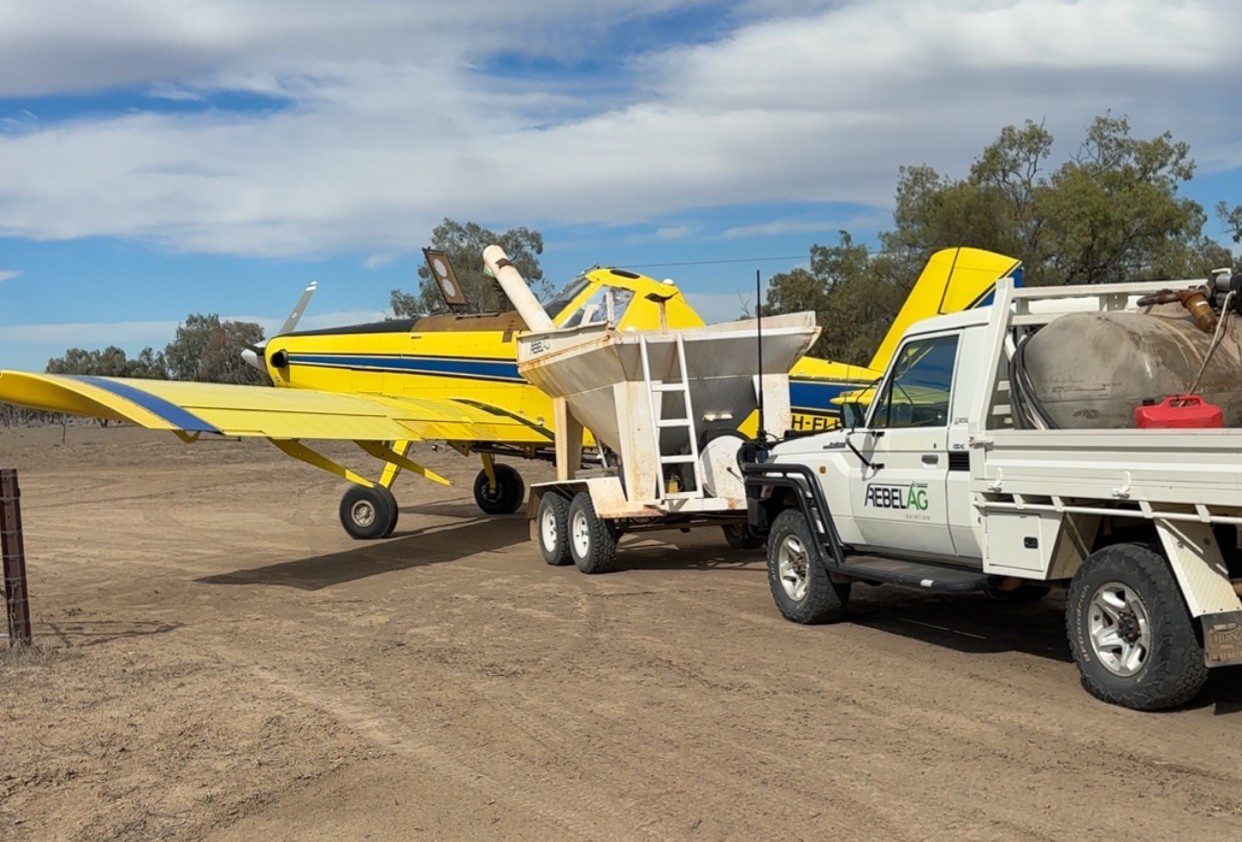
Trangie-based contractor Rebel Ag uses its fill cart to load faba beans for dropping to lambing ewes on Yappalee. Photo: HM Lowe & Co
A MOB of Brewarrina ewes had a welcome delivery last week when an aerial contractor delivered their first feed of faba beans.
The strategy has been employed to minimise the chance of mismothering at HM Lowe & Co’s Yappalee, and provide a nutritional boost to Merino ewes as they lamb on dwindling paddock feed.
While the cost of $2000 for just one hour of aerial contracting time, plus ferrying costs, to get four tonnes of beans out may sound expensive, the company’s overseer of northern operations David Motley said the numbers should stack up.
“After trail feeding, we would mark 60 percent of lambs,” Mr Motley said.
“We’re hoping we do 80-85pc through being able to leave them alone through lambing.”
At an estimated $200 per lamb, even 50 lambs saved would more than justify the cost of the exercise.
“You go the whole year and you get a lamb on ground, and you want to keep it.
“I think in the industry we just accept losses; best practice is not to.”
Innovative solution
Beyond its home property at Yeoval, HM Lowe & Co owns and operates around 40,000ha in the Nyngan and Brewarrina districts, where it typically runs a flock of 20,000-25,000 adult Merino sheep and lambs.
Both hubs, including Yappalee as purchased in 2022, are east of the lushest part of inland New South Wales, its far west, where station country from the Victorian to the Queensland border is generally enjoying a bumper season.
Footage shot by aerial contractor Marcus Ashby of Rebel Ag, Trangie.
That has made Yappalee one of countless NSW properties stretching east into the New England buying in feed to ensure breeders are in good order ahead of lambing or calving.
“It’s been very dry, and we’re back to minimum numbers,” Nyngan-based Mr Motley said of Yappalee.
The property does not have feeders, and Mr Motley said trail-feeding was likely to be a costly exercise in terms of lamb losses.
“They hear the feed truck coming and they take off; the singles keep up but it’s the twins that get left behind.”
It was property owner David Lowe who suggested feed be air-dropped to the mixed-age ewes, part of the self-replacing flock on Yappalee.
“I was going for a drive with the boss…and he said: If you had to, you could fly some beans on.”
The first drop of faba beans, with another possible if conditions stay dry, has been timed to give maximum nutrition with minimum disruption.
“We’ll leave them alone for first week or 10 days, and come back at the end for the last week or so, when…80pc are on the ground.”
“That’ll be in three to five weeks; hopefully we get a rain, and we won’t have to worry.”
“We’re trying to stay away from them through the guts of lambing.
Mr Motley said the business opted to air-drop faba beans for their size as well as their nutritional value.
“We needed a big seed so they could find them.”
Find them they did over the trails, at around 15-20m across in the 1000ha paddock, and spread via three 1200kg drops, and a 400kg drop to empty out.
Mr Motley is himself a pilot who occasionally flies the properties, so the sheep are familiar with aircraft, who started to tuck into the beans at the earliest opportunity.
“They were all over the trail before the plane went.”
Changing economics
Market strength has been a further incentive for HM Lowe & Co to get the most from the 2026 lambing at Yappalee, where ewes have been joined to White Suffolk rams so wether lambs can be sold, ideally over the hooks.
Mr Motley said the northern operation has previously produced Merino lambs to get a wether portion that can be sold into mixed-farming operations to control weeds.
“Wethers were being sold…as woolgrowers, but with meat job like it is, that’s where they’re going.
“If we can get them heavy enough, they’ll go over the hooks; if not, they’ll go through the saleyards.”
If conditions stay dry, Mr Motley said he hoped other producers in the district would consider coming on board to air-drop faba beans so they could share the cost of getting the aircraft and the fill cart from Trangie to Brewarrina and back.
“If there were five of us doing it, it would be $1000 each.”
While some may baulk at the expense, Mr Motley pointed out that trail-feeding costs time as well as money.
“If you had to run staff and feed trucks, with wages and diesel, it’s going to cost you $2000 anyway…to [trail] feed ewes three times a week.”
Air-dropping the faba beans has also negated the issue of ground access if the ewes’ paddock gets significant rain during lambing.
While it will spark a welcome flush of herbage, it will also make the paddock inaccessible.
“When it rains on black ground, you can’t get to sheep.”
Beans aplenty
Narrabri-based brokerage AgVantage Commodities helped HM Lowe & Co source faba beans earlier this month for Yappalee when the market was sitting at just above $500/t free on truck Moree.
Rain in the past 24 hours, and more on the forecast, means the market has dropped, with beans now available at around $475/t ex farm Coonamble.
AgVantage Commodities principal Steve Dalton said indications are that plenty of growers in northern NSW still have beans on farm ready to sell into the grazing market.
“Depending on what happens with the weather, that price will come under a bit of pressure,” Mr Dalton said.
He said cold weather setting on the New England tablelands made prolific pasture growth unlikely, unlike west of the Newell Highway, where relatively mild conditions could see pasture jump away where rainfall has been significant.
“One thing supportive for the faba beans is demand to the east.”
Mr Dalton said the trial of air-dropping faba beans at Yappalee may have broader applications, particularly during flood events or in situations where ground access becomes difficult or impossible.
“AgVantage Commodities was proud to play a small role in supporting the initiative by sourcing the faba beans required for the trial.
“At a time when seasonal volatility continues to challenge Australian agriculture, initiatives such as this highlight the innovation and adaptability of producers on the ground, and the importance of practical supply chain solutions that help farmers protect both productivity and profitability.”
Grain Central: Get our free news straight to your inbox – Click here
HAVE YOUR SAY