
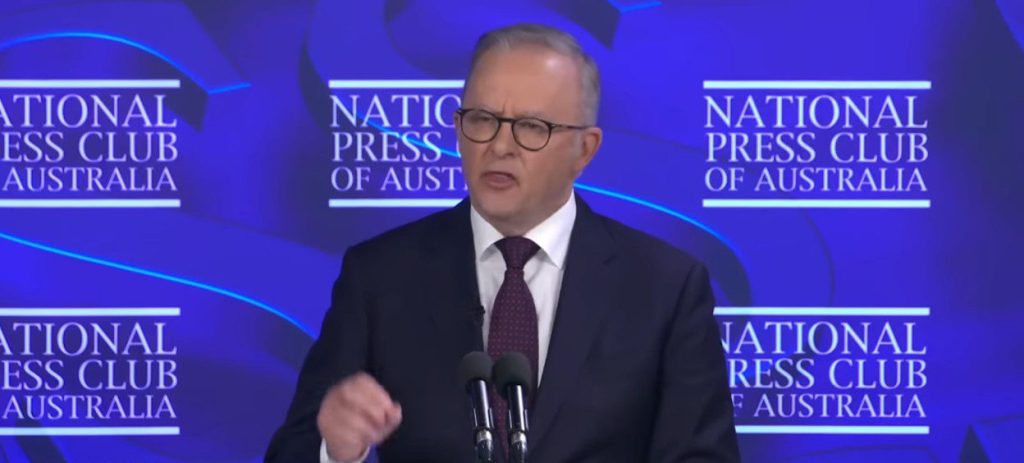
Prime Minister Albanese at the National Press Club today.
NATIONAL agreement to forgo goods and services tax revenue on fuel excise for three months and interest-free loans for manufacturing and fuel businesses are the latest Albanese Government initiatives announced today.
The announcements came as the Australian Competition and Consumer Commission urged the passing on of fuel excise cuts as soon as possible and outlined action for business to justify fuel surcharges.
Prime Minister Anthony Albanese said the states and territories had agreed to work with his government to forgo increased GST revenue on fuel transactions, locking in more relief for motorists.
“This will provide another $400 million of fuel relief and will be delivered through additional 10.9 per cent cut to the fuel excise for three months, which is a further 5.7 cents per litre cut.
“Combined with the halving of fuel excise already legislated by the government, the total reduction in excise on petrol and diesel will be 32 cents per litre,” he said in a statement.
“This relief is already starting to show up in petrol prices and we expect more to flow through in the next one to two weeks.
“This is more help with the cost of living for millions of Australians when they fill up,” Mr Albanese said.
“People are under cost-of-living pressure and a lot of that pressure is being piled on at the petrol pump due to the conflict in the Middle East.
“Giving back the GST windfall on fuel will help to further take the sting out of petrol price rises,” he said.
“This agreement delivers on the commitment by states and territories at Monday’s National Cabinet to return additional GST revenues they are receiving on fuel from the elevated prices we are seeing.
“It is easier and faster to implement this by further cutting fuel excise than by amending the GST itself.”
At the National Press Club today, Mr Albanese also announced that under our Economic Resilience Program the government will make available $1 billion in interest-free loans for manufacturing and fuel businesses dealing with the economic costs of this conflict.
“Truckies, freight companies – and fuel and fertiliser producers.
“These firms are not just being affected by this global crisis, they are essential to Australia getting through this crisis,” he said.
“So our government will extend their credit to help them, and the farmers and producers who rely on these supply chains, to weather the storm.
“This is just another way we are acting to get ahead of issues,” Mr Albanese said.
“No government can promise to eliminate the pressures this global crisis will impose.
“But we can be a buffer against the worst of it.”
Challenge to prioritise fuel for food and farmers
The announcement came after the National Farmers and the red meat sector called for additional measures to prioritise fuel for food supply chains and farmers.
Shadow Minister for Agriculture, Fisheries and Forestry Darren Chester said the government had been ‘light on details’ in Federal Parliament this week when asked about its plans for fuel and fertiliser.
“Key agricultural industry groups are already warning that further disruptions to fuel and fertiliser supplies will create shortages and price increases for Australian families,” Mr Chester said.
“A survey of Red Meat Advisory Council members has warned that 85 percent of meat producers and abattoirs have only enough diesel supply for one week of normal operations.
“Government ministers have repeatedly claimed there’s more fuel in the country than before the war in Iran, but can’t explain why up to 800 service stations are experiencing shortages and farmers aren’t receiving the bulk diesel supplies they ordered weeks ago.
“The government needs to be open and transparent with Australians regarding any domestic supply chain failures and demonstrate how it will prioritise fuel for key industries like agriculture if the situation deteriorates,” Mr Chester said.
“We need some clarity and transparency from the Prime Minister on how the government will guarantee food production and delivery, not more empty rhetoric and platitudes.”
Mr Chester said the deteriorating global environment had also strengthened the need to fast-track the ‘National Food Security Strategy’ and elevate the issue of food and fibre security to a matter of national importance in the future.
“When it comes to food security, I agree with industry leaders that it’s time to take the issue more seriously and link it to national security in an increasingly uncertain world.
“As a nation, we grow more than enough food for our own domestic consumption, but the agricultural sector depends heavily on many imported critical inputs like fuel, fertiliser and pesticides.”
Mr Chester said disruptions in the supply chain being seen today have the potential to undermine farmers’ capacity to feed Australians and the tens of millions of people around the world who rely on our high-quality agricultural exports.
“Household budgets are already under pressure, and Australian families can’t afford the price shocks associated with these supply chain disruptions.
“The government was warned by industry almost four years ago on the consequences of not having a nationally co-ordinated food security plan, which includes fuel and fertiliser, and it must be part of Australia’s national security planning today, and in the future.”
Energy Minister Chris Bowen has claimed that diesel is being prioritised to rural areas for farmers.
This included releasing additional fuel from fuel reserves on the condition that fuel companies prioritise areas that need it most – including farmers, regions and the ag sector.
ACCC issues fuel excise cuts warning and legal notices
The ACCC today warned fuel retailers they should fully pass on all fuel excise cuts by the Federal Government as quickly as possible.
It was announced today that under a deal between States and Territories and the Federal Government, fuel excise would reduce by about 5.7 cents per litre (cpl), in addition to the cut in fuel excise of 26.3 cpl, which came into effect on 1 April.
In addition, the ACCC has today served notices on several businesses operating across South Australia, Western Australia, Queensland and the Northern Territory requiring them to justify sizable ‘fuel surcharges’ imposed on deliveries to remote areas.
The ACCC said it is continuing to monitor fuel prices daily in capital cities and more than 190 regional locations and will closely analyse price movements following the government’s cut in the fuel excise from 1 April 2026, and the subsequent cut.
ACCC chair Gina Cass-Gottlieb said the commission is pleased to see that already several retail sites have dropped fuel prices and passed on savings to customers in response to the initial cut in fuel excise on 1 April.
“Earlier this week we made it very clear to the major fuel companies that we expect to see them pass on the full cut in the fuel excise to consumers without delay.” Letter to fuel companies about the excise reduction ( PDF 151.04 KB )
“We expect the same for the further cut in the excise under the proposal announced today, so that retail petrol and diesel prices should reduce initially by about 26.3 cpl and ultimately by 32 cpl, from what they would otherwise have been,” Ms Cass-Gottlieb said.
Latest fuel monitoring report data on the excise cut
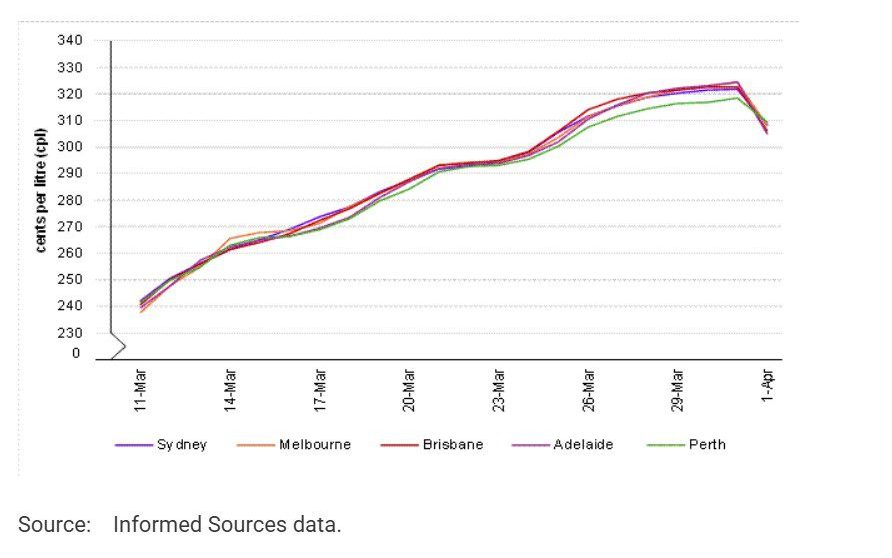
The ACCC monitors retail fuel prices, as well as changes in underlying benchmark prices, which continue to be volatile and also influence retail price levels.
Figure 1 – Daily average retail petrol prices in the 5 largest cities
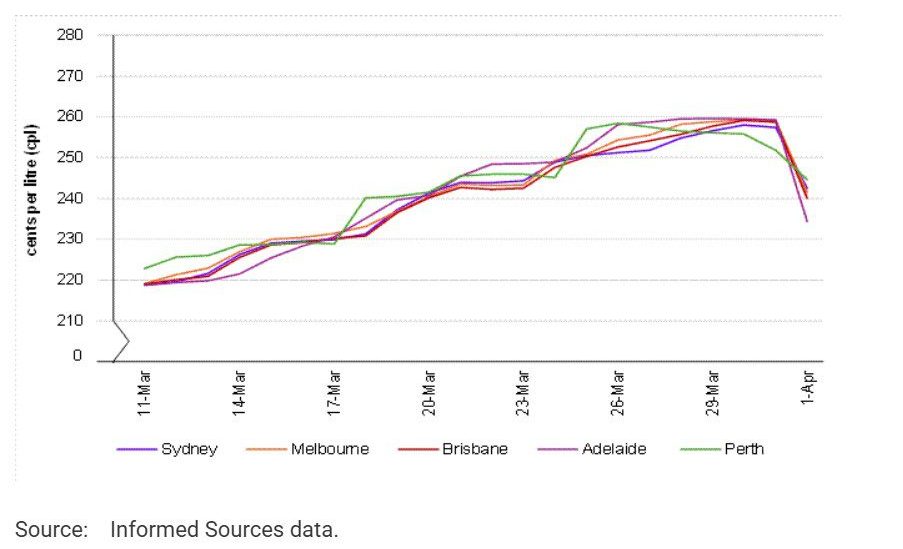
Figure 2- Daily average retail diesel prices in the 5 largest cities
The ACCC said in almost all city and regional locations, average retail petrol and diesel prices decreased following the excise cut. The size of the reductions varied widely between locations, with reductions in some regional locations being more than 20 cpl, while others did not change significantly on the first day of the fuel excise cut.
On April 1, across the five largest cities, daily average retail petrol prices were 16.7 cpl lower and daily average retail diesel prices were 15.0 cpl lower, compared with the previous day.
For regular unleaded petrol, average prices reduced by between 7.2 cpl and 25.4 cpl, with the greatest reduction in Darwin and smallest reduction in Perth.
For diesel, average prices reduced by between 9.1 cpl and 19.5 cpl, with the greatest reduction in Adelaide and the smallest in Perth. Separate to the impacts of the excise cut, in the week to the end of March, international refined fuel prices continued to be volatile, the ACCC said. More details are available in our weekly fuel price monitoring report this afternoon.
“Many service stations raised fuel prices relatively quickly around the start of the conflict in the Middle East, in many cases without usual lags from the turnover of fuels in stock,” Ms Cass-Gottlieb said.
The ACCC said it understands that rather than basing retail prices on the cost of fuel currently in their storage as they usually would, some retailers moved to pricing based on what it would cost them to restock at the current prices.
“Fuel companies know that consumers expect them to pass on the excise cut with similar haste or risk losing customers,” she said.
“While we recognise some areas have had supply or demand challenges, we encourage motorists to shop around where possible and reward those service stations that pass on the reductions.”
In addition, the ACCC is concerned about reports that some fuel retailers increased their retail fuel price soon after the government initially announced the fuel excise would be reduced, before then cutting prices.
“We are concerned that pricing changes may be used to obfuscate a failure by retailers to fully pass on the reduction in the excise and, if that is the case, we will take appropriate enforcement action,” Ms Cass-Gottlieb said.
Under the Australian Consumer Law, businesses are prohibited from engaging in misleading conduct or making misleading representations, including false or misleading statements about prices. This includes false or misleading statements about price savings and discounts.
“Increasing prices shortly before offering a “discount” can be misleading conduct under the Australian Consumer Law,” Ms Cass-Gottlieb said.
Legal notices sent
The ACCC said it has sent legal notices known as substantiation notices to some distributors supplying goods or services to remote and regional Australia, asking them to substantiate the representations they have made about their reasons for imposing sizable fuel surcharges or levies.
These types of surcharges are being widely justified on the basis that the suppliers’ costs have increased due to the impact of rising oil and fuel prices in the supply chain. The businesses have three weeks to respond to the ACCC and to substantiate the representations they have made about ‘fuel surcharges’.
“We have seen an increase in complaints from consumers and small businesses about the introduction or increase of fuel surcharges, including surcharges of more than 70 per cent imposed on small businesses servicing remote communities,” Ms Cass-Gottlieb said.
“Businesses must not mislead consumers about their prices. If a business is going to impose a surcharge or levy and represent that it is directly related to the high fuel costs, then the business must be able to substantiate and justify those representations,” Ms Cass-Gottlieb said.
“The ACCC will take appropriate action against breaches of Australian Consumer Law, such as misleading consumers about surcharges.”
Consumers or small businesses are encouraged to report concerns about businesses imposing large fuel surcharges to the ACCC.
The ACCC is also concerned these surcharges or levies are being used by some businesses or industry groups to increase prices across the board.
“Businesses are reminded that they need to make decisions about prices and levies independent of their competitors. Coordination of prices by competitors is a serious breach of competition laws,” Ms Cass-Gottlieb said.
HAVE YOUR SAY