
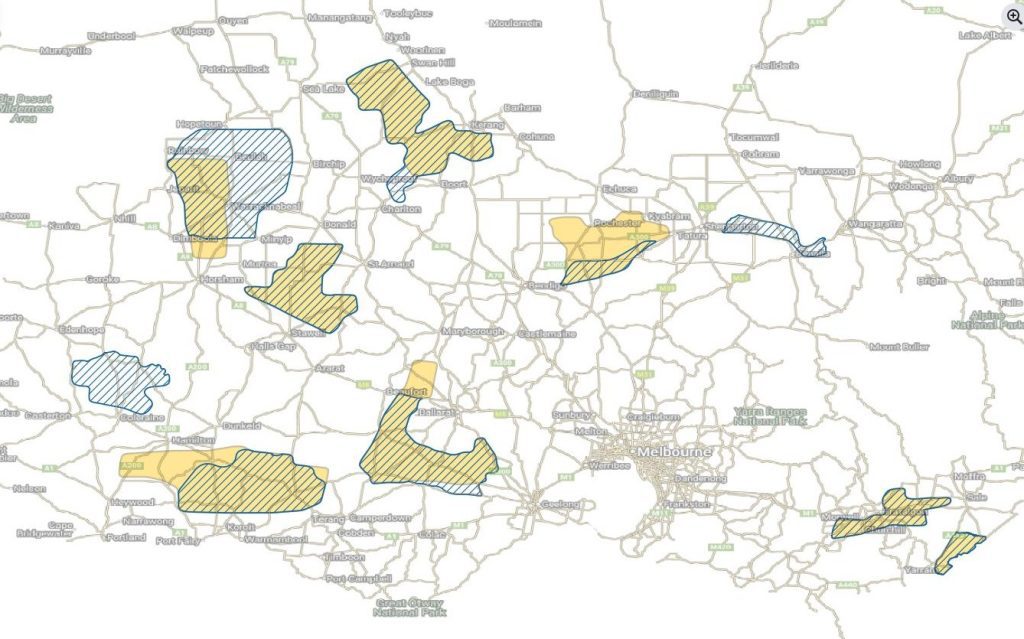
The updated REZ zones from VicGrid. Image – Wallaloo and Gre Gre District Alliance
THE Victorian Farmers Federation believes the State Government’s new Victorian Transmission Plan looks more like a roadmap for developers than a fair deal for regional communities.
VFF president Brett Hosking said many farmers believe in deep, economy wide emission cuts and the industry has already made huge steps forward.
But he said the way the government is going about the plan is leaving families in the regions carrying facing an uncertain future.
The plan was released on Sunday and lists proposed renewable energy zones – the six areas across the state most suitable to host new renewable energy generation, such as wind turbines and solar farms.
It also outlines the proposed Gippsland Shoreline Renewable Energy Zone, where offshore wind developers will need to locate infrastructure such as underground cables to connect offshore wind farms to the grid. The zone is not designed to host onshore generation such as wind turbines or solar farms, the government’s website says.
The plan also details the proposed transmission network upgrades needed from 2025-2040. The projects range from upgrades within existing terminal stations to reconstruction of existing transmission infrastructure and four new transmission projects.
Mr Hosking said the plan has been sold as a way to keep the lights on, “but it still leaves farmers in the dark.”
“The government has redrawn the Renewable Energy Zones to suit developers, yet we still don’t know how much power will actually be built, what protections farmers will get, or what benefits will flow back into local communities.
“We keep seeing the see-sawing cost of these projects and you must wonder where it will end. How is a plan a plan if it fails to outline even the basic details of how much it will cost?,” Mr Hosking said.
The VFF said the plan shows that renewables in the new zones could either double what’s in the ground now, or grow by more than ten times by 2040, while the government admits it hasn’t set any firm limits.
“That means a farming family can wake up and find themselves mapped into a zone, but have no idea whether they’ll see a few turbines or a wall of projects built around them,” Mr Hosking said.
The zones now cover nearly two million hectares of farmland, yet the rules on compensation, community benefits and fair consultation are still missing.
“Right now, developers are getting the green light, while farmers are told to sit tight and that’s completely unacceptable.
“If you want a fast and fair transition, you’ve got to bring communities with you and not just bulldoze past with a plan to have a plan,” he said.
“The government is forgetting that in the path of these mega-projects are generational farming families, utilising some of the most productive farmland in the country. They matter and we won’t let the government forget that,” Mr Hosking said.
Mr Hosking said the VFF’s message was simple: the government needs to stop leaving farmers guessing and be transparent.
“Farmers can work with change. But we won’t cop being treated as second-class citizens on our own land.
“If the government wants to get this transition done, it needs to put communities at the centre, not at the end of the queue,” he said.
Energy alliance says plan could offer certainty
The Renewable Energy Alliance (RE-Alliance) said the draft transmission plan is a 15-25 year plan for what Victoria’s Renewable Energy Zones and transmission could be.
The alliance said the plan could offer some much-needed certainty for Victorians and RE-Alliance national director Andrew Bray said rural and regional leaders in Victoria say people in the regions generally support the shift to renewable energy.
“But there has been a lot of uncertainty about how this shift will happen and what it means for each community.
“The draft Victorian Transmission Plan gives Victorians some clearer direction, but the key to its success will be further engagement to finalise the plan,” he said.
“VicGrid needs to have a greater presence in key regions and clearly state how they will work with communities to incorporate local knowledge and feedback as they take their next steps.
“Communities can now review the plan, including the Community and First Peoples Partnership Guidelines and the Community and Industry Engagement Guidelines, and provide feedback on the work done to date.”
The draft 2025 Victorian Transmission Plan is open for public consultation until Tuesday 10 June 2025. VicGrid is seeking feedback from First Peoples, landholders, communities and industry. For more information about engagement opportunities, how to provide feedback about this draft and how feedback will be taken into account and shape decisions as the plan is finalised, visit engage.vic.gov.au/vicgrid.
RE-Alliance, alongside partners Community Power Agency and Yes2Renewables, has been calling on the Federal Government to fund Local Energy Hubs in key renewable energy regions.
“With so many government agencies and private companies involved in the shift to clean energy, communities are telling us they need a source of trusted information that can answer their questions as they navigate new renewable energy, battery storage and transmission developments. Local Energy Hubs could provide this,” Mr Bray said.
“These hubs would be physical centres with a strong outreach program, staffed by independent local experts to help build trust and provide accurate information about what’s happening,” he said.
More information on the Local Energy Hubs model can be found at: localenergyhubs.org.au.
Andrew Bray, very few immediate neighbors want anything to do with these overseas-owned and mainly interstate or overseas workers who come in for couple of years, destroy our roads, break school bus curfews and then leave us with the sleep deprivation. It’s like working jet-lagged the next day when you have broken sleep from the thumping and vibration in our homes as the blades go past their tower. Labor has no respect for country people and our way of life. They’re turning our catchments and underground water into PFAS bisphenol industrial junkyards.