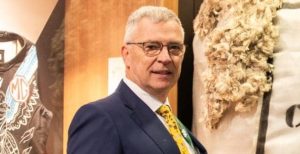
Wool Industries Australia president David Michell.
WOOL Industries Australia and its grower, broker and exporter members are still committed to forming an industry strategy on mulesing, according to WIA chairman David Michell.
“I think they are in agreement that we need to work out a way forward,” he said.
Mr Michell said he expected a workshop to be probably held in November, once a “framework” on how to form the strategy is determined.
“We are progressing with a framework to work out how we can talk about it and once we work that out we will get a bunch of people in to work out what the position is.
“So it’s happening, it’s always slower than you want it to be but there are a lot of people to corral in the one room,” he said.
WIA is regarded as the national representative body for the Australian wool industry, with executive members drawn from the Australian Council of Wool Exporters & Processors Inc,, the Australian Wool Exchange, AWH Pty Ltd, Australian Wool Innovation, the Australian Wool Testing Authority, the National Council of Wool Selling Brokers of Australia and WoolProducers Australia.
Mr Michell said the WIA members are keen on working together.
“So that’s what I’m trying to do and it will happen when it happens, so watch this space.”
The recent impetus for an informed industry discussion about market signals on certified non-mulesed wool production started in August after Australian industry representatives were told at the recent International Wool Textile Organisation Congress in France that China’s Nanjing Wool Market had a preference for certified non-mulesed wool from South Africa and especially non-mulesed Responsible Wool Standard clips, followed by New Zealand with Australia the third in line. This was followed by a call for a united mulesing strategy backed by WoolProducers Australia, ACWEP and the NCWSBA.
This feedback was reinforced last month at the Nanjing Wool Market Conference with WoolProducers Australia general manager Adam Dawes reporting the message to the China Australia Joint Working Group on Wool Quality and throughout the conference was consistent – Australia needed to produce more certified non-mulesed wool.
Mr Michell said the interaction between the Australian and Chinese trades at the Nanjing conference was probably the best it has been in a decade. He said it was not news that China wanted Australia to produce more certified non-mulesed wool and the certification feedback had not changed from the France IWTO Congress, although he said the Chinese did not care about certification because they have their own domestic market.
“What they’re finding is that their domestic market is not firing all that well either, so they need to sell more internationally and as soon as you do that you need a certified process.
“Certified wool has been around for many years, it is becoming more difficult to source the vol;ume, which is why the Australian Wool Sustainability Scheme has come to the fore to try to help with a certification process that encourages more farmers to get into the certification program,” he said.
“And the next step which are already underway, which are happening as we speak with the Textile Exchange, is to get them interested in using AWSS as a feeder into the RWS,” he said.
“Certainly non-mulesed is an issue, but that’s the first one of many, so what you need to understand is that certification isn’t one-dimensional, it’s one of many.
“So once you have a non-mulesed certification the next segment retail wants is what are the animal welfare processes like on farm , what are the human practices on farm , what is your triple bottomline reporting on ESG requirements, are you hitting all those – so it’s not one issue, fix it, it’s the whole thing.”
Mr Michell finally admitted that the recent feedback at the IWTO Congress and the Nanjing conference had specifically been about Australia’s certified non-mulesed wool production.
“”Yes, but it’s also wider than that, you ZQ out of New Zealand, you’ve got Authentico which goes to the Italians, you’ve got RWS that seems to be taking the forerun at the moment, so there are multiple authentication processes already in train and they all have slightly different twists.”
However, Mr Michell said he didn’t know that all the aforementioned certification programs were for non-mulesed wool only.
Understanding on AWI director actions
Mr Michell said he had not been contacted by any AWI directors on how or whether a mulesing strategy should be formed.
“I don’t think they need to contact me, they’re big men and they can talk to whoever they like, can’t they?”
Mr Michell said the AWI directors were probably trying to understand the issues “on the floor”.
“That’s what I would do, I would be actually asking people so what really are the issues?
“AWI sits on the WIA table so whatever position they have comes to that table and we all work, I think, pretty well together and I don’t think there is any difficult or problematic that can’t be overcome in calm debate.”
Media debate on issue not constructive
Mr Michell said having a debate on the issue through the media is not constructive for anybody.
“I’d rather try to fix an issue and then tell you guys about it.”
Mr Michell said he was not looking for brownie points or a media debate.
“I just think we can fix this if we just step through it calmly.
“The challenge is everybody has a point of view,” he said.
“I think there are some pretty smart compassionate people in this industry and I would rather get their input and come up with a solution that we can all live with.
“I’m a great believer in choice, so if farmers want to mules that’s their choice,” Mr Michell said.
“I mean there will be a financial result from that choice, but if they choose to go down that path I’m not going to stop them.
”I would like to try to work out how we can bring forward a framework that gives them a better future for the long-term rather than just jumping from season to season.”
HAVE YOUR SAY