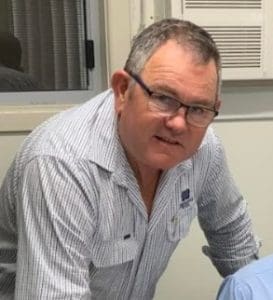
NCWSBA president Rowan Woods.
AUSTRALIA’S wool brokers have joined WoolProducers Australia in calling for an informed discussion on the market signals surrounding the nation’s certified and non-mulesed wool production.
The call also has the support of Australia’s wool exporters and the peak body Wool Industries Australia; however, the grower-levy funded Australian Wool Innovation was non-commital.
NCSWBA executive director Robert Herrmann said the confronting message to the China/Australia Joint Working Group from the China delegation at the recent International Wool Textile Organisation Congress in France was a wake-up call to the Australia wool industry.
China’s Nanjing Wool Market delegation told the working group that its first preference for wool purchases was South Africa and especially non-mulesed Responsible Wool Standard clips, followed by New Zealand with Australia the third in line.
NCSWBA president Rowan Woods said contrary to some industry reports, this preference was not due to price, it was the availability of accredited and traceability credentials.
 “The IWTO conference message was that global customers prefer accredited wool, with the preferred schemes all including non-mulesed wool only.
“There was a greater percentage of accredited wool in South Africa and New Zealand, which was why buyers were preferencing these markets over Australia,” he said.
“While wool brokers are not in the business of telling their wool growers what animal husbandry practices they should adopt, we would be derelict in our duty as advisers if we didn’t convey the messages we receive from the global wool trade”, Mr Woods said.
“Wool growers considering this decision need to have accurate and current information,” he said.
In reinforcing the message from Wool Producers Australia chief executive officer Jo Hall at the recent Victorian Farmers Livestock Conference, Mr Herrmann said Chinese wool processors are now asking for accredited wool.
“In the past there has been little discussion about mulesing from China, but there is no doubt they are now looking for non-mulesed wool.
“The largest Chinese independent topmaker wool buyer at auctions is also the largest buyer of RWS accredited wool,” he said.
“That should get us all thinking seriously about mulesing.”
What Ms Hall said at the VFF Livestock Conference
At the VFF conference, Ms Hall said mulesing was an example of where things have not been undertaken properly in the Australian wool industry.
She said regardless of a grower’s personal opinion on mulesing, “nobody in this industry can say that we have handled this issue properly.”
She said the industry had not kept its own deadline to cease mulesing by 2010 and there were good reasons for that.
“But in saying that we have invested a lot of money looking into alternatives since 2004, but we haven’t made much progress as an industry in taking a really strategic approach to this issue.”
“There are still people in the industry that don’t accept that mulesing is an issue and I think in my role at WoolProducers I do have the luxury of speaking to supply chain partners and hearing on the ground about the sentiment around mulesing,” she said.
“And the reality is in our supply chain mulesing is so on the nose, it has been for a number of years and people know that, but yet we haven’t come together to this conversation that is so so desperately needed.”
Ms Hall said she was shocked to hear the China delegation at the IWTO Congress in France say that South Africa is its preferred supplier of wool “that is because we can access RWS-certified wool,” she said.
“To hear our largest customer, our customer that takes nearly 85pc of our product, come and say that in a public forum was quite jarring.
“And the reality is Australia does hand-on-heart believe and know this to be true, that we do produce the best wool in the world, but something the industry isn’t dealing with is the fact that there are now issues over and above quality that our customers are seeking to have when they purchase our product, and mulesing is that big of an issue,” Ms Hall said.
“I just think it’s time that we really come together as an industry and without fear of personal attack or retribution start having the conversation in a grown-up way.”
Ms Hall said wool is now less than 1pc of the world apparel market.
“As much as I hate saying this, the world does not need wool, but the world doesn’t need Coca Cola either and it seems to be doing pretty well.
“What we have to do is start listening to our customers,” she said.
She said “saying that we need to have a strategic conversation about this” is not about setting another mandate, but “it means about getting the messaging back to growers so that they can make informed decisions.”
“And that informed decision might be to leave the industry, it might be to keep doing what you’re doing or it might mean to change genetics or management or other practices impacting the production of your product, but at least it’s an informed decision which I kind of think hasn’t happened for a lot of our growers to date and I think that’s a huge disservice to our growers.”
Ms Hall said the wool industry had an amazing story to tell, “but we’re just really really bad at telling it” and this was true for agriculture in general.
Market signals can’t be ignored – Herrmann
Mr Herrmann said NCWSBA representatives attending IWTO 2025 in France received some direct messages and it is important that they convey these to wool growers, so they have the latest market information when making decisions such as to mules or not.
“The strong message coming out of Lille for the future was that sustainability and traceability are what the customers are asking for.
“The clear and consistent premiums for accredited wool in recent times at auction was another strong pointer that the market was preferencing these lots,” he said.
“These market signals cannot be ignored.”
Mr Woods said it was disconcerting to sit at IWTO and hear New Zealand and South Africa talk up their wool credentials, with their opening statements pointing to their ceased mulesed status, “an obvious ‘dig’ at Australia.” Regardless of any price premiums, Mr Woods said he accepted that China was preferencing South African wool over Australian wool.
He said the Australian wool industry must “talk up” its credentials at future international forums.
“We must have a coherent and credible story about our Australian reliability of supply and the strength of our traceability credentials.
“Of course, underpinning this message will be the quality of our wool clip including having sufficient non-mulesed accredited wool to meet buyers’ requirements,” he said.
Mr Woods said it must be acknowledged that Chinese processors are dealing with clients that are demanding “things that we’re not delivering.”
“And that could include traceability, it could include non-mulesed wool, and they no doubt do.
“We can still sell mulesed wool, but there is a premium for non-mulesed …. It is quite easy to prove that there is a significant premium for non-mulesed wool at the moment.”
Mr Woods said Australia risked market share by ignoring signals.
“I think we do run a risk, because we are struggling to maintain market share as it is, we’re losing market share all the time.
Exporters also support an informed discussion
Australian Council of Wool Exporters and Processors president Josh Lamb supported an informed discussion on the issues around clip certification and non-mulesed wool production.
“An informed discussion at the association level to formulate a direction is probably long overdue.”
Mr Lamb said the industry risked “plenty” by not resolving the issue and doing nothing is not an option.
“Look where we are now as a result of doing next to nothing over the last 18 years?
“The risk we run is we’re going to have a fibre that struggles to get market access,” he said.
“Not everybody’s going to finish up non-mulesed and producers have got to make their own decision, my question is do they have all the right information to make that decision?
“That’s where I am at and I don’t believe they are getting the right information.”
Discussions on certification issues are ongoing
Wool Industries Australia chairman David Michell attended the IWTO Congress and heard that the Chinese processors prefer South African wool because it is RWS-certified, but are having the same problem in sourcing adequate supplies of certified non-mulesed wool as the early stage processing sector in Australia has had.
Mr Michell said WIA members, including peak broker, grower and exporter body representatives, and Australian Wool Innovation, have been discussing the issue of wool certification and traceability before, during and after the IWTO met in France.
Mr Michell said the challenge the Chinese processors faced, despite going first to South Africa, was that the SA RWS wool would not fill their supply chains.
“If you want Merino wool you’ve got to come to Australia.”
Mr Michell said there was a need for a certification system for the entire Australian clip, including mulesed and non-mulesed wool.
“I think there is an important discussion happening amongst the wool industry bodies,” he said.
“I reckon it’s the first time I’ve seen them aligned this closely in decades, if ever.
“So I think you will find that the work that is happening behind the scenes is positive and is seeking a solution; it is looking at the entire clip so that we can actually come up with something that’s going to work for everybody and it’s got to be affordable.”
Mr Michell agreed not sorting out the certification issue is holding the industry back, but he believed Australia could regain the position as the most preferred global source for wool.
No action plan from AWI on China’s preference for South African wool
AWI chief executive officer John Roberts also attended the France IWTO Congress and said he fully endorsed Mr Woods’ comment that the Australian wool industry should “talk up” its credentials.
“Australia leads the world in classing and testing standards, sheep genetics, animal husbandry practices, on farm productivity and so much more and we need to be proud of this.”
Mr Roberts said there is no question that there is growing interest in integrity systems and accreditation schemes that cover matters relating to animal welfare and ESG more generally.
“In response to this the Australian industry bodies are collaborating closer than ever in an effort to meet customers’ needs and at the same time ensure wool growers are rewarded accordingly.
“This is evidenced by the collaborative work currently being undertaken and endorsed by the industry around the Australian Wool Traceability Hub and integration with integrity schemes,” he said.
“The industry should always be awake to any issue raised by its customer and never rest on its laurels.
“Even though we do lead the world in testing and quality standards and we are one of the largest producers of non-mulesed wool in the world, it does not mean we switch off to what our customers are telling us,” Mr Roberts said.
Despite being asked directly, Mr Roberts did not say whether AWI is concerned that China had said it preferred South African wool over Australian fibre, nor what should be done about it.
“The fact that this was said cannot be disregarded; however, it is important to test these anecdotal comments before jumping to conclusions.
“Such comments are not unusual in these types of forums and are not always a true reflection of what is actually happening in the marketplace,” he said.
“I’ve been attending China/Australia Trade Working Group meetings since 1996.
“It is not unusual to be told that another country is performing better than you,” he said.
“What really matters is the data and the statistics around what they’re actually buying.”
It looks like AWI is not required any longer. Wool brokers have jumped ship. AWI will take every last wool grower down with them.
Maybe it’s the ideal time for a wool grower referendum? Those who want to keep mulesing can stay with AWI, and those that don’t can choose an alternate path for their wool research, development and marketing investment.
Come on AWI if you won’t say what we have to do at least make non-mulesed wool a different label; segregate and promote accordingly. Non-mulesed should be able to be viewed in a different space.
Full traceability equals customer satisfaction. The golden rule is the person with the gold makes the rules.
Oh, now they act surprised. Has the wool industry truly been blindsided by the issue of mulesing, or has it simply spent years in wilful ignorance, head buried in the sand?
At last week’s national sheep and wool show, I was stunned by the outdated rhetoric echoing through the halls. The old guard, parading in their moleskins and fawning over their pampered rams, wagged fingers and muttered clichés as if clinging to the past were a virtue. Their tut-tutting about mulesing felt more like denial than debate.
The truth? Change isn’t complicated. It just requires courage. For over two decades, progressive growers have quietly reshaped their flocks to align with evolving ethical standards and market demands. These producers aren’t loud, they’re effective. And they’re building the future while others hesitate.