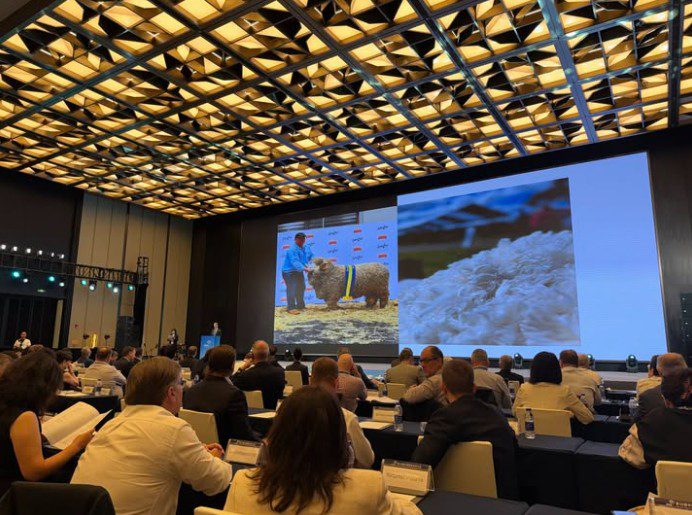
Ambassador of Australia to China Scott Dewar gave the introductory speech at the Nanjing Wool Market Conference. Image – AWN.
AUSTRALIA needs to produce more certified non-mulesed wool was the message delivered to Australian exporters, brokers and growers at the Nanjing Wool Market Conference in China last week.
The feedback has reinforced the message the Chinese trade delivered to the Australian industry at the International Wool Textile Congress in France last month.
WoolProducers Australia general manager Adam Dawes said the message to the China Australia Joint Working Group on Wool Quality and throughout the conference was consistent – Australia needed to produce more certified non-mulesed wool.
He said the conference delegates were told issues like animal welfare, mulesing and carbon are not priorities for Chinese retail consumers.
“But the Chinese demand for information and wool that has come through certification schemes like the Responsible Wool Standard is driven by the requirements of their downstream clients, primarily in the North American and European markets.”
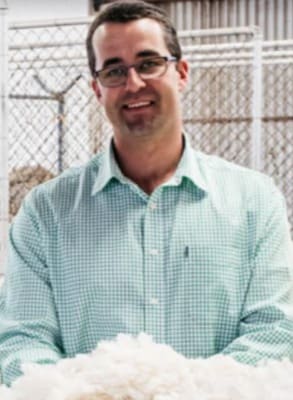
WoolProducers Australia general manager Adam Dawes.
Mr Dawes said no figures were given on the volumes or percentages of wool going to specific markets, although the United States remains China’s biggest wool garment export market.
“In their language, there has been strong growth in demand for those wools.
“Australia does not have enough certified (non-mulesed) wool to meet their demand, so they have to go to markets like South Africa to source it,” he said.
“For them South African wool is more expensive on a landed basis than what Australian wool is, but they simply have to go there because we don’t have enough (certified non-mulesed wool.
“The South African clip is 60pc certified (non-mulesed), what can we do to lift Australian levels of certification is what they were asking.”
Mr Dawes said the Nanjing feedback reinforced the message at the France IWTO Congress.
“I think so, we are not currently fulfilling the demands of the customers.
“The opportunity for us to supply more of what our biggest customer is asking for,” he said.
“Obviously there needs to be some sort of cost/price benefit for growers to go there, but the message from our biggest trading partner is loud and clear – we don’t have enough of that category of wool to meet their requirements, so they are going to other markets.
“Similarly, producers that aren’t in that fully certified space don’t have access to all markets, so it’s fair they’re not getting the best opportunity for their wool when it comes to selling it.”
On the issue of the consistency of auction price premiums for certified wool, Mr Dawes said some of Australia’s certified non-mulesed wool is receiving premiums, but is not being traded through the auction system.
Mr Dawes said he wanted to determine how strong the growth in certified non-mulesed wool demand is.
There is a need for Australia to develop a national strategy on the issue and that is what the peak body Wool Industries Australia is working towards, he said.
“It’s not just about mulesing, it’s about getting messaging to growers so they are empowered to make decision on farm about what they do about mulesing.
“It’s in relation to what do we do about pain relief; we know for a lot of certification schemes non-mulesing is a pre-qualified – basically for all schemes apart from ResponsiWOOL — that’s what our customers are asking for.”
AWN chairman John Colley said he has been told the Chinese made it very clear to the China Australia Joint Working Group on Wool Quality in Nanjing last week that there is no retail demand internally in China for non-mulesed or certified wool.
“But their issue is they buy 85 percent of our wool, 50pc (of which) they use internally in China … the other 50pc they are selling into North America and European Union who are increasingly demanding non-mulesed and certified wool.”
Mr Colley said Australia is losing market share to South Africa, New Zealand and Uruguay because it did not produce enough certified or non-mulesed wool.
On whether China’s huge domestic market would give consolation to growers who continue to produce mulesed wool, Mr Colley said a growing market in China was next-to-skin wear, “which is increasingly being manufactured by people who use accredited and non-mulesed wool – it’s only going to grow.”
“At the moment there are significant premiums for these wools in the market and it misleading to say that China doesn’t care if wool is from mulesed (sheep) or don’t care if it is non-mulesed or certified; that’s not giving all the information.
“That’s what we as an industry are uptight about, because when you don’t give all of the information it takes people down the wrong path.”
Mr Colley hoped that the industry is headed toward developing a strategy for Australia to reclaim its reputation on this issue.
“I would hope that that is where the industry is headed.”
The wool market is a joke. We are paying triple for shearing from 10-20 years ago, yet we are barely getting 10-year average prices.
With the collapse in WA and drought sending truck loads of breeding ewes to slaughter in South Australia, we can’t afford to swap out Merinos with non-mulesed sheep. Why hasn’t the market convinced people it’s ethical in comparison to flyblown sheep getting eaten alive? This government does not care about farming just carbon neutral and funding European investors to take over farms with renewable energy.
Then pay a premium. Australia has an auction system and on the specification provided with all wool sold it states whether it is from mulesed or non-mulesed sheep. If you claim you want something you need to pay for it, otherwise farmers won’t supply it. We already have the Australian sheep industry collapsing and being replaced by cropping and beef. If China desperately requires unon-mulesed premium wool but are not willing to pay for it then they are simply not able to compete with other industries like grain and beef and Chinese wool mills will have to close.
Audie, the reality is if the customer is not provided with what they require, inevitably market share for wool is lost. The evidence of market share loss has been in front of our eyes now for sometime.
In respect to premiums, it is unusual that your wool is not attracting a price premium. Has it been correctly certified as non-mulesed beyond the National Wool Declaration? A failure to give the customer what they want also results in discounts. However, premiums are currently recognized in the market. If you don’t think you are getting a premium then I suggest you talk to your broker.
We need to stop all these SAMM and Dohne breeds being allowed to be marketed under the Merino wool brand.
‘a growing market in China was next-to-skin wear “which is increasingly being manufactured by people who use accredited and non-mulesed wool – it’s only going to grow.”’
This is in contrast to AWI who is spending growers’ money defending the shrinking old suiting market, which they admit “no one is buying”…
Last out turn the light off.
Congratulations to John Colley, Chair of AWN and Adam Dawes, General manager of WoolProducers for faithfully bringing back to Australia a truthful account of the concern of the Chinese wool industry in respect to mulesing.
Actually, the Chinese delegation to the IWTO meeting in Sydney in 2016 came with the same message. About 10 years ago, they came wanting to support a European textile submission regarding mulesing to that IWTO meeting. But they were told by AWI that they could not raise the issue concerning mulesing in Australia, and certainly not at the Sydney IWTO. I know because I was sitting with some of the Chinese delegation, who I know, and they showed me the paperwork.
It is also known by many informed wool growers that for many years the Woolmark Company has been reporting to AWI Sydney of the detrimental impact mulesing was having on the demand for wool textiles.
AWI is culpable for failing to report to growers the true position of the world textile industry in regard to mulesing. This failure of AWI is so serious and so damaging to wool growers’ incomes that the Minister of Agriculture, Julie Collins, should immediately sack the entire AWI board. Growers should have the opportunity to elect a new board, free of the mulesing deceit. A new board should enlist all the skills and science at our disposal to move, as we said we would nearly 25 years ago, to a wool clip that is correctly certified and predominantly non-mulesed. With the right leadership it can be done.
We already have stated on the wool specifications of all wool sold through the auction system in Australia whether it is from mulesed or non-mulesed sheep and have for many years. I have only unmulesed sheep on my property, but see little evidence of a premium.