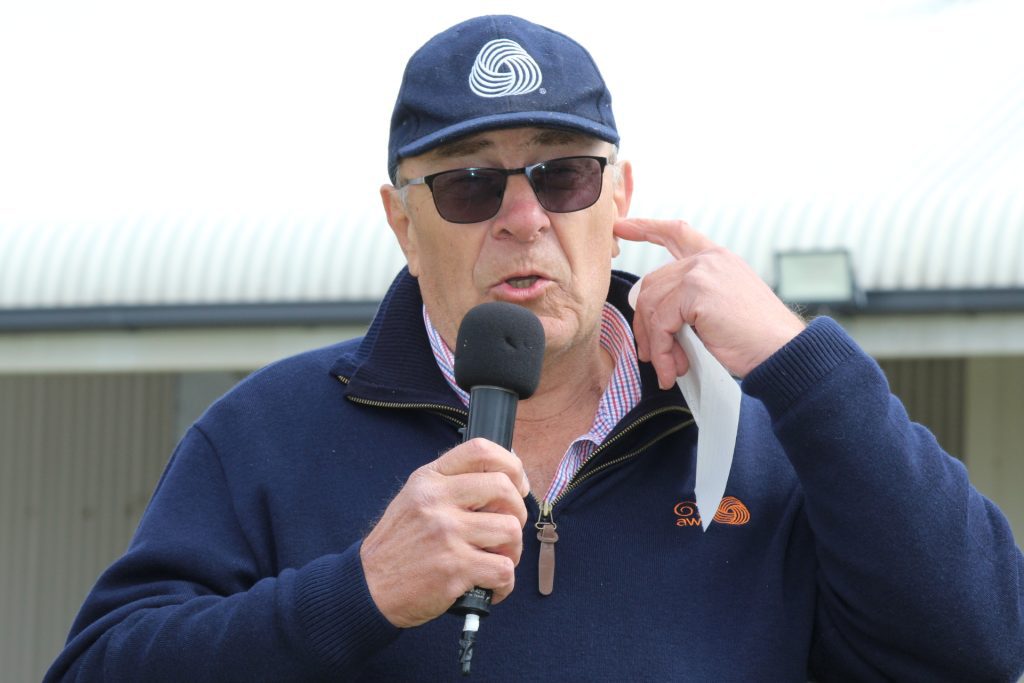
AWI chairman Jock Laurie at the Riverina Sheep and Wool Expo.
AUSTRALIAN Wool Innovation chairman Jock Laurie has doubled down on his message that all wool will continue to sell – mulesed or non-mulesed – in Merino field days across New South Wales, sparking outrage among peak industry body leaders.
More than a month after Sheep Central reported that Mr Laurie had told growers at the Australian Sheep and Wool Show in Bendigo to keep producing wool from mulesed sheep, the AWI leader again downplayed non-mulesed wool market preference feedback and price premiums.
The AWI leader repeated this message at the Riverina Sheep and Wool Expo at Conargo last week and at the South West Slopes Stud Merino Breeders Field Day at Harden yesterday he claimed all wool growers “have the same credentials”.
At Conargo, the AWI chairman also downplayed the industry’s grower attrition rate and non-mulesed wool market feedback that Australia was not a preferred wool source in comparison to South Africa and New Zealand — where mulesing has been banned – while neglecting to mention non-mulesed wool price premiums in his public presentation.
Mr Laurie also outlined why AWI was also not openly defending mulesing nor promoting non-mulesed wool production, while declaring that it does not matter how wool is produced and he had committed that AWI “would provide honest market advice back to the wool growers.”
At Conargo, Mr Laurie told the crowd he wanted to be very clear about the positive future of the Australian wool industry.
“I spent a lot of time hearing and listening to people about stories, people going in and out of the industry at the moment.
“But all the feedback we’re getting, all the messaging we’re getting, where the market is heading at the moment, is all putting a very positive light on the industry,” he said.
“I think people need to have confidence to speak confidently on behalf of the wool industry – history quite clearly shows that the market will turn around; it always has before and it will in future, and I think we need to have confidence as growers to be able to do that.”
Mr Laurie said the industry had taken some “very big lessons” from history, including the Reserve Price Scheme, and breeders should take credit for turning the Merino into a dual purpose animal for wool and sheep meat production, with lambs being sold for $300.
Mr Laurie said since November last year the wool price benchmark, the Eastern Market Indicator, had increased about 11 percent as of yesterday. There had also been cost reductions in that time, he said, including AWI investment in shearer training and given access for overseas shearers, putting “a lot of pressure on supply and demand.”
“And of course, we’re starting to see reductions and we’re hearing about reductions in the costs of shearing right across Australia, so that is good, on top of an increase in price, that’s a good thing.”
Mr Laurie said he needed to say that wool in Australia is produced in different environments, with each wool-growing family also having different debt loads and access to staff.
“Everything is completely different so we all have to have the ability to make up our own mind as to how we produce our animals – obviously within the legislation that’s sitting there at the state and federal government levels.
“And while we have that diversity the market is also exactly the same; the wool market itself actually creates tremendous diversity for wool and the product we produce,” he said.
“It does not matter how we produce it, wool is put up there and has competition.
“All of the wool that is put into the market is actually bought out of the market and so where I hear that there are sections that people don’t want, it is not actually supported by what’s happening in the market.”
“So we’ve got all the diversity around how we produce it, but at the same time we’re going to the market and all of those different types of wool are actually creating demand at a certain level in the market and we need to know that.”
Forget China’s IWTO statements, China is still supportive – Laurie
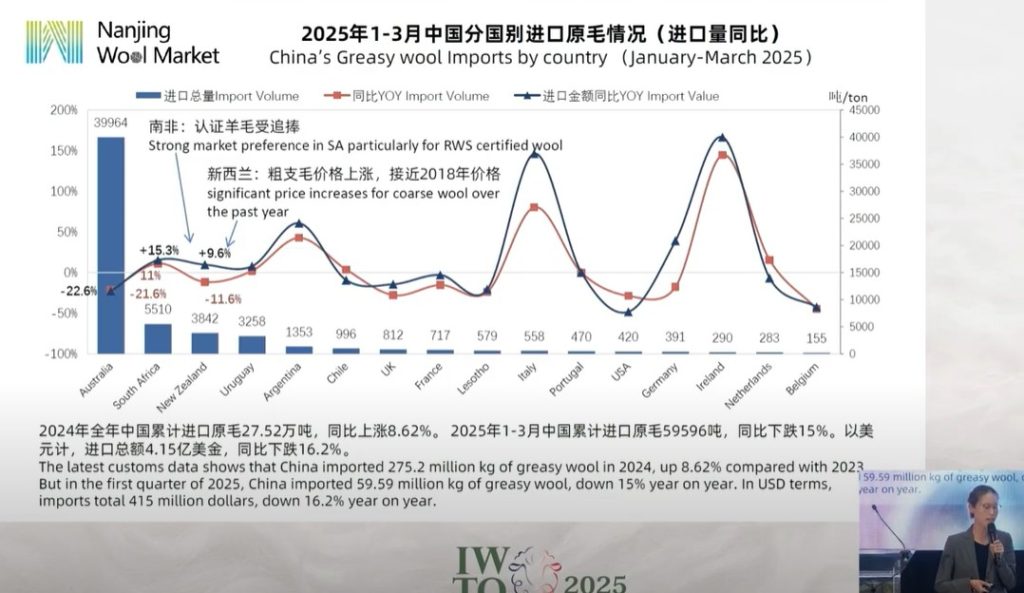
The Nanjing Wool Market slide at the IWTO Congress in France referencing the preference for certified non-mulesed wool from South Africa.
Mr Laurie also commented on industry discussions around statements made at and after the recent International Wool Testing Organisation Congress in France, when Australian industry leaders heard a Nanjing Wool market speaker outline a preference for certified non-mulesed wool from South Africa and New Zealand, over Australian wool.
“One of the commitments I gave when I took over this role was that we would provide honest market advice back to the wool growers,” Mr Laurie said.
“Certainly some of the comments that came out of the IWTO have got people nervous and what we did is go back to the people who made those comments to get clarity around exactly what they meant by those comments.
“And it’s been quite clear to us that the Chinese are still very supportive of the Australian industry,” he said.
“There are components of the Chinese industry that export into many markets around the world that require a level of compliance and that’s quite obvious and that’s just been supported.
“But there’s a lot of wool that goes back into the Chinese market itself that doesn’t require the same standards,” Mr Laurie said.
“So any advice I give to anyone is along those bounds; all of those types of wools, once again, are finding demand in the market and can be sold.
Mr Laurie said he had been advised that over the past 20 years there has not been a huge variation in the landed price of wool into China from Australia versus South Africa.
More confidence in the global industry
Mr Laurie said the market was flat at the moment and post-COVID, global wars, tariffs have been a problem for wool demand, but he said there was some surety now on what the US tariffs meant to China.
“And we’re getting into a position now where people have a bit more confidence.”
He said inflationary impacts and interest rates around the world are “starting to come off.”
“There is a whole range of things that are starting to look good, and one thing that we need in the wool market is confidence in economies and confidence in economic circumstances for people to then turn around and start spending.”
Mr Laurie said once woolen products start being shifted, the supply situation in Australia would create some tremendous opportunities.
“So what we’ve been doing in the last two or three years while that’s been happening is trying to make sure that we position wool exactly where it is, all of its natural strength, all of its environmental issues, its biodegradability.
“You’ve got to remember the debate that’s happening domestically and internationally at the moment is all about making sure that we are actually producing things that deliver good environmental outcomes.”
He said wool is in a good position to deliver to Europe’s Product Environmental Footprint legislation as a natural fibre with its biodegradability and environmental sustainability.
“So we continue to reinforce that in the markets around the world.”
Mr Laurie said AWI has also been actively involved in the debates and research around methane carbon to give growers the science and evidence to defend their position globally.
“So we will make sure that we will continue to do that and the company has been doing that for a long period of time.”
On the 60:40 marketing to research and development levy spend split, Mr Laurie also said the industry groups through the WICP and WCG had been asked what issues were important to them.
He said it became clear that “everybody” wanted AWI to defend the fibre, ensure proper labelling and understanding of environmental credentials, supported by science and rigorous assessment.
“We need to be in an environment where we can sell our product and make sure it is correctly labelled.”
“The second part of it is to take opportunities in markets that are out there to actually continue to sell product as we can and continue that market going over,” he said.
“Certainly the big opportunities have been in China over that period of time and China is now consuming up to about 50 percent of what they take over there, into the domestic market.
“So we know there is big demand and we’ve got to keep driving that.”
Shearer training aimed at keeping costs low
Mr Laurie said what was also really important to the wool industry was around shearing and making sure there were enough supply of shearers and wool handlers “so that we could actually be in a position where we could put pressure on and had a level of control over shearing costs, because they we had lost control of those.”
“So there has been a huge investment up to about eight or nine million dollars invested in that over three years doing a huge amount of training.
“The fourth thing was around research and I notice here today Dr Michelle Humphries who is the chair of the research committee and is around the research that is being done,” he said.
Mr Laurie said a lot of AWI’s research has been around production and productivity “and while we are not actually involved in that at the moment what has already been done is out there and being delivered in extension programs that are going back into the industry.”
He said finalization of the Merino Lifetime Productivity Project will allow research to go to the next level.
Mr Laurie said AWI is spending “somewhere around 55pc going back into defending our right to grow the wool and have it labelled properly, and making sure we are doing that research, selling the wool into markets that we can and actually have the capacity, doing the shearer training that we need to do to make sure that we actually continue supply, make sure that we doing the genetic research around flies …. sterile flies.
“So rather than have a 60:40 split around it, being in a position that we can actually sit down and do the things that are important to the industry.”
He said the final component of levy expenditure is maximizing the government contribution available for “claimable research.”
“And we make sure that we max out on that each year so that we get projects that are eligible for the research that’s assessed by the company and we make sure that we go and do that work, get the maximum out of the government – the government have been very good partners of the industry – and they will continue to be.”
Mr Laurie said AWI maximized the value from the grower levy and government contributions by going into the domestic and international marketplace by working with 87 different groups across the world, including governments, brand partners, retailers, processors and universities and other RDCs, including 10 projects with Meat & Livestock Australia.
“We will collaborate with anyone – anyone that we can get added value out of on your behalf we will.”
AWI needed a sound knowledgeable board delivering outcomes
He said many people are concerned about wool production coming down, but many are expanding their wool-growing capacity “because they can see the tremendous opportunities in the future” because they know demand will increase, although he later admitted production and prices would impact AWQI’s budget. Mr Laurie said wool growers also needed to make money and AWI had been around the world telling buyers that if the current price level continued it would drive change in wool production in Australia.
“Some of those groups now are getting concerned about where the wool supply is going to go, but the industry will respond to that in time and that will very much reflect the price that is given to them.”
Mr Laurie said the company had dramatically changed the way it does things, but it needed the support of the industry.
“If we don’t have the industry wanting to support their own company it makes it very difficult for it to operate.”
He said AWI had staff and management around the world “and just about on every project that we approve funding, it comes based on the best information, the best research that can be given to us.”
Mr Laurie also urged growers and breeders to talk to the current candidates for the 2025 election, including Drew Chapman and Michelle Humphries. Fellow election candidates Anthony Uren and Paul Swan, didn’t attend the Conargo field day.
“It’s very important that we get a good sound knowledgeable board that can deliver outcomes for wool growers and levy payers across Australia.”
AWI has dropped the ball on mulesing says grower
A local wool grower, Colin Bull, told Mr Laurie: “I think you’ve dropped the ball on mulesing from our point of view.”
He said people are being told to cease mulesing while AWI has not come out with an alternative to mulesing “which we need in this pastoral country”.
Mr Laurie said “our (AWI’s) position in mulesing hasn’t changed on mulesing at all.”
“Wool growers should be able to do whatever they want to ….
“As I say, there is a market for all wool and it is entirely up to you how you make the decision,” he said.
“Now if the industry wants to change that position it’s up to the industry to do that, AWI is a research company and we’re prohibited from doing anything in policy.
“So if the industry wants to go down that path they can, but as far as the company is concerned each individual wool grower needs to be able to make up their own mind,” Mr Laurie said.
“If you want to go to non-mules we will provide you the tools to go to non-mules, if you want to understand what’s happening in the market we’ll provide you with the information,” he said.
“We’ll provide you with all the information we possibly can to help you make your mind up, but the wool industry itself, all the wool growers sitting around here, are the ones that need to make the decision around where they want to go with mulesing or want to change their direction.”
“Our position hasn’t changed, let the industry make up their own mind about what they want to do.”
Mr Laurie said there were different ways to breed sheep, “but it’s up to the individual to make up their mind, it’s not for myself or for anybody sitting on the board to do that.”
No mention of non-mulesed wool price premiums
Mr Laurie significantly did not mention certified non-mulesed wool price premiums in his public presentation at Conargo or Harden, but later reiterated his position at the Bendigo sheep show when he told the Weekly Times that an analysis of certified wool prices compared to normal lines had shown there is no consistent price premium for non-mulesed wool.
And at the South West Slopes Stud Merino Breeders Field Day at Harden yesterday Mr Laurie said AWI was in the business of selling products against competition from synthetic fibres.
“And we in the industry need to stick together and make sure that we are promoting what we’ve got, the great thing that we have, which is wool and all of the attributes, the environmental attributes that are so important to fit in with exactly what people want.
“But we now need to be in a situation to take advantage of that and I’ve got no doubt we can,” he said.
He said there has been plenty of competition for wool in the market lately.
“All I can say is that all wool gets offered, all wool gets sold.
“We’re all here to produce the one product, we all have the same credentials, let’s just be proud of that and make sure that we go out and do that.”
Mr Laurie also again plugged the AWI board members at the field day, including directors George Millington and Dr Humphries, and other election candidates Paul Swan, Anthony Uren and Drew Chapman.
Mr Laurie AWI directors are “simply not policy people, policy people get picked up by the industry and taken by the industry.”
“We’ve got very strong obligations to make sure that directors are operating as directors, and so we can have all of the views on issues that we like, but in the end we’ve got to do our role as professional directors and make sure that we do that on a long-term basis.”
He said he honestly believed that the market is about to “boom”.
“So let’s have confidence in where we are, there’s a great future, I don’t think there is any doubt, and the people who have stayed in the game of wool production will most certainly reap the benefits in my view.”
It’s easy to understand the lack of confidence growers have with hopeless leadership by AWI. They are voting with their feet and leaving wool in droves …”but all wool sells.”
Less 90 million kg in 10 years. More than 26 percent. Hopeless.
So true, once again industry leadership is tone deaf to growers, who are paying their over-the-top salaries. Get into the real world of wool growers or resign and get out.