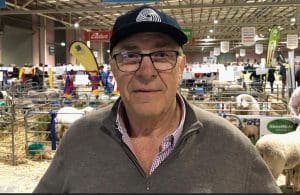
AWI chairman Jock Laurie in Bendigo.
AUSTRALIAN Wool Innovation chairman and non-mulesed wool grower Jock Laurie has defended encouraging a grower to continue to produce mulesed wool.
During a discussion with Sheep Central about industry confidence, Western Australian grower Michael Wright, told Sheep Central he spent an hour talking to Mr Laurie at the Australian Sheep and Wool Show at Bendigo last week.
Mr Wright is farm manager for Rhodes Pastoral’s 1000 bale-plus 20 micron Whitburn Wool operation in the state’s south-west.
The farm manager said he had found it “nearly impossible” to secure a direct manufacturer or wholesaler buyer for the clip. However, he discounted that the clip’s mulesed status and market signals of the preference for non-mulesed wool might be a price factor or an obstacle in obtaining a direct buyer.
He said he had heard about China’s Nanjing Wool Market telling the recent International Wool Testing Organisation Congress in France last month of its preference for traceable non-mulesed Responsible Wool Standard certified wool from South Africa.
No price incentive to stop mulesing – Wright
But Mr Wright said there’s no incentive to stop mulesing at the moment, price-wise.
“All it is is that you’ve got to do RWS, but there are other things that you can do without the mulesing bit in it.
“According to Jock Laurie, the biggest Chinese buyer didn’t give a shit whether it’s mulesed or non-mulesed, he just wants wool,” Mr Wright said.
“So, that’s from the horse’s mouth.
“I think there’s a bit of internal noise, not external, coming from shedder breeders and things like that more than anything probably,” he said.
Mr Wright’s relaying of the AWI chairman’s advice came despite Mr Laurie’s and previous AWI statements maintaining AWI is agnostic on the issue of mulesing and was not about telling producers what to produce.
In July 2021, Mr Laurie told Sheep Central: “AWI is a research and marketing organisation and shouldn’t be in a position where it is trying to determine or dictate what wool growers should be growing or should be producing, it’s their decision.”
And despite AWI’s own market reports referring to continued premiums for RWS-certified wool at Australian auctions, Mr Wright also said: “There is no reflection in price at the moment to make me want to jump and change (to non-mulesing).”
“According to Jock Laurie, he’s got mates that have stopped mulesing and now gone back mulesing, because they’re losing too much wool cut,” Mr Wright said.
“I don’t think it is going to faze China, from what I’ve been told.
“I’ve got to listen to what I’ve been told by the people who are in the know and there’s really no advantage in price at the moment, because there is no demand from the European people who are buying the finished garment, to say well I’ll pay $100 for that jumper because it is non-mulesed,” he said.
“The reality is the wool is the same, it’s just got a tag on it that says mulesed or unmulesed.”
In 2021, Mr Laurie stated he hasn’t mulesed his sheep for 15-16 years and in recent conversations has not said he had returned to mulesing.
But Mr Wright said he was “not sure” of Mr Laurie’s flock status in regard to mulesing.
Mr Wright chuckled when told there had been premiums for non-mulesed wool in the Australian market.
“I prefer to mules my sheep and get the wool cut, than lose the wool cut and get a premium on less wool, so you’re losing out.
“No one wants to buy a non-mulesed ewe here, so you’re going to get a discount there or find it hard to sell them, for starters.”
Talk about mulesing and non-mulesed wool is ‘white noise’
Mr Wright said he expected WA to lose more sheep producers, but he said mulesing isn’t the issue, it is the loss of the live export option.
“Mulesing seems to be a white noise that will come and go as it has been for the last 15-20 years.
“Show me the colour of the money, if it was $4 a kilogram you would do something, 50 cents, it’s not worth it,” he said.
“I doubt they will ban it – not in my career, I doubt they will ban it.”
He believed the wool market was just 100-150c/kg short of “all the white noise going away.””
But Mr Wright believed Australia needed its own certification system for wool as an alternative to RWS and also wanted to see figures on how many lambs were lost due to flystrike because they weren’t mulesed.
“And how much wool cut are they losing, how are their costs going up to get that (non-mulesed) wool with two crutchings and jetting, where we only crutch once?”
He said the Whitburn flock has sourced new genetics to improve carcase, but without losing wool cut.
What Jock Laurie told Sheep Central about non-mulesed wool premiums
Mr Laurie was asked if he had told any growers about China’s advice at IWTO on sourcing non-mulesed wool or about market premiums for the wool, and despite being asked twice, he did not say he had told any growers at Bendigo about the China advice on its South African RWS wool preference.
“All wools that goes into the market will get purchased or not purchased by whomever, so that’s been very clear,” Mr Laurie said.
“So the feedback we’re getting out of the market and from others is that they’re buying the (mulesed) wool.
“We can’t, and we’re not in a position where we can sit down and say well, that’s not the case, because that is the case – that’s the point I was making.”
“We regularly talk about the RWS premiums, but the RWS premiums sit at different microns and are not consistent,” he said.
“So we regularly talks about RWS premiums and the fact that people need to have a look at their wool micron and talk to their brokers and have a look and see whether the premiums are there for their type of wool.
“We know the (RWS) premiums are sitting in the market at 18.5-19 microns through to 20 microns (the Whitburn clip micron), there’s an RWS premium there, and at varying percentages, but at other microns there doesn’t appear to be a premium with RWS wools,” he said.
“We talk about that regularly, that information is given on a regular basis.
“The Chinese are getting into the market and they’re buying mulesed wool and that’s the biggest market signal you can possibly get as to whether they are in the market buying or they’re not in the market buying,” he said.
“And when it comes to a premium, we simply can’t pick where that premium is going to be, but what we do know is there is a premium for RWS sometimes, and then sometimes there is not a premium for RWS.
“And it’s really important that wool growers know, from our point of view, that we can’t tell them that there is going to be a premium, because it is up and down, it’s at different microns, it’s at different percentages,” Mr Laurie said.
“What they need to do is they need to have a look on-farm themselves, they need to make a decision whether they want to invest in RWS and whether they see value in it, but we are very clear about the fact that it’s there and I think that you can’t deny the fact there there’s a premium in certain sectors, but it varies, and that’s the trouble.
“So I’m not going to be in a position where I tell people to go, that they have to go RWS, on the proviso that there is a premium in the market.”
Just produce wool, no consistency in RWS premiums – Laurie
Mr Laurie maintained that he was “telling people to keep producing wool, the market will dictate what they want,” but he reiterated there is no consistency in the RWS premiums.
“And that being the case, we can’t tell people that they should be going RWS to pick up a premium, it’s their choice, a personal choice whether they want to do that or not and obviously they will talk to their brokers to see whether they see there is value and opportunity there – that’s the part that the brokers need to play.”
Mr Laurie rejected the notion that his advice to Mr Wright reflected AWI continuing to downplay non-mulesed wool market trend information while assuring growers that mulesed wool demand would continue.
However, AWI still has not released a report on a survey of consumer sentiments around mulesing and was allowed the change the scope of the study by DAFF to cover broader environmental issues, effectively muting the mulesing component.
Nevertheless Mr Laurie maintained that AWI regularly provided non-mulesed wool market and premium feedback and signals.
“John (AWI CEO John Roberts) talks about it regularly, I talk about it regularly, Scott Carmody talks about on a regular basis.
“But I’ve got to be honest with people and say that I don’t know where the premiums are going to be and I don’t know how consistent it’s going to be.”
Will AWI tell growers the Nanjing Wool Market prefers non-mulesed South African wool?
In AWI’s latest Beyond the Bale direct-to-grower publication there was no mention of the Nanjing Wool Market’s advice of a strong market preference for traceable RWS-certified (non-mulesed) wool from South Africa at the last International Wool Testing Organisation Congress in June, either from AWI CEO John Roberts or Mr Laurie. There has also been no media release from AWI on what this means for Australian wool production or marketing going forward, and the trend is not accounted for in AWI’s recently released strategic plan for the next three years.
“John was at the IWTO, I wasn’t there, you will need to talk to John about his report,” Mr Laurie said.
Sheep Central was told that the latest issue of Beyond The Bale had gone to the printers before Mr Roberts could report on the IWTO Congress.
Mr Laurie disagreed that AWI has been silent about the importance of the China market feedback at the IWTO Congress.
“I don’t agree with that, we talk about this with people on a regular basis.”
Mr Laurie said growers often asked AWI whether they should be mulesing or not.
“I say well, I don’t know, it’s your individual circumstances, you need to have a look at the market, you need to have a look at the premiums, you need to have a look at whether you want a premium or don’t want a premium, you need to talk to your broker.”
He said the Australian Wool Exchange reports regularly on non-mulesed wool premiums.
“I’ve been clear at just about every Woolgrower Industry Consultaton Panel meeting around where the market is, we provide the information that we’re getting.
“But in the end, the market will dictate what it wants and it’s not up to myself or anyone else to do that.”
Mr Laurie said it seemed Mr Wright had made his own mind up about what he wants to do.
“And that’s exactly what we want growers to do, we want growers to have a look at it and we want growers to make a decision on what suits them.”
Mr Laurie said he was “quite happy” to tell people he is a non-mulesed wool grower.
“It doesn’t worry me, but I also say to them, even if I’m non-mulesed, I’m not telling anybody else what they should be doing, that’s the choice I’ve made and when I speak at meetings I tell people I’m non-mulesed, so I keep that completely open and transparent.
“I’m non-mulesed, but I’m not going to tell people what they should or shouldn’t be doing, it’s not my role to do that.”
As to the reputational future of the Australian wool industry – partially mulesed and non-mulesed – Mr Laurie said the market will decide that question.
“The market will clearly tell you what it wants.”
He cited the breed dominance in the cattle market changing from Hereford to Angus over the past 30 years.
“That’s the market talking.
“So to answer your question, if the market doesn’t want the (mulesed) wool, they won’t buy it.”
Grower and breeder groups need to lead any change
Mr Laurie said the wool reputational risk feedback on Australian growers continuing to mules varied around the world.
“I do get feedback from people who say that, but I also get feedback from people who say it is not an issue for them.”
However, he said if there is going to be any change on mulesing and non-mulesed wool production “the industry needs to lead the change.”
The industry policy leaders – the grower and breeder groups, not AWI – need to set the direction in regards to mulesing, he said.
Mr Laurie is still confident that AWI is still agnostic on the issue of mulesing.
“Absolutely, we’re clear about the fact that there are markets for non-mulesed and mulesed wool, and when I get asked the question I say exactly that, because that’s the feedback we get.”
When asked if the AWI board was being influenced by the breeder bodies seeking to maintain bloodlines that require mulesing in parts of Australia, Mr Laurie said the sheep in Bendigo showed there has been a “massive transformation” toward plainer bodied sheep.
“The information we are providing is making people seriously consider their breeding options going forward.
“If you have a look at history the (Merino) breed has changed enormously,” he said.
“Wool growers are smart enough to make these decisions and I think they’re making the decisions, I don’t think there is any doubt about that.”
When asked if it was AWI’s responsibility to inform its shareholders of potential changes to RWS standards such as the inclusion of Ceased Mulesing wool, he said it could be shared with the grower groups.
However, Mr Laurie said he had been condemned for supplying non-mulesed wool market and demand signals.
“And if I go the other way, I get condemned for doing that.”
Significant 7-15pc premiums for certified non-mulesed wool
Australian Council of Wool Exporters and Processors president Josh Lamb said the premiums in the market at present are significant for certified (non-mulesed) wool from 7-15 percent.
“At a time of historically low prices, a premium of any kind is welcomed.
“To do this their clip needs to be integrity scheme certified and to achieve that they need to be non-mulesed.”
Mr Lamb said premium prices are often paid by China for certified wool, but they are actually driven by export markets i.e. Europe or Japan.
“That is semi-processed Australian wool re-exported out of China for further manufacturing elsewhere.
“Prices for Chinese domestic consumption puts a base under the market in the Australian sale room, but it is very price sensitive,” he said.
“Other downstream countries placing premium orders to China processors are what drives higher market prices.
“Increasingly that is mainly for certified wool.”
The real discussion needs to be about breeding Merinos that don’t need to be mulesed, with quality skins that don’t attract flies.
These sheep are available and are producing great results for those that are running them.
Any one can stop mulesing, but that doesn’t mean they should. Unfortunately for the good of the industry about 80 percent of the Merino flock are in this group.
I will say that those with the traditional Merino are tenacious and determined not to change.
Surveys have shown that 87pc of those who make the change to a modern Merino stick with the new Merino and don’t look back.
The work has been done, the modern merino is available.
Perhaps those producing the modern Merino should be able to retain the levy (wool tax) that they pay to do their own research and marketing as they are seeing very little progress from AWI.
The blind continue to be led by the blind.
This sounds like the same sort of “white noise” that preceded the legislated closure of the live sheep export trade.
We ignore the signals around mulesing at our peril. And if we’re not careful, all those waiting for non-mulesed market premiums will end up dealing with buyers that simply won’t buy mulesed wool.
“Be careful what you wait for…”
Strong points, Angus, and well made.
Markets can fail. Waiting for our market to decide is to give up control of our future. It’s not leadership, when leadership is clearly needed with the outcome likely to be either a failed industry or one that survives under increased government control; that is a mulesing ban.
My clear preference is for a grower-lead direction, centred around an animal that doesn’t need to be mulesed, with the best news being that the genetic solution is now readily available.
And here lies many of the issues the wool industry faces, no one can agree…
I believe strongly in the future of wool, but we don’t make it easy for ourselves