
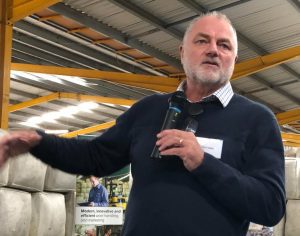
Dr Paul Swan.
AUSTRALIAN wool growers should vote to allow an increase in directors while the current board is dominated by growers and breeders, according to AWI director candidate Paul Swan.
Dr Swan said any effort by a sitting board to restrict the scope of skills and expertise at board level below what the company constitution allows is dangerous, antithetical to modern good governance principles, and should be rejected by the shareholders.
He said clauses 14.1 and 14.2 of the AWI Constitution requires a board composed of between 5 and 10 directors and gives the board the ability to appoint additional directors if required up to the 10 director upper limit.
“This right to add directors outside the normal director election process is granted on strict condition that these additional appointments are only valid until the next AGM, to allow the shareholders to exercise their right to elect their directors,” he said.
 “In other words, the AWI constitution obliges the board to have the appropriate mix of skills given the nature of the business, provides them the ability to add missing skills if identified, without exceeding board size limits, and makes sure that the shareholders get the opportunity to endorse or reject any board-added skills at the next election.”
Dr Swan said the board’s current skills mix is not aligned with the scope of AWI operations, the structure of the wool value chain, or even the relative spend on-farm vs off-farm.
“It is; however, aligned with preserving a status quo.”
Dr Swan believes AWI and shareholders should encourage more directors with a diversity of off-farm skills, and considers the current board is seriously lacking in international wool textiles experience, and science and product innovation horsepower.
On research, development and marketing
Dr Swan said it is critical AWI research, development and marketing is more deeply and narrowly focussed on what truly matters for industry survival and prosperity.
Heading his top three priorities for AWI RD&M is successful development and deployment of technologies and training that ensure the cost of wool harvesting to Australian growers declines in real terms for the foreseeable future.
Dr Swan said high and rapidly growing harvesting costs not only incentivise increasing fleece weights and so risk of breech strike in conventional Merino sheep, but they impact the industry’s ability to move away from reliance on surgical mulesing. He said ever escalating harvesting costs threaten the financial viability of wool production in Australia, and may undermine its ability to implement genetic solutions to surgical mulesing on a wide scale,” he said.
End reliance on mulesing
Dr Swan said mulesing is a reputational or market access risk to the Australian industry.
“Absolutely, especially to the extent that we have no credible plan to innovate our way around it.”
He believes the industry runs the risk of perceived industry inaction and growing reputational risk opening the door to imposition of state or federal-level regulation against mulesing. There needs to be successful development and delivery of technologies and training to end reliance on surgical breech modification, potentially including oral-delivery prophylactics.
“Australia’s reliance on surgical mulesing remains a major international reputational issue, undermining efforts to grow preferential demand for Australian wool, and providing easy targets for organisations ideologically opposed to livestock agriculture.
“It is also creating a real ‘wedge’ issue undermining industry unity, and feeding into agri-political machinations resisting meaningful dialogue, change, and even clear market reporting.”
He said AWI’s focus needs ensure clearer communication of market signals relating to mulesing and its impacts on our downstream partners, encourage industry cohesiveness and strategic commitment to ending the practice via cost-effective alternatives, assist development and commercialisation of alternatives to current practices and collaborate effectively with other industry bodies to encouraging NWD uptake, use of effective pain relief and development of low cost traceability and practice verification systems.
Need for well-leverage advocacy research
Dr Swan said there also needs to be effective, well-leveraged fibre advocacy research combatting misleading narratives about wool’s ecological, welfare and product wellness attributes.
He said the divisive nature of grower industry politics acts as an impediment to cohesion around industry priorities, and AWI’s direct election board model and short levy poll cycle combine to lead to dilution of focus and reactiveness to short-term political interest – with major impact on the ability of the R&D team to plan, initiate and generate effective outcomes and partner effectively with other RDCs.
“Against its obligations in this area, I believe AWI’s stakeholder consultation efforts are characterised by an over-riding political sensitivity to the interests of the traditional stud breeders and the ‘freedom to farm [mules] however I choose’ mindset – a governance failure.
“A case in point was the ‘man in the mirror’ scandal, where legitimate CEO-approved stakeholder consultation for the genetic program was seen as a threat by the chair of AWI. “
Dr Swan said the industry’s top two opportunities include the rising affluence and sophistication of China, India among others, and their changing population dynamics, representing a growing market for lightweight, base-layer capable products much less reliant on the EU-zone or North America.
The other opportunity is the growing realisation that the IPCC-led eco-accounting and finalisation industry is not contributing effectively combatting climate change, and that livestock agriculture and the products therefrom represent a major global opportunity for proactively driving both sequestration and GDP.
“In relation to the greatest opportunities, I would work to ensure we focus on the smallest number of the most important activities which convert these opportunities into sustained new demand for our fibre, and diversification of our markets.”
Click here to read Dr Swan’s responses to WoolProducers Australia and to the Sheep Central questions.
The responses from the other AWI election candidates — Chris Mirams, Michelle Humphries and Anthony Uren — will be published on Wednesday.
HAVE YOUR SAY