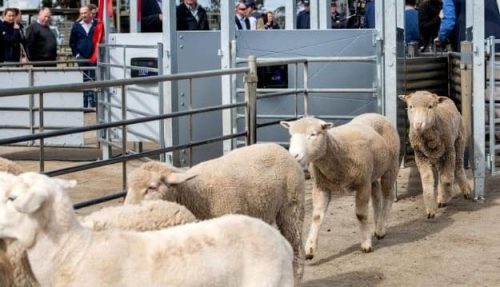
Sheep running through an EID ear tag scanning system in a saleyard.
NEW South Wales saleyards are playing a key role in the successful rollout of electronic identification for sheep and goats, with strong uptake across the supply chain ahead of mandatory requirements from 1 January next year, according to NSW Agriculture Minister Tara Moriarty.
In line with the nationally agreed implementation program, all sheep and goats in NSW must have an EID device applied before leaving any property, regardless of their age, by 1 January.
Electronic identification is one of the key measures in the NSW State Government’s $1 billion biosecurity budget and a major tool in protecting the state’s $25 billion primary industry sector, Ms Moriarty’s office said in a media release.
The minister’s office said recent sheep sales at Griffith Saleyards have demonstrated the willingness of industry to prepare for the transition.
An early September sale yarded 16,000 sheep, four times the average yarding of 4000 head, due mainly to dry conditions, with all sheep carrying compliant National Livestock Identification System (NLIS) tags.
Importantly, more than 13,000 of the younger sheep presented for sale were already fitted with electronic identification tags, highlighting the strong uptake by producers and the work of agents and saleyard operators to ensure livestock arrive with the correct identification, the office said.
Despite NSW Farmers earlier this year supporting a two-year delay in final implementation, the Minister’s release said the Griffith Saleyards result reflects a broader trend across NSW, where producers and industry have embraced EID. Almost 25 million EID tags have been purchased since mandatory tagging requirements commenced in January 2025.
NSW saleyards have been at the forefront of the transition, with more than 5.5 million electronic identification tags scanned since January 2025. In 2026, around 73 percent of all sheep and goats moving through NSW saleyards were already equipped with an EID device.
The NSW Government, supported by the Federal Government, has committed $41 million to implement the nationally mandated sheep and goat eID system, the largest funding commitment of any state or territory.
The NSW sheep and goat industry contributed $2.74 billion to the state’s primary industry total Gross Value of Production of $25 billion in 2024-25. The NSW Government said it has supported producers, saleyards and supply chain participants through tag discounts, infrastructure rebates and education programs to help drive the transition.
Griffith livestock agent Rod Evans said as a livestock agent, his clients were using the EID tags as an effective tool to better track weightgains of individual sheep to see how their flocks are performing in real-time.
“If we’re getting positive results from a producer’s particular line of stock, we can target them into specific markets — it’s very good that way. The detailed information also helps us with our forward contracts of livestock going to abattoirs and has taken a lot of guesswork out of the process,” he said.
“We encourage producers to get on board with EID so they can use the data to benefit their business, comply with requirements, and reduce costs at the saleyards if their animals are not properly tagged.”
NSW Agriculture minister Tara Moriarty said saleyards were a critical link in the livestock supply chain, and the strong compliance being seen demonstrated the collaboration between producers, agents, saleyard operators and government.
“Having more sheep and goats electronically identified improves our ability to quickly trace livestock movements, which is essential when responding to emergency animal diseases or other biosecurity threats.
“NSW is building a more resilient, traceable and biosecure sheep and goat industry that will support producers, saleyards and regional communities for years to come.”
HAVE YOUR SAY