
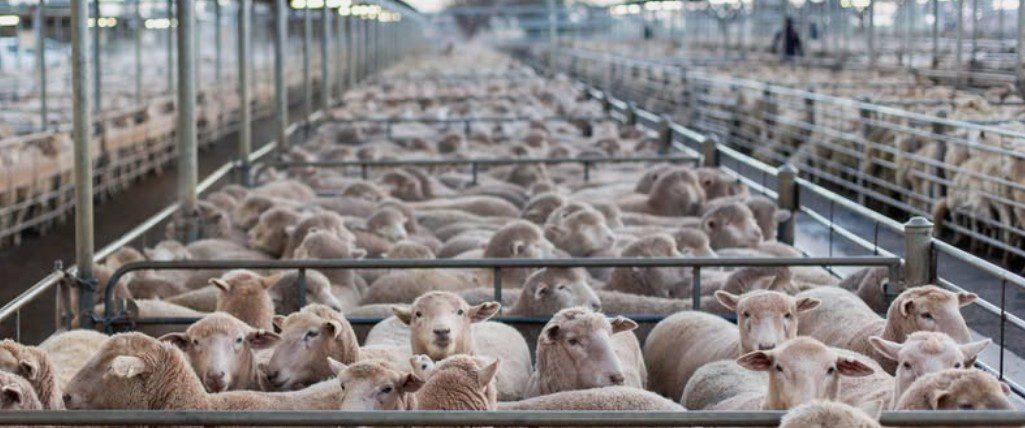
Wagga lamb prices surged $20-$44 this week. Image – Riverina Livestock Agents.
LAMB prices surged $20-$44/head at the Wagga Wagga saleyards yesterday, buoyed by strong competition from Victorian processors, a heavier yarding, forward contracts and lower year-on-year supply.
MLA National Livestock Marketing Service reporter Jenny Kelly said it was the largest one-day price spike ever in the Wagga market, with southern processors dominating across all trade and export classes, and particularly for 26-30kg cwt lambs.
 Wagga’s lamb run of 49,000 this week — down about 7000 head on the same sale 12 months ago — and not helped by recent rain, combined with intense competition creating the sudden price rise, has highlighted the level of processor concern about being short-bought for plant capacity to meet strong overseas and domestic demand.
Mutton prices reportedly approaching and exceeding 900/kg at Griffith and Wagga also points to processors competing more strongly for sheep meat per se to supplement killspace.
Despite reports of variable but mostly lower lamb marking percentages and high mutton prices leading to higher ewe sales to repay debt and defray feed costs, some south-west Victorian stock agents remain confident that good supplies of new season lambs will come forward in the next few months.
However, agents elsewhere note a generally lower turnoff of quality lambs into saleyards after increased early selling of light lambs to restockers and export, especially online, and increased shearing of secondary lambs for feedlotting/crop backgrounding as pointing to a smaller, shorter spring flush and a bigger turnoff of shorn finished lambs next autumn. In August, September and October, Riverina agents were forced to sell thousands of immature lambs due to season failure.
The recent improved prices for trade and heavy lambs in saleyards, and revived restocker interest, following forward contracts of $10.40-$11/kg for lambs for November-December and $10.80 for early January delivery have been perceived as reflecting processor and supermarket concern about future supplies and a fear of being short-bought.
The National Livestock Reporting Service’s heavy and trade lamb indicators have been kept below $12/kg for the past two weeks, but this week’s price increases at saleyards have turned the indicators around to track toward $11/kg (trade lamb) or above it (heavy lamb). The mutton indicator is tracking well above $7/kg.
Hamilton district agents confident on numbers
Southern Grampians Livestock director Heath Templeton thinks there are areas that might supply fewer lambs this year “but I don’t think it is here.”
“For every one that is down, I’ve got one that is up.”
And he said at weaning, most producers’ lambs are 5 kilograms heavier than last year, and some have been up to 10 kgs better.
“I reckon we will kill a larger portion.”
He said if the store lamb price stays above $5/kg liveweight he doesn’t see many producers shearing and holding lambs over to feed for early 2026 sales.
“I think a lot of people would prefer to take the money ($200 for a store lamb) and consolidate, and pay off a few bills from the last two years of pain and hope we get an early break and prices stick around.”
He said the recent dip in saleyard prices was due to supply coming on in other areas of the country.
Mr Templeton said high prices need to be sustainable for farmers.
“If we can get a good sustainable price where farmers can make $10/kg-plus and processors can make money that’s our ideal world.
“If they’re not under pressure at $10.50/kg then we’re happy.”
LMB Linke agent Bernie Grant also believed his clients’ spring lamb numbers would be similar to last year. Although some producers had fewer ewes, their marking percentages improved. He didn’t expect the spring lamb turnoff to “crank up” until late November, about a week later than usual, but he said producers would have a higher percentage of heavier killable lambs — 70-80pc – with fewer shorn and held over for next year.
Hamilton saleyard’s lamb numbers are down about 1000 on the last sale in October last year, but the main flush is expected in November/December, with agents predicting most lambs will be killable with fewer store lambs, although some producers have already shorn lambs.
“A lot of people will sell because if a lamb is worth $150-$200 as a store lamb they’re just going to sell it,” Mr Grant said.
He believed there would still be plenty of lambs coming out of feedlots in the autumn.
Mr Grant said processors and supermarkets issuing forward contracts wanted to secure lambs to shore up killspace.
“They haven’t been able to do it.”
He said south-west Victoria and lower south-east South Australia were likely to be the only areas with good numbers of new season lambs later this year.
Ballarat lamb numbers are lower
At Ballarat, Charles Stewart and Co agent Jamie McConachy said lamb numbers are already down. This week’s sale yarded 15,494 lambs, about 10,000 lower than at the same time last year.
“The main contributing factor is lack of ewes and it has finally caught up with us,” Mr McConachy said
“We knew it was going to happen and all of a sudden it is really happening.
“It’s been a very very slow October, normally we go up 5-10,000 every week in October and that hasn’t been the case,” he said.
Mr McConachy said AuctionsPlus has been full of lambs for six weeks, with large numbers of immature lambs hitting going to restockers, feedlotters and backgrounders rather than processors.
He expected to see an increase in supply around Easter next year when light lambs sold prematurely to restockers and feedlots come onto the market again.
“You might see a price correction then, we are not expecting a price correction pre-Christmas based on the contracts that fell in our laps last week.”
Mr McConachy said it is uncommon for $10-$11/kg contracts to be offered in the peak of the season.
“This year they’re nervous on supply so they’ve issued contracts to try to secure numbers.”
Processors push prices over the $12 mark
Riverina Livestock Agents director James Tierney said export and domestic processor buyers competed at Wagga Wagga like they were short of numbers this week.
“It was everyone bar the supermarkets.
“It was bloody dear, our lambs were deadset over $12/kg.”
He said although many believe the southern lamb turn-off will be the savior, he believed it will be hard to source good lambs in December-January.
The industry was already in a short-supply situation and although February-March-April have always been good supply periods, “and then look out after that, it will get serious again I would have thought.”
Wagga Regional Livestock agent Isaac Hill said “it could be harder for buyers to find good lambs in the next little while than easier,” with some Victorian processors fielding two buyers at the Wagga sale.
“They’re short, they are short of lambs.”
Elders livestock manager at Bendigo Nigel Starick said the state of the lamb market in January will depend on what Victoria’s Western District will be able to produce. He said Bendigo lamb numbers have been similar to last year, with few producers selling off ewes and saleyard throughput boosted by northern lambs.
“We’re pretty much on par if not better than this time last year.
“Bendigo saleyard volume is up year-on-year; we’ve got a lot more sheep out of the Riverina into Bendigo last year went to Wagga.”
He said Ouyen’s numbers have also been boosted recently by more South Australian lambs.
Before this week’s prices rises, Nutrien national livestock director Mark Barton said domestic and export processors were trying to shore up lamb supplies at the moment, but had been buying hand-to-mouth to avoid getting “too long” at high prices.
“They were hoping from a processor point of view that they might see the market come off a little.”
Mr Barton said the season had not allowed big lines of heavy quality lambs come forward from New South Wales. He said most of his clients across NSW — between Goulburn, Young and back to Wagga — have said their lambing percentages were down on last year, but have been good further east.
“I’ve have producers with crossbred ewes making between 60-80pc and a lot of blokes are saying the same.”
He said it was plausible that lamb numbers across Victoria and NSW could be 20pc down, but he didn’t believe the impact of the lower marking percentages will be seen until February-March next year.
Mr Barton said more producers would have taken the contracts offered if $12 has been offered and based on supply and demand there was a chance of lamb prices pushing above $12/kg again.
Costco, US prices and demand
After the recent dip in trade and heavy lamb prices below $12/kg, Sheep Central investigated reported US consumer resistance and weakening demand from Costco — Australia’s single biggest buyer of lamb in the United States.
One processor said Costco was offering tender prices that were 20pc below what many processors needed and because of this would have difficulty sourcing its requirements for Christmas.
“There is a 15pc disconnect between lamb prices and the current world market and all small stock processors will be in a terrible financial position for the first quarter of this financial year.
“So it is not surprising to me that lamb prices need to come back and with extra supply that should happen, (but) it will still be very good for producers.”
However, an eastern state processor told Sheep Central the current lamb prices had forced Costco to look for lower-cost suppliers able to still extract a viable margin from its tender price despite the current Australian saleyard prices.
“They have realigned who they work with.”
Global AgriTrends analyst Simon Quilty said wholesale and retail pricing is very firm in America at the moment.
“What we’ve found is that lamb retail pricing (across all lamb sold) in July was US$8.99/lb (A$30/kg) and in August it went to US$9.17/lb (A$31/kg) and in September it held constant.”
He said Australian lamb in the US has been high-priced for some time as a premium product.
In September the comparative beef retail price was US$7.39/lb, fresh chicken was US$3.21/lb and fresh pork at US$3.30/lb.
“Lamb has consistently traded at a premium for this entire year.
“In actual fact our volume at these prices continues to rise.”
Mr Quilty said wholesale prices in America have been strong and continued to get stronger.
He said the data would imply that if demand and volumes continue to rise, and prices continue get stronger or hold firm, lamb prices dropped in Australia recently because of an increase in supply allowing more selection.
“This (the recent price drop) has not been driven by lower global prices, this has likely been driven by extra supply in Australia.”
However, Mr Quilty said lamb shipments into America in August and September fell away.
“We were consistently sending 3500-4000 tonnes a month and then as supply has tightened in Australia that fell to 2500 tonnes a month.
“That’s just added to the tightening of supplies in America, and in terms of why wholesale and retail prices remain firm, is that the number one supplier in Australia has really slowed down shipments due to lack of supply, not because of lack of demand.”
Mr Quilty believed any increase in lamb supply would be short-lived in Australia and once through the flush, lamb prices will start to move higher again.
“I think we are probably talking in Q1 that that’s probably more likely, but it may come earlier.
“It may takes us by surprise by December that there are not the numbers there that we thought,” he said.
“So either way it is probably going to be the back end of this quarter or the front end of the next quarter that supply starts to tighten again.”
Mr Quilty said there would be a seasonal lift in demand for the Middle Eastern bag lamb market in coming months, combined with restocker demand for feedlotting, would restrict trade and heavy lamb supplies.
A comprehensive description of the current situation.