
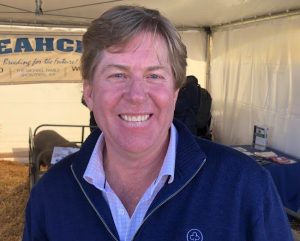
AWI director candidate Anthony Uren.
MULESING will be a reputational and market risk for the Australian wool industry as long as there is disunity and dysfunction, and the issue is debated publicly, according to Australian Wool Innovation director candidate Anthony Uren.
Among several questions from Sheep Central, Mr Uren was asked if he considered “continued mulesing a reputational or market access risk for the Australian wool industry, or a practice justified for lifetime animal welfare, and is any action needed?”
The South Australian sheep operations manager said it is extremely important that all participants in the mulesing conversation, understand and respect the roles that representative bodies play in advocating for the industry.
“AWI’s role is to invest in research and development that lifts productivity on farm and throughout the wool supply chain, and secondly to invest in projects that create demand for Australian wool, as stated in the Statutory Funding Agreement.
“Policy development and regulation is the remit of others, not AWI,” he said.
 “While ever there is disunity and dysfunction within our industry and we thrash out our views and debate in public forums on this topic, there will no doubt be reputational and market access risk for the Australian wool industry.
“I have oversight and experience across both mulesed and non-mulesed flocks, and I empathise with arguments on both sides of this challenging debate,” Mr Uren said.
He said the Australian wool industry is a broad church, and Australia is a vast continent with differing environments.
“My lived experience, gives me absolute confidence to say that they all have very different challenges, that are not solved with the one simple solution.”
Mr Uren said while the collective industry navigates a path on mulesing, he believed it is AWI’s role to ensure growers are receiving timely, accurate market signals and supply chain intelligence that allows growers to inform their own decision-making processes based on fact.
“It is then incumbent on AWI to ensure wool growers have the tools and knowledge to maximise production in which ever system they choose.
“It is only through balanced, rational discussion and collaborative problem-solving, with AWI as an active participant, can a united industry successfully navigate this challenge and regain control of the narrative on mulesing and ultimately a solution.”
AWI directors have other skills
Mr Uren believes it is disingenuous to label the AWI board is dominated by Merino breeders and growers and should it somehow encourage more directors with a diversity of off-farm skills?
“All of the current directors and standing candidates have a far greater skill set beyond the statement.
“There are significant business management and business development skills, marketing, ag tech, veterinary science, animal welfare, policy development and stakeholder engagement skills,” he said.
“As well as wool brokerage, logistics and supply chain relationships and engagement.
“The benefit is, that these skills are held in conjunction with the knowledge of wool growing, which is a strong foundation from which to stand.”
Mr Uren said AWI and the industry should absolutely encourage a diversity of skills.
“The Board Nomination Committee process is independent and guided by the existing AWI Board skillset and the independently prepared skills matrix.
“This matrix, is evaluated and updated when the skills mix of the board alters and the demands of the company change,” he said.
“The BNC also has the opportunity to advertise widely for candidates who specifically fit a desired skill set, and this has been practiced.”
Mr Uren said it is important to remember that the process to become a board member of AWI is rigorous, that for most nominees, involves gaining the signatures of more than 100 registered growers, independent Board Nomination Committee BNC face-to-face interviews and referee checks.
“It should be noted that WoolProducers Australia is external to the AWI election process.
“However, it is important they engage with wool growers throughout the election, choosing to follow a process of asking candidates to address a set of pertinent questions.”
Mr Uren said he has been fortunate to receive recommendations from the AWI Board Nomination Committee and the WoolProducers Australia board as a preferred candidate for the 2025 election.
He said it is imperative that all shareholders and levy payers engage and vote in the future of their industry.
“Voting ensures that the AWI board reflects the views and interests of wool producers, helping shape the future direction of the Australian wool industry.
“The more people that engage in the voting process gives a greater level of integrity and confidence in the result.”
On AWI board size
Mr Uren believe shareholders should vote to maintain the current number of directors on the board.
He said seven directors is an adequate number to achieve the breadth of skills and experience required to effectively manage the company.
He said he perplexed as to why the constitutional resolution to maintain the current board size has become an issue at this election.
“Of all the times to seek for an increase, in a time where the wool industry and the AWI business are financially constrained.
“I believe it would be a misuse of funds to engage more directors to the board, when that money can be better invested directly in the business to drive better R&D and demand creation outcomes.”
Mr Uren, long with fellow candidates Dr Michelle Humphries and Chris Mirams, has declined to share his responses to WoolProducers Australia questions around industry threats, priorities and opportunities; and strategies for an effective relationship between AWI and WPA and for effective consultation between AWI and industry.
Mr Uren said out of respect for the WoolProducers Australia board and its recommendation/decision-making process, he will not be providing Sheep Central with his responses to the WPA questions.
WoolProducers Australia advised the AWI director candidates that WPA would not be releasing their responses to its questions and told Sheep Central it would have to ask each candidate for the responses. Candidates Dr Paul Swan and Drew Chapman have provided their responses to the WPA questions.
Click here to read Anthony Uren’s full responses to Sheep Central’s questions.
HAVE YOUR SAY