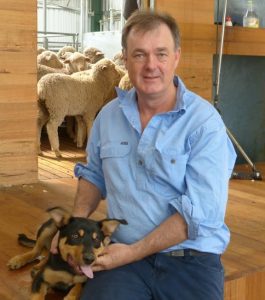
 AUSTRALIAN Wool Innovation director candidate, consultant and grower Chris Mirams, supports the current size of the AWI board and skills search process, and believes an immediate cessation of mulesing would be an animal welfare disaster.
In his responses to Sheep Central questions, the successful skills-based candidate said it is critical for the future of the wool industry that AWI shareholders engage, vote and appoint directors with the appropriate skills, knowledge and experience.
“AWI shareholders are currently being asked to vote on who they would like to see on their board.
“AWI is an international innovation company with a budget of over fifty million dollars, investing in research, extension and marketing that affects the prosperity of thousands of wool producers and their communities and the future of a multi-billion dollar export industry,” he said.
Mr Mirams said the role of a company director is a senior leadership position that requires a very specific set of skills and knowledge. They include :
- A passion for the industry and a demonstrated ability to lead.
- Significant previous board and/or corporate experience.
- Expertise in corporate governance and risk management.
- Financial literacy.
- Ability to think systemically and make critical decisions.
- Excellent communication skills and an influential network of stakeholders.
AWI board size is ‘appropriate’
On whether shareholders should vote to increase the size of the seven-director AWI board, Mr Mirams said AWI “is a skills-based board.”
“The AWI constitution allows for between 5 and 10 directors.
“Currently there are seven positions,” he said.
“This number is appropriate for the scale and financial circumstances of AWI.
 “What is more important than the number of board members is their individual capability and that they are purposefully selected to collectively possess an alignment of values and the range of skills and experience required for the board to fulfill its role,” Mr Mirams said.
“That’s the role of the (AWI) Board Nomination Committee.”
Mr Mirams did not answer whether he thought the AWI board is dominated by Merino breeders and growers or should encourage more directors with a diversity of off farm skills.
“To maintain a high performing board requires directors with an optimistic, inquiring and collaborative mindset, diverse skills and perspectives, who act with integrity and discipline, with a strong commitment to the company and the industry’s success,” he said.
“As an innovation company, the AWI board also requires directors with lived experience in research, extension, adoption, marketing and market access to lead the conversation.
“To achieve this not all directors will be wool growers; however, wool growers who have the appropriate skills are highly desirable.”
Mulesing is a complex issue
Mr Mirams was asked if he considered continued mulesing a reputational or market access risk for the Australian wool industry, or a practice justified for lifetime animal welfare, and is any action needed
“Mulesing is a complex issue,” he said.
“The national flock continues to evolve to a plainer bodied sheep and there are a growing number of producers who have made the substantial genetic and management changes to be able to cease mulesing.
“The practice of mulesing carries reputational, market access and political risk; however, mulesing is still an essential procedure for most producers and an immediate cessation would cause an animal welfare disaster,” he said.
“It is not AWI’s role to determine whether producers mules their sheep or not.
“AWI’s role is to provide transparent information to inform producer decisions and to invest in technologies and proactive extension programs to improve animal welfare, including programs tailored to enabling producers to reduce their reliance on mulesing.”
Process was professional and rigorous
In his responses to Sheep Central questions, Mr Mirams said the pathway to being recommended for the skills-based position on the AWI board came through an extremely rigorous process managed by the independent chair of the board nomination committee and an executive search agency.
“The board identified a specific set of governance skills and extensive prior experience they view as critical for the board.
“The process was professional and rigorous, including conversations with the search agency, written application, BNC interview and three referee checks,” he said.
Mr Mirams, along with fellow candidates, Dr Michelle Humphries and Anthony Uren, has declined to share his responses to WoolProducers Australia questions around industry threats, priorities and opportunities; and strategies for an effective relationship between AWI and WPA and for effective consultation between AWI and industry.
“I agree with WPA being engaged with the BNC process; however, I disagree in principle with WPA running a quasi-selection process.
“Out of courtesy I did respond to their questions,” he said.
“I have decided not to forward the document as it was specifically directed to WPA.”
WoolProducers Australia advised the AWI director candidates that WPA would not be releasing their responses to its questions and told Sheep Central it would have to ask each candidate for the responses. Candidates Dr Paul Swan and Drew Chapman have provided their responses to the WPA questions.
Click here to read Mr Mirams full answers to Sheep Central’s questions.
HAVE YOUR SAY