
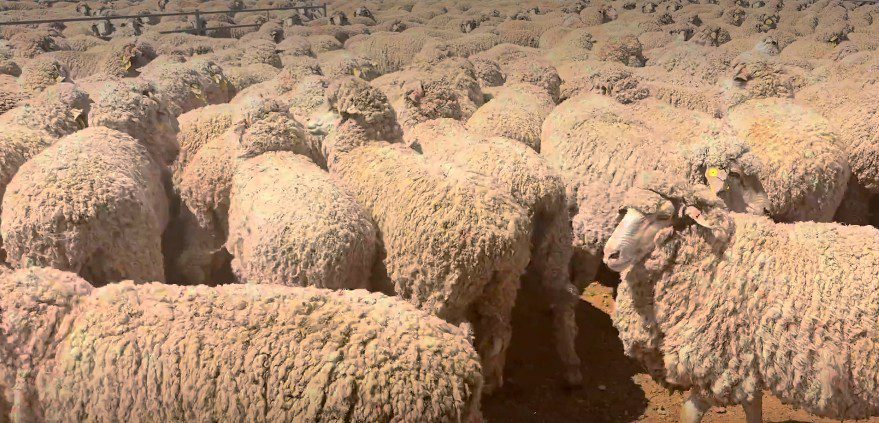
The Condobolin wethers at side sampling in mid-February. Image – AMPT.
THE latest shearing evaluation within Australia’s biggest Merino wether production trial next week is coming at a critical time for the historically low national flock.
The shearing will take place near Wagga Wagga next week and Australian Merino Production Trial convenor Craig Wilson said the event has potential to give the industry direction for the future.
“It is seriously the first time ever that you can look at the correlations between intramuscular fat, fibre diameter, fleece weight and yield.
“It has never really happened that you’ve had a commercial trial that represents so many different bloodlines, with independent protocols, data collection and analysis,” he said.
For the first time every Australian state has wethers in the trial, with 74 teams, including sheep from four of the top volume wool growers, with 900 wethers run at Condobolin and 300 at Temora, he said. Click here to see videos of the wethers at fleece side sampling last months.
“The trial represents about 350,000 ewes on those growers’ farms.”
Mr Wilson said the wethers will be trucked to the ‘Glenmoira’ shearing shed at the Kooringal Horse Stud’s Harefield property on the 10th, 11th and 12th March.
The difference this year is that the two sites are linked, with six wether teams having sheep at both sites, he said.
“What that means is that we can assess the environmental variability between the sites.”
The brothers of the wethers to be shorn were assessed over the hook last August. The 980 wethers averaged 29.5kgs carcase weight after processing at the Fletcher International Exports plant at Dubbo, and the carcases were measured for intramuscular fat for the first time.
“They came back with an average value as lambs of $360, including a $19 skin.”
Mr Wilson said the really interesting part of the trial will be looking at the feedlot performance of team wethers and comparing the fleece value of their now older brothers.
“We will have teams that will average eight kilograms of wool at 17 micron at 11 months, and their brothers have dressed 33kgs on the rail.
“There will be at least 100 percent difference in the fleece value between these teams and when you bring it back to net profitability it’s a lot more than 100pc,” he said.
“When you look at the IMF data and the relationship between fibre diameter and a raft of different things, it says that there is absolutely no reason why you can’t have a good eating quality carcases on a wool sheep.
“That’s exactly what the data says,” he said.
“We had teams of wethers that averaged 6-6.5 for IMF and I know, because I know their history that they will do exceptionally well on the wool side of it, and that’s been achieved almost randomly.”
Mr Wilson said the tragedy is that too many Merino studs did not know the genetic capacity of their sheep for meat and wool production.
“This trial doesn’t measure indexes, it measures money, so to all those guys who say data doesn’t work, put your sheep in the trial and prove it.
“We’re not measuring what the indexes are and it doesn’t matter what your pedigree is.”
Mr Wilson said the trial is not about winning or losing.
“When people ask me who is the winner, I tell them the bloke whose wethers ranked last, because he’s got the most to gain.
“It’s not about winning and losing, it’s just understanding what the capacity of your genetics is,” he said.
Mr Wilson said the Condobolin wethers were on grazing crops for their first four months to allow a comparison with the wethers in the feedlot, whereas the Temora wethers have had a harder run. The Condobolin wethers are averaging around 69ks versus 63kgs for their Temora counterparts.
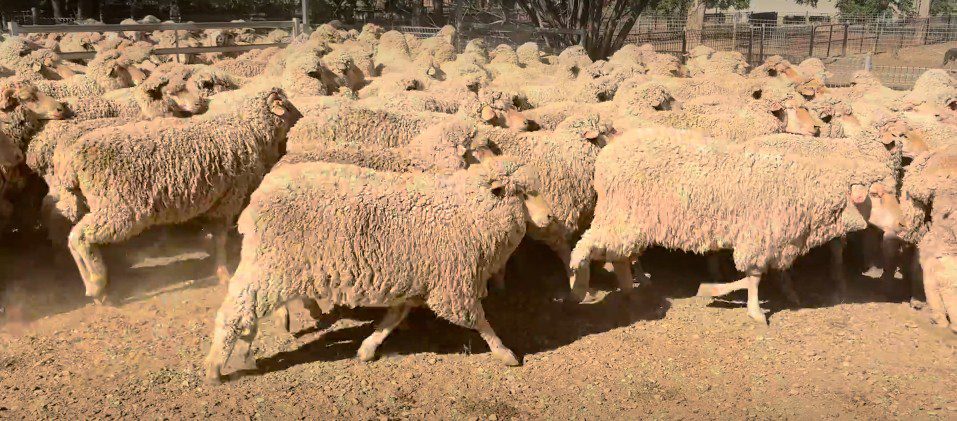
The Temora wethers in mid-February. Image – AMPT.
Fletcher still major backer, but MLA has come on board
Mr Wilson said the main supporting partner of the trials is Fletcher International Exports and the processor is backing the running of some trials in Western Australia in November-December this year.
“Without Fletcher’s support we couldn’t do what we are doing.”
But he said Meat & Livestock Australia is now supporting the trial financially and Australian Wool Innovation has also indicated it wanted to attend the shearing evaluation.
“I think what we are doing is looking forward into the future and certainly the commitment from Fletcher and MLA is for the future and for the longer term.
“MLA is seeing that the information coming out of these trials is obviously commercially relevant.”
Mr Wilson said the trial is not about the wethers themselves.
“It’s about the production of the ewes at home, that’s what it is about.”
It offered insights into how different genetics could efficiently produce meat and wool.
“In the meat side, there was six percent difference in the dressing percentages between the teams all run together.
“People have to understand what makes them money, and that’s probably different in different regions,” he said.
“What we are clearly highlighting is the advancement in the Merino industry in the last 20 years and I’ve been running these trials for 20 years.
“I’ve got 20 years of data run across eight or nine different environments.”
An industry dinner will be held on Tuesday 10 March at the Champagne Bar, Murrumbidgee Turf Club, Wagga Wagga.
To RSVP for the shearing evaluation and book tickets for the dinner click here.
I’m looking forward to seeing all the data calculated for meat and wool from this trial. This is an outstanding trial and a credit to all involved. I attended, and saw, the processing of the lambs at Fletcher International Exports and had access to the meat and skin performance data of the different genetics. When they add the wool data to the meat data and include eating quality, the Merino industry will have lots to celebrate as a profitable product. Craig’s line “When people ask me who is the winner, I tell them the bloke who’s wethers were ranked last, because he’s got the most to gain”, it’s very true.
With MLA supporting trials like this, hopefully they will see the value in Meat Standards Australia grading of lamb and very soon implement it for the sheep industry, which will reward the better sheep industry breeds and genetics.