
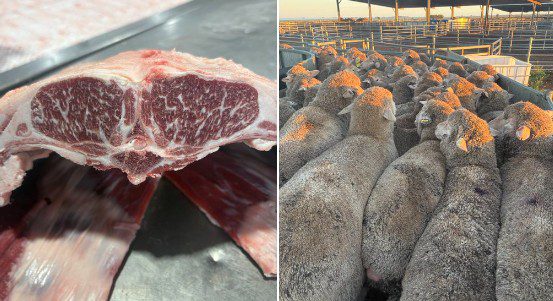
A Merino wether loin with an IMF score of 7.8pc and some wethers in the Australian Merino Production Trial. Image – Craig Wilson.
THE first large scale eating quality analysis of wethers in the Australian Merino Production Trial has shown the enormous opportunities for eating quality and feedlot weight gain among multiple bloodlines, according to trial convenor Craig Wilson.
For the first time the lambs in the meat challenge section of the trial have been measured for loin intramuscular fat through the Fletcher International Exports plant at Dubbo.
Mr Wilson said every loin was measured for IMF using the STOMA (near-infrared spectroscopy) tool and the average was 5.2 percent across about 980 lambs.
“It’s the first time that it has been done at that scale in sheep that have all been run under the one set of circumstances.”
The trial includes 75 teams of 30 Merino wethers from across Australia, plus linkages, measuring all traits across 40 different bloodlines after been run together in the Kiargathur Station feedlot for 83 days.
Mr Wilson said half of each Merino team, including wethers from a benchmark Poll Dorset-Merino lamb team, have been processed, giving a comparison between pure Merino and Merino cross carcases.

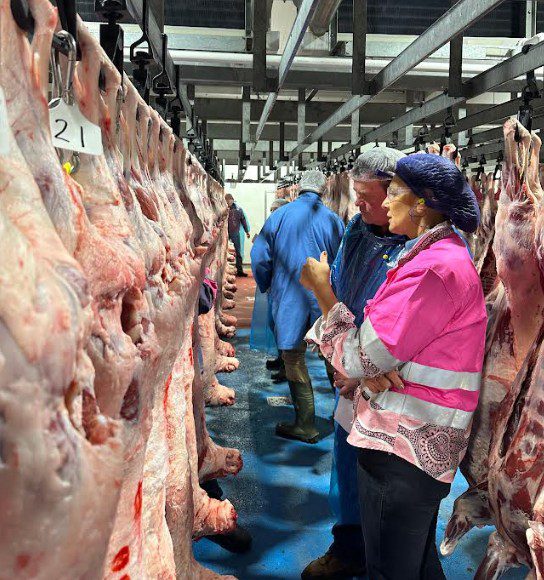
Producers inspect their carcase trial entries on the hook at the Fletchers plant in Dubbo. Image – Craig Wilson.
In an X post, Mr Wilson said the preliminary (carcase) results are looking great as an average across all teams.
“Results need to be statistically analysed due to significant variation in age.
“What we can say is that there has been some individual lambs that have performed almost beyond belief, showing what is possible,” he posted.
“I think the (eating quality) opportunities are enormous, I mean 40 different bloodlines and the sheep have come from all over Australia.
“It’s the largest trial that’s ever been run in terms of the numbers of sheep and where they’re from,” he said.
“And when you look at what individual sheep have been able to achieve it is nothing short of astounding.
 “Our challenge is to find those individuals in the breeding programs that we can multiply out for not eating quality, but for a whole raft of things.”
Mr Wilson said he looked at the feedlot results for the top 10pc and bottom 10pc of lambs in the trial for weight gain.
“The top 10pc averaged 310 grams a day average for 83 days and the bottom 10pc averaged 140 grams a day for 83 days.
“So it’s more than double and on current values, the difference between those two groups is over $100 a head on just meat alone,” he said.
“And the other part of that is those lambs that put on that enormous weight had a starting weight that was four kilograms lighter than the lambs that put on 140 grams a day.”
Mr Wilson said the trial has clearly identified the cost of sheep that stopped putting meat on and started to lay down fat.
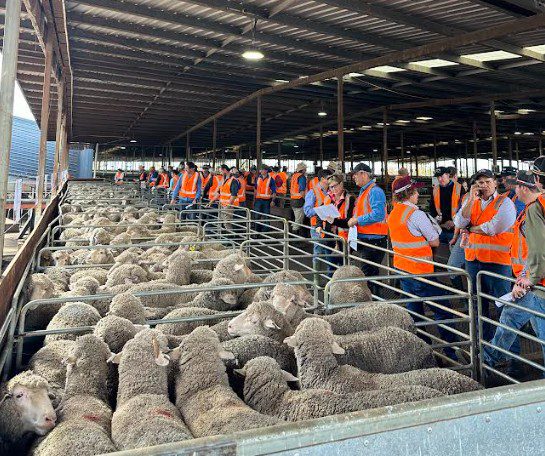
Carcase trial wethers are inspected before being processed. Image – Craig Wilson.
Mr Wilson said the openness and commitment from the team from Fletcher International Exports is outstanding.
“Thanks are extended to all of the team that has assisted with all of the data collection and processing.
“The trial cannot run without their investment and involvement,” he said.
“All of the data will now be professionally analysed and reported as soon as possible.”
The brothers of the lambs processed for the carcase component will be shorn in early March next year.
Full carcase results are expected to be finalised this month.
Mr Wilson said there are plans to run carcase trials nationally.
The results from this trial will have enormous consequences for the Merino industry and the future breeding direction. Hopefully there may be scope in the future for measuring individual feed conversion efficiency as well. I feel we are probably going down the wrong track of breeding larger animals that have good ASBVs without taking into account the feed required to produce those better figures. Roger Fletcher has always put a lot back into the industry.
Great article.