
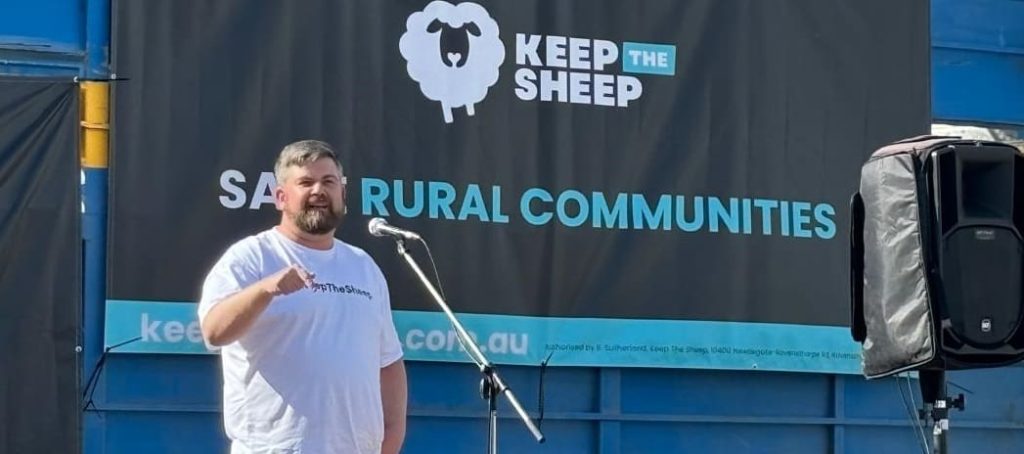
ALEC CEO Mark Harvey-Sutton speaks at the KeepTheSheep rally in Perth last year.
AUSTRALIA’S peak livestock exporter body has sheeted responsibility for a lack of planned Middle East sheep shipments for the remainder of this year to the Albanese Government.
Australian Livestock Exporters Council chief executive officer Mark Harvey-Sutton has confirmed an ABC report that no live sheep shipments are booked out of Western Australia this year, despite the annual three-month Northern Summer moratorium ending this week.
The Federal Government legislated last year to end live sheep exports by seas from Australia after 1 May 2028, initiating a confidence crisis in the WA sheep industry and a sharp drop in the flock, limiting available sheep supplies.
The commercial viability of sourcing sheep for live export has also more recently been impacted by high lamb and mutton slaughter prices available to remaining sheep farmers in Western Australia and nationally.
 In June this year, WA’s Department of Primary Industries and Regional Development reported a marginal increase in the number of sheep exported live from WA in the first six months of 2025.
DPIRD said 266,100 sheep were exported live up to June, 3 percent5 more than this time in 2024. Kuwait remained the top destination in 2025, receiving 101,200 sheep, up 53pc on this time last year. Qatar increased its intake of WA sheep to 33,000 sheep by June, up from 1200 last year. There was also significant increases in the number of sheep exported to the United Arab Emirates and Oman, DPIRD said.
The ABC this week quoted WA Livestock Exporters’ Association chair John Cunnington stating that not one livestock vessel is confirmed to return to Australia between now and the end of the year.
He pointed to high sheep prices and Western Australia’s shrinking sheep flock, but added it didn’t mean that there would be no shipments this year. Mr Cunnington told the ABC the live sheep export trade has had a reliable history of sheep shipments to the Middle East after the Northern Summer moratorium.
However, Mr Harvey-Sutton said responsibility for the situation “lies squarely at the feet of the Federal Government.”
“This is what happens when governments unnecessarily disrupt markets for no good reason.
“It is going to be a very difficult situation for the industry going forward,” he said.
He said the lack of planned shipments in 2025 spoke to the uncertainty that is impacting the WA sheep industry at the moment.
“This doesn’t mean that there won’t be shipments this year or no shipments going forward, but at the end of the day exporters and importers, like any business, have to make sure that it stacks up commercially, and that’s the process that they are going through now.”
Mr Harvey-Sutton said live sheep exports had been a viable marketing option for WA sheep producers, but the planned live sheep export by sea ban has impacted the size of the WA flock and the numbers of sheep available to the trade.
“It has to be acknowledged that the impact of the (live sheep) ban overhanging the market and the outcome of the last federal election has impacted confidence in the WA sheep production sector.
“WA’s DPIRD has predicted that the flock could be dropping down to 9 million this year, a 25pc reduction,” he said.
“What has happened is the prevailing market conditions have meant that there is tight supply currently and prices are very high, which does obviously come into the considerations of importers and exporters about best to make shipments commercially viable.
“This is a commercial decision for those businesses and they will make those commercial decisions,” he said.
“But there is no doubt that there has been unnecessary market intervention by the federal government here and that is what we are seeing playing out.
“The commercial environment has changed as a direct impact of this policy taking place, which is why we are seeing an unprecedented situation where no ship has been booked, but there is no shortage of desire from Middle East markets to import sheep and it doesn’t mean that there won’t be shipments this year,” Mr Harvey-Sutton said.
“”It just means that the consideration of doing a shipments is that much more difficult and that is what these businesses are having to undertake at the moment.”
In June, DPIRD said the WA sheep flock numbered 12.4 million as of July 2022, according to ABS data, but industry confidence during 2024 was low due to poor seasonal conditions, low prices, and uncertainty due to the Australian Government’s announcement of the phase out of live export of sheep by sea.
This combination led to very high rates of turn-off as producers reduced the size of their sheep enterprise, DPIRD said.
“This has likely resulted in significant flock decline between 2022 and 2025.
“Via DPIRD modelling, it is estimated that the total WA flock size may have declined to between 8.6 and 9 million head by July 2025; however; recent strong sheep prices may improve confidence levels in the industry and slow the flock sell down.”
Government should pay the cost of phaseout policy implementation – SPA
Sheep Producers Australia CEO Bonnie Skinner was asked if she also blamed the Albanese Government’s planned trade ban in 2028 for lowering industry confidence and the WA flock, and the early slowing of the trade justified fast-tracking of transition measures to the WA sheep sector.
She said SPA has consistently raised concerns about the need to maintain confidence and critical mass in the sheep industry in WA, where live export plays a key role in underpinning market options, seasonal turn-off, and regional employment.
“Early on, during the government consultation process and the Independent Panel’s discussions, it was highlighted that the transition package and market conditions would influence the speed and shape of change within the WA industry.
“The uncertainty introduced by the policy and its legislation have resulted in destabilisation, including reduced sheep numbers, increased turnoff, reduced investment, processor uncertainty, and market hesitancy,” Ms Skinner said.
“This impact is felt by the whole supply chain, including exporters. Delays in delivery of assistance to date have increased the impact on, and cost to, industry.
“SPA has maintained that the government should pay the cost of implementation of this unwanted policy, not the industry and businesses affected.”
Minister for Agriculture Forestry and Fisheries Julie Collins did not respond to questions about the impact of the proposed trade phaseout, but an unidentified Federal Government spokesperson said the Albanese Labor Government continued to roll out the $139.7 million Sheep Industry Transition Assistance Package to assist businesses to adjust to the phase out of live sheep exports by sea.
“Funding is now available to Western Australian sheep producers and processors to build capacity under the $40 million Supply Chain Capacity Program.
“We are committed to the sheep industry in Australia and remain confident that there is a strong future for the sheep industry and those associated with the sector,” the spokesperson said.
The government also said Federal Parliament agreed that live sheep exports by sea will end by 1 May 2028 and that the legislation passed “provides certainty and enables the roll-out of a transition assistance package.”
“Decisions regarding the export of live sheep ahead of the end of the trade are a matter for industry.”
The government said Australia’s sheep meat exports were worth $5.7 billion in 2024-25, setting a second consecutive annual record, and under the Albanese Labor Government sheep meat exports have increased 27pc from 2021-22.
Sheep Central contacted the two main WA sheep exporters Rural Exports & Trading (WA) and Livestock Shipping Services for comment.
HAVE YOUR SAY