
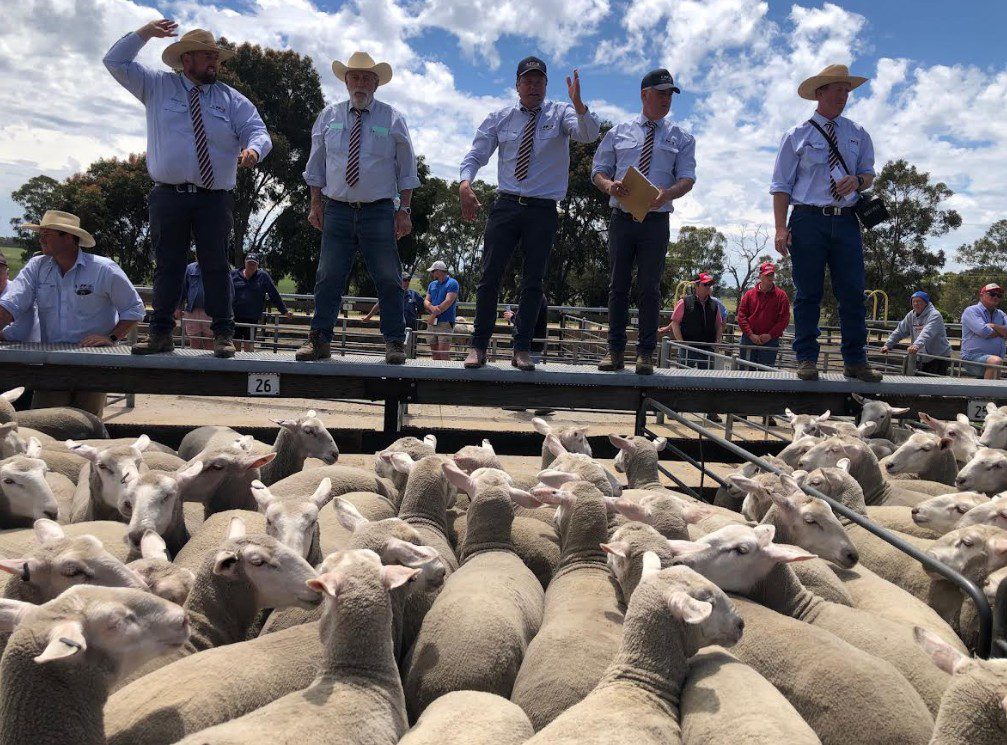
The PPHS teams sells the Mentara Park Farms ewes for $540 at the 2025 Naracoorte First Cross Ewe Sale.
SOUTH Australian red meat producer Graham Johnson’s family has backed first cross ewes for decades for assured production of heavy lambs straight off grass-fed mothers.
But despite prices hitting Australian record levels recently — $540 for 1.5 year-old May-June drop Mentara Park Farms ewes paid by Mr Johnson at Naracoorte last week – for the first time in six years, current lamb and mutton values are justifying the high ewe replacement prices.
Mr Johnson said he averaged around $480 for the 750 ewes he bought at the 13 November sale, and this year has bought 2500 ewes in the last two months to replace cast-for-age ewes averaging well under $400.
The Johnson operation currently runs about 10,000 first cross ewes and all replacements are bought in, focusing on specific lines known to perform.
Mr Johnson said he doesn’t buy ewes based on the calculation that the cull ewe and her last lamb should pay for the replacement ewe, and preferred not to state his recent cull ewe and lamb prices.
 “But if you run by the old ewe and one lamb computation or equation to buy the new ewe, even at $480 last Thursday, I’m in front of that equation for the first time in six years.”
“I don’t run by that equation, I run by the fact that if you don’t have crossbred ewes you don’t have any lambs – I just buy them and I buy the best ones.”
Mr Johnson said he has dropped first cross ewes numbers from 13,000 to 10,000 simply based on labour.
“All I’ve done is upped the cow numbers and kept more heifers to breed more calves for less work.”
His family had run Border Leicester-Merino first cross ewes on its Naracoorte country since World War II because they suited the lower south-east SA country, he said.
The ewes are joined to Poll Dorset rams for a late April-early May lamb, aiming to market 90 percent of the progeny by mid-October at 25kg carcase weight. The sires come from mainly from the SA studs, Allendale, Morton, Gowan Brae, Wrattenbullie, Mullinger Park and Paxton Park, as well as Janmac at Goroke in Victoria.
“We lamb early and if it’s an average season, onto green grass, although in the last two years, of course, they have not.
“We always started feeding in February to keep the weight on the ewes; you must keep the weight on crossbred ewes.
“If you let them slip, you don’t get them back up again,” he said.
“This year we had to feed up to July.”
Mr Johnson said he has tried composites on his land, and despite achieving high lambing percentages, he could not get the lambs to the required liveweight straight off their mothers by October.
“Whereas, with the crossbreds (first cross ewes), through September and into mid-October, 90 percent of the lambs are gone straight off mum at 25kg cwt and no mucking around.
“With the composites (lambs) you’ve got to shear them and hold them, and in my country which turns off in mid-October, I’ve either got to be sold or shorn – with the crossbreds generally they are all gone.”
Most of the Johnson family’s crossbred ewes are at Naracoorte, but they have country at Wrattenbullie, Lucindale, Greenways and Beachport that runs mostly beef cattle.
Mr Johnson said the recent rises in crossbred ewe prices have made little difference apart from helping to meet costs.
“For the last five to six years since COVID we’ve been getting about $10-$12 a head for the (first cross) wool, this year that’s double … it’s better than it has been for five years.”
Naracoorte first cross ewes average $435
The 11,637 1.5 year-old first cross ewes sold at the Naracoorte saleyards averaged $435 last Thursday. The top-priced ewes were sold in the PPHS run and were followed by Deepwater Trust’s 208 June-July ewes that made $462-$502. The remainder of the first run ewes ranged from $438-$490.
The perennially well-formed Coolawang Pastoral ewes made to $502 in Elders’ run, with 104 June drop ewes. Pembroke Pastoral also cracked the $500 mark with 60 May-June drop ewes, as did Lockhaven’s 95 August drop ewes in the Southern Australian Livestock run.
The sale was generally strong for ewes in good condition and frame, only dipping below $400 for lines lacking condition score, frame or presentation. Support from the bigger agencies underpinned purchasing and prices.
PPHS Pty Ltd principal Robin Steen said the Naracoorte sale was “very, very good”.
“We were a bit concerned but I think we had the best of it.
“We had great support and it went very well,” he said.
But he was not expecting prices to reach $540.
“We were hoping for $500 and expecting $470 or $480.”
Mr Steen said producers have been averaging $280-$300 for B double loads of lambs, putting “a fair bit of powder in the gun” for potential ewe buyers.
“But you’ve also got to remember a lot of these people have got a lot of catching up to do.
“The last two have been pretty hard.”
He said there has also been a big push into the composite ewe job, potentially affecting Border Leicester ram sales.
He said the Naracoorte sale showed that restocker ewe values had caught up with the current lamb and mutton prices.
Elders’ agent Tom Dennis said the first cross ewe values are now in line with the current prime lamb and mutton prices.
“I think the whole industry is dealing with the current pricing regime, so I think restocker sheep are going to follow suit.
“I think the national flock is sitting around 60 million rather than 70 million that MLA suggests, so I think that shows us that there is still an undertone of the last two years flowing through people.
“But as you can see they are starting to sell a few lambs and get some money back in the kitty,” he said.
“So, in turn, they need sheep to breed them.”
Mr Dennis believes ewe purchasing is driven from lamb and mutton return cashflow and agency assistance rather than bank finance.
“I think the banks will probably want to see some more runs on the board.”
He believes lamb numbers this year could be 20-25 percent lower than last year “because a lot of our sheep data is based on surveys that no one fills out.” Otherwise there is slaughter data, but this not reliable because of the numbers of ewe lambs that have been killed.
“Hence the flock is smaller than what everyone thinks and what we are seeing is a result of that.
“I think if we can hopefully get through with a balance between the processing sector and producers, and everyone survives and comes out the other end better off,” Mr Dennis said.
“I think the global shortage of red meat is helping the processors as well, so I think that is buffering what we would like to think is the new norm, but no one is really sure at the moment.”
Edenhope sale cracks $500 twice
At AWN’s first cross ewes and ewe lamb sales preceding Naracoorte, two lines of 1.5 year-old ewes cracked $500 — Stobo Farms 284 April-May drop ewes and Wimmera Downs’ 299 April May drop ewes — giving the first indication of improved confidence in restocker ewe purchasing at a higher level than at previous sales.
The Edenhope 1.5 year-old ew values were also then relatively solid at $420-$495 for the heavier ewes, but with plenty of opportunity to purchase ewes joinable next year after conditioning at $350-$395. Ewe lambs in joinable condition generally made $300-$340, those needing work for even a late autumn joining sold from $280-$310 and ewe lambs needing to be run on made $235-$300.
HAVE YOUR SAY