
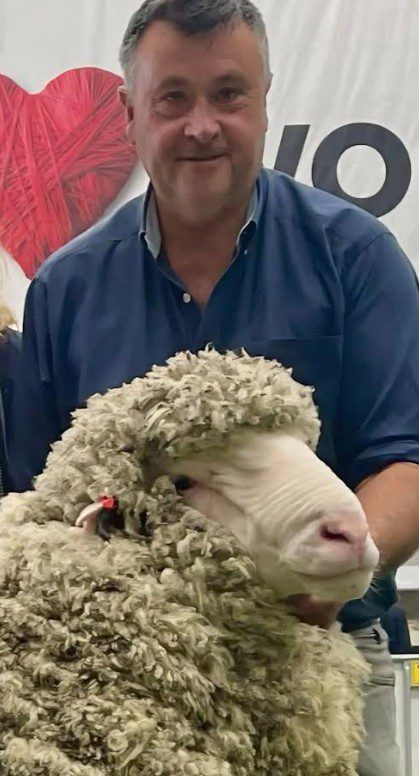
AWI election candidate Drew Chapman.
AUSTRALIAN Wool Innovation director candidate Drew Chapman supports a bigger marketing spend, action on fly research rather than mulesing and maintenance of the current board size in his 2025 election responses.
Mr Chapman is one of only two candidates who have agreed to share with Sheep Central his responses to questions from WoolProducers Australia. He has also answered a few questions from Sheep Central, on board size, skills and mulesing reputational risk.
When asked by WPA to list his top three priorities for industry research, development and marketing, Mr Chapman said in relation to the current R&D to marketing split ratio of 40:60, there is a wide range of views among shareholders from favouring a 100% percent marketing spend to zero.
He supported a 30:70 ratio in favour of more marketing.
“Targeted marketing in collaboration with industry consumers of the fibre are critical to creating demand for the fibre and in turn higher prices paid to our shareholders.
“I note that a higher market indicator brings in more revenue to the company thus as a percentage the research dollars component also increases,” he said.
“If we cannot create high demand and price for our shareholders, no matter how revolutionary our research is, shareholders will move to other more profitable enterprises.”
Mr Chapman believes the election of at least two completely new directors this year, the retirement of the current chair and resignation of the AWI chief executive officer will the company will have a reset. He said there is a very real opportunity to have a detailed look at the consultation terms and conditions.
 “As a candidate that has not been privy to all the inner detail of the workings of both WICP and WCG, it is hard to comment on their functionality.
“However, I do note the following, it is imperative for the long-term industry sustainability that all parties work in a respectful and constructive manner.”
He said it disappoints him that areas of conjecture are aired through the media rather than between the relevant parties in a professional manner.
“I believe when the new chair of AWI and CEO are appointed, a meeting with WoolProducers should occur to establish an acceptable framework for both parties for consultation to occur where areas of mutual interest are resolved in-house.”
In relation to industry threats and opportunities, Mr Chapman believes carbon and renewable policies in relation to world fibre markets, and the ongoing divide over mulesing are among the industry’s top threats and opportunities.
“We have an opportunity to market the sheep as the ultimate renewable; converting sunlight, cellulose and water into fibre, protein and being able to reproduce itself in harmony with the natural environment.
“Targeting marketing in this area can be a massive growth area for the fibre,” he said.
Concentrate on the fly, not mulesing
Mr Chapman believes the ongoing industry divide on how to go forward to the challenges of mulesing really need a fresh approach.
He supports the right for producers to manage and breed their animals to animal welfare best practice.
Mr Chapman said work on the sterile fly on Kangaroo island is welcome, but further research into genetically interrupting the fly, he believes is the future in this area.
“As the fly genome has now been mapped, an all out research approach to alter the fly’s ability to sense odor (wool suint and urine stain) could be interrupted.”
He believes further research into genetically interrupting the fly is the future in this area, to take out flystrike and making a lot of the current strategies unnecessary.
“There are a large number of producers that would exit the industry if current management practices are banned or modified so a targeting of the cause (the blowfly) I believe is the priority.”
Mr Chapman did not comment on whether mulesing represented a reputational risk to the industry.
On marketing, Mr Chapman said it is very important that AWI promotes its positive narrative “and with social media our message can be delivered to consumers without third party negative narratives.”
“We have as an industry spent far too much time responding to industry critics rather than promoting our strengths.
“Activists are not customers and our efforts should be working collaboratively with wool buying processors and brands to promote the advantages of fibre to consumers in a clear and concise manner,” he said.
“Our opposition fibres do not run an ongoing narrative on their ecological and pollution problems, so why is our industry so fascinated to run media campaigns highlighting negatives.”
AWI can hire any skills needed
Mr Chapman also supports in-house resolution of industry disputes rather than in media coverage.
On the issue of whether the AWI board is dominated by Merino breeders and growers and should it encourage directors with off-farm skills, Mr Chapman said where a specific skill set is needed, AWI has the ability to employ specialists on contracts with key performance indicators in specific roles.
“It is not what section of the industry board members are derived from, but in the shareholders’ view the person that best represents their interests and can deliver positive outcomes for the industry.”
Mr Chapman said AWI’s role as an industry R&D body needs full industry support to promote the industry’s strengths at every opportunity.
“In the carbon field we have a powerful positive narrative to market, instead of wasting resources talking about our competitors narratives.
“No other industry spends time telling the world it’s problems,” he said.
“Shareholders want continued positive marketing messaging to grow demand for the fibre, which leads to higher prices and profitability which is what wool growers are in business for.”
Click on the links highlighted to read Mr Chapman’s complete responses to questions from WoolProducers Australia and Sheep Central.
The responses from the other AWI election candidates — Chris Mirams, Michelle Humphries and Anthony Uren — will be published on Wednesday.
As a seedstock producer, Mr Chapman’s responses to the WoolProducers’ questions are entirely predictable. Stud breeders offer the same policies as the last 30 years. More on marketing and nothing on mulesing. And we can expect the same results as the last 30 years, a gradual decline of the wool industry. Stud breeders should look after their own interests, livestock sales and leave commercial producers to look after their own interests – wool sales.