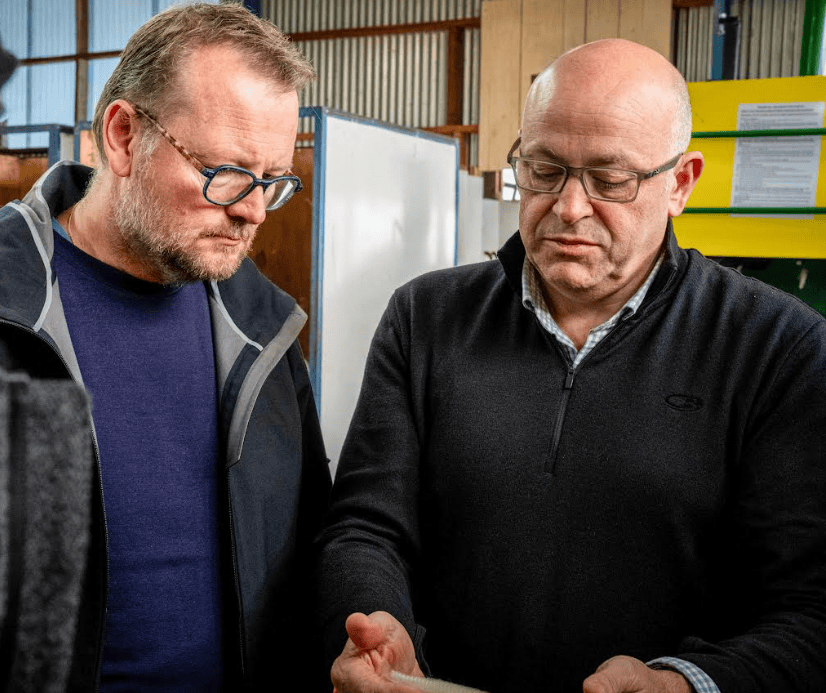
Global brand president of Icebreaker, Jan Van Mossevelde, left, with Zentera’s general manager global supply Matt Hand.
NEW Zealand’s Zentera Wool Company is upping the ante to source more non-mulesed wool from Australian growers, with longer term contracts and a continued derogation for ‘ceased mulesing’ production.
Zentera Wool Company general manager global supply Matt Hand said Zentera has gone from offering three-year contracts to five and 10-year contracts.
The company handles 75 per cent of the Merino wool clip in New Zealand and has certified about 100 Australian wool growers across New South Wales, Western Australia, South Australia, Victoria, Tasmania and Queensland, along with a significant number of growers in South Africa.
But he said Zentera could, in the short-term, easily handle three times the volume of non-mulesed wool it is currently sourcing from Australia.
The auction market and contracts
Australia’s auction market is now regularly characterised by supply-driven cycles, with any movement toward a benchmark price of 2000c/kg being resisted by buyers, while lower prices lead to growers withdrawing wool.
Mr Hand said term contracts offer an option for growers to break out of the auction-based price-taker cycle.
 “It’s just that long-term stability and the knowledge of what you are going to receive for your wool – you just don’t get it any other way.”
He said the need for Australian wool producers to get strong price signals to maintain or increase production has been “urgent for some time.”
“Our (Australian) growers need more, they need a better outcome so we’ve got to change the way we look at markets and address them and interact with them – so it is time to do it differently.”
Zentera generates demand for certified wool, and provides continuity of supply to more than 140 global brands, including leading outdoor activewear companies, Icebreaker and Kathmandu. These brands purchase only non-mulesed or ceased-mulesed wool through direct supply contracts from ZQ certified growers.
“These contracts are transacted outside the Australian auction system, and the premiums sit in those contracts,” Mr Hand said.
“As a result you don’t see the prices growers are getting for ZQ wool reflected in the market reports, because the wool wasn’t sold at auction.”
He said the Zentera contracts provide greater price stability and long-term security than the auction market.
“Our contracts are stable while the auction market is volatile,” he said.
“Our contracts consistently outperform auction market levels and are currently reaching the 95th percentile.”
Australian wool ‘increasingly lacks relevance’
Mr Hand said the Zentera contract opportunity comes as Australian wool increasingly lacks relevance in key non-mulesed markets across the world.
“The perception is that Australia is a mulesing country.
“Yes, you can buy non-mulesed wool here, but the reliability of being able to source the type at the time they want it from that smaller pool of non-mulesed wool is limited,” he said.
“They (the brands) generally place their orders in South Africa and New Zealand, so we miss the opportunity; they just automatically come here because we’ve got plenty of wool.”
Sheep Central has been told that requests for NANM wool — non-Australian, non-mulesed – from brands are increasing, and Mr Hand could not confirm this, but said it wouldn’t surprise him.
Mr Hand said if a wool supplier has ceased mulesing for 12 months or more, the property and its entire production can be eligible for ZQ-certification. This contrasts with Textile Exchange’s decision to end its acceptance of ‘ceased mulesed’ wool under the Responsible Wool Standard after the transition to the new Materials Matter Standard next year.
“If we take that (ceased mulesing) incentive away from growers they are less likely to cease mulesing,” Mr Hand said.
“We need to give them a commercial reward for ceasing the practice and giving them that market access straight away so they can cease the practice and move forward, and move away from a practice that is frowned upon globally.”
Zentera said Australian wool growers have an opportunity to capture significant premiums through its ZQ certification, providing direct access to global brands seeking verified non-mulesed wool.
“If I put myself in the growers’ shoes, if I’m going to invest so heavily in producing 12 months of the year every year of my working life, I want that product have access to every market opportunity and by continuing mulesing you are cutting off market access to the highest priced markets in the world,” Mr Hand said.
He said ZQ certification offered growers a pathway back into these premium markets as global textile and fashion brands increasingly seek wool that meets animal welfare and ethical sourcing requirements.
“It’s not just a few brands in isolated regions, it’s a global view held by brands, heavily linked to their sustainability goals and consumer demand,” he said.
Commercial upside to ceasing mulesing lacks clarity
With 35 years’ experience trading and exporting wool globally, Mr Hand said consumer attitudes towards animal welfare were increasingly influencing brands’ sourcing decisions, with mulesing “a practice that consumers are uncomfortable with and therefore a practice that brands today overwhelmingly reject.”
He said the commercial opportunity for Australian wool growers who cease mulesing needed to be better understood, with significant premiums available through Zentera’s contracts that connect growers directly to brands.
“The true commercial upside to ceasing mulesing hasn’t been presented to Australian growers with a great deal of clarity in the past,” he said.
“There are quite significant gains to be made for those who want to move to a non-mulesed flock.”
Mr Hand said the long-term contracts also provide growers with greater certainty over their income.
“If you sign a five-year contract you have clarity of forecast revenue for your wool enterprise,” he said.
“That’s very important when you’re operating a business, you know what your product is selling for, so you can drive your focus towards production rather than worrying about the market.”
For growers considering the transition to a non-mulesed flock, Mr Hand said Zentera also works with leading studs and a network of geneticists, sheep classers and industry specialists across Australia who can provide practical support.
Importantly, Mr Hand said growers retain their existing wool broker, with Zentera working alongside most Australian firms.
“Australian wool growers have valuable, often generational, connections with their brokers, who add value for their clients in numerous ways,” he said.
Mr Hand said Zentera had a team committed to delivering better outcomes for wool growers, at a time when consumer attitudes are creating a significant opportunity for natural fibres.
“Wool is such a magical fibre, but it has lost market share to synthetics over the past 30 years,” he said.
“Now consumers are saying they want to move beyond synthetics, they’re suspicious of their environmental and health impacts, and they want more natural fibre options.”
He said Australian wool was well placed to capitalise on that shift, but the industry needed to ensure it could access every market seeking natural, non-mulesed and certified wool.
“We want to support growers to transition their flocks to non-mulesed so that Australian wool can remain viable and relevant, and continue to be one of the best natural fibre producers in the world.”
HAVE YOUR SAY