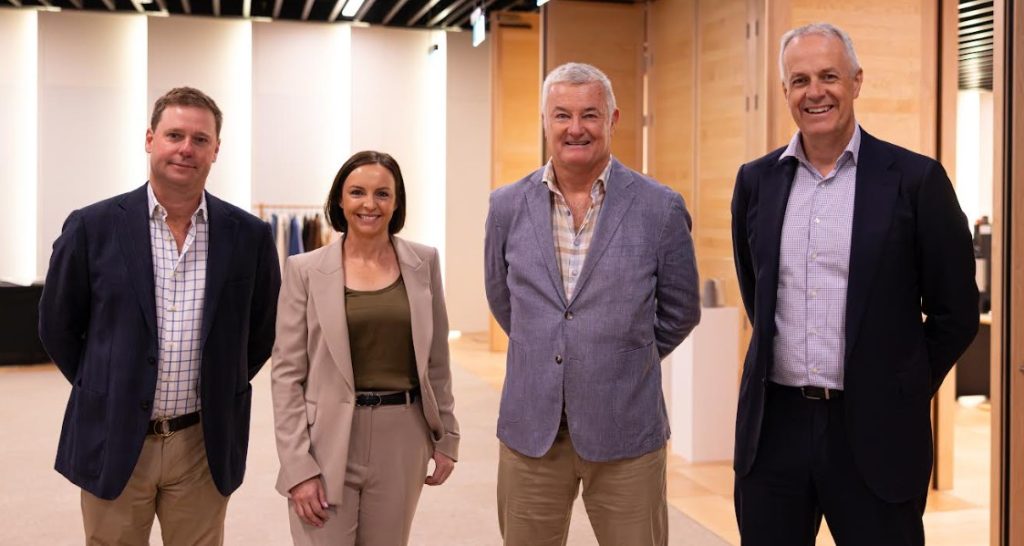
At the Australian Natural Fibres Forum were, from left, AWI chair George Millington, Cotton Australia chair Liz Stott, Cotton Australia CEO Adam Kay and AWI CEO Bryan Fry. Supplied by AWI.
AUSTRALIA’S peak wool grower body, WoolProducers Australia, was effectively excluded from an inaugural invitation-only cotton-wool industry forum touted as ‘industry unity on show’.
The Australian Natural Fibres Forum in Sydney yesterday was an invitation-only event co-hosted by Cotton Australia and Australian Wool Innovation’s marketing arm Woolmark.
Media was not allowed to attend, and was notified of the event through a media release emailed on 23 April, but embargoed until the day of the event.
However, the embargoed release detailed what speakers said, what forum discussions highlighted and what the host organisations committed to – five days before the actual event.
The release said “Australia’s world-leading cotton and wool industries have joined forces” to host the inaugural forum and that it marked “the beginning of deeper collaboration between the cotton and wool industries.”
The release said the forum “brought together growers, researchers, supply chain partners and industry leaders to strengthen the future of natural fibres.”
Cotton Australia is the representative body for the nation’s cotton farmers and its parallel wool grower organisation is WoolProducers Australia.
However, Sheep Central has learned that AWI twice deliberately declined to invite WPA to the forum, despite inviting at least two other wool growers, the Australian Wool Exchange, the South Australian-based cotton-wool innovator eqwools.
WPA general manager Adam Dawes confirmed that WPA was not invited to the Australian National Fibres Forum.
“We learnt about the event through cotton industry colleagues.
“WPA initially approached the AWI GM International (Stephen Hill) seeking further detail and were advised to raise the topic in a forthcoming meeting with AWI chair (George Millington) and new CEO (Bryan Fry),” Mr Dawes said.
“WPA subsequently raised the forum in a meeting with the AWI chair, CEO, and GM Consultation & Engagement (Kevin Wilde) and were advised to approach Cotton Australia.
“Feeling that this was more of a cotton event and AWI having no role in curating wool industry attendees we did not progress enquiries with Cotton Australia,” he said.
Mr Dawes said AWI has not given any reason for not inviting WPA to the event, which, according to the joint CA-AWI media release, attracted almost 250 representatives from leading global and Australian brands.
Mr Dawes said it appears that sustainability and sustainable production was a focus topic for the event, meaning it would have made sense for WPA to attend as co-owners of the Sheep Sustainability Framework.
“WPA is also working actively with the Australian Cotton Shippers Association and Austrade to deliver an Australian natural fibres summit in Bangladesh in the coming months.”
WPA also recently reached out to AWI for collaboration on the summit from its in-market representatives and two weeks ago WoolProducers co-hosted a networking reception before SaigonTex 2026 with AusCham Vietnam and the Cát Tường Group for key stakeholders in the Australian and Vietnamese textile sectors, including eqwools.
Mr Dawes said with about 250 delegates at the Sydney forum and AWI-Woolmark sending direct invites, “WPA does feel excluded.”
“We asked AWI on multiple occasions for an invite and they referred us to Cotton Australia.”
With AWI not inviting WPA to the event, but inviting other wool organisations and having knowledge of WPA’s activities in the wool-cotton space, Mr Dawes said AWI should answer whether it had actively excluded WPA from the forum.
“That would be a question for AWI to answer; however, through our ownership of SSF, being custodians of industry campaigns, such as Trust In Australian Wool and our membership of the Austrade Trade Diversification Network, it would be fair to say that WPA participation could have added value to the event.”
Has AWI contravened its SFA with the Federal Government?
The joint AWI-CA media release’s statements that the two industries had “joined forces” and that the forum “marked the beginning of deeper collaboration between the cotton and wool industries”, with quotes from only CA chief executive officer Adam Kay and AWI CEO Bryan Fry, has raised the question as to whether the wool levy-funded body was acting as, or had implied to attendees that it was, an industry representative body.
AWI’s Statutory Funding Agreement with the Federal Government states:
AWI must not, at any time, act as an industry representative organisation or reference or provide information which implies to stakeholders or trading partners that AWI is an industry representative organisation.
Mr Dawes said the text of the media release doesn’t explicitly say that AWI was acting in a representative capacity.
“With WPA not being invited to participate it’s difficult to comment on what impressions attendees at the forum may have had in this regard.
“One would think that the members of AWI’s Woolgrower Industry Consultation Panel and/or Woolgrower Consultation Group would have been aware of/invited to such an event, I don’t believe that this has been the case.”
Before the forum, Sheep Central asked AWI’s new CEO Bryan Fry via email who was representing Australian wool growers at the event and a spokesman replied that chairman George Millington and Mr Fry would attend.
“The forum is an opportunity for wool and cotton to work with key brands to use more natural fibres.
“As the research, development, and marketing company for Australian wool it is an essential role for AWI to create more demand and that is exactly what the forum is designed to do,” the spokesman said.
“The collaboration with Cotton Australia is a good thing for Australian agriculture.”
After the forum, when asked what organisations at the event represented the wool industry, Cotton Australia CEO Adam Kay told Sheep Central “the Woolmark Company as part of AWI.”
“They had a number of farmers speaking, the chairman of AWI was there, some farmers from Victoria and one from southern NSW, they were giving the grower voice.”
Mr Kay said he was aware that WoolProducers Australia was the industry’s peak grower body, but when asked why WPA was not invited, he said: “We just reached out to the wool industry and AWI, and spoke to them.”
“We’re not involved in wool industry politics and that sort of stuff, and the body that we’ve work closely with in a number of events and promotions of Australian natural fibres has been AWI.”
He said Cotton Australia and AWI shared the responsibility of inviting forum delegates.
“We invited two or three growers to present and AWI invited two or three growers to present.”
The forum had raised awareness of the sustainability and traceability of Australian cotton and wool, “the huge advantage that natural fibres have over man-made fibres in terms of our environmental impact,” Mr Kay said.
Mr Kay said the media wasn’t invited to encourage frank discussions among the brands and retailers.
“It was sort of Chatham House and it enabled frank discussions about what brands and retailers needed in their supply chains from our natural fibres.”
Before the event, Cotton Australia’s website said it was a “Landmark forum to unite Australia’s natural fibre leaders” and Mr Kay said the event is “a move toward a more united approach for Australian natural fibres.”
“By bringing cotton and wool together, we’re helping the industry make more informed decisions and tell a stronger, more unified story for natural fibres.
“By standing together, we’re showing that Australian natural fibres are part of the solution for sustainability, innovation and the future of fashion.”
Sheep Central asked Mr Fry via email why AWI didn’t invite WPA to the event, despite inviting other wool industry bodies and people, and to explain whether AWI has contravened its SFA.
An AWI spokesman responded that AWI was invited by Cotton Australia to collaborate in the event to jointly promote natural fibres to their customers.
“WPA were given the opportunity to register with the event organiser (Cotton Australia) and did not take up the offer.
“AWI provided those details to WPA’s CEO on April 8 via email,” the spokesman said.
“AWI is not in contravention of its SFA.
“AWI is the marketing, research, and development company for Australian woolgrowers and as such welcomed the opportunity to work with Cotton Australia,” the spokesman said.
“Cotton’s RDC has no marketing function so AWI could not work with them on such matters.”
Cotton and wool industries share similar challenges
Victorian wool grower Katherine Bain said she was invited by Woolmark to participate on a panel at the forum.
She said New South Wales grower Paul O’Connor was also on the panel with two cotton growers.
Ms Bain said there were some good discussions around sustainability and traceability, especially on managing the coming European Union regulations and customer demands on fibre sources.
“It showed that there were a lot of similarities (in the two industries) especially with challenges post-farmgate, in terms of branding, traceability and sustainable practices – what customers think is happening versus the reality on the ground.
“A similar approach is needed for both (industries) to overcome those challenges.”
AWI/Woolmark also invited Mr O’Connor and Fox & Lillie brokerage and technical manager Eamon Timms to the forum, who said it was good to see collaboration between the two industries.
HAVE YOUR SAY