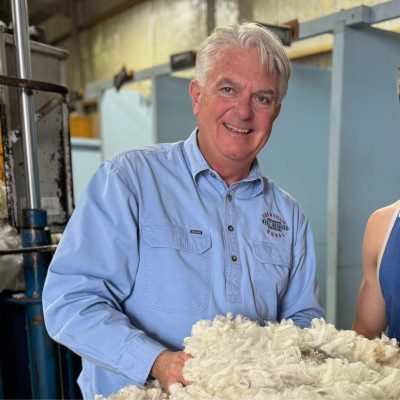
Fox & Lillie national wool brokerage manager Eamon Timms.
A SIGNIFICANT drop in the number of wool bales tested over the past year has highlighted the industry’s ongoing supply issues, according to Fox & Lillie national wool brokerage manager Eamon Timms.
In his latest market report, Mr Timms said AWTA test data to be released this week showed there has been a significant drop in wool tested in October 2026 compared to October 2025 in Australia.
“In excess of 40,000 bales less, which equates to a 23 percent drop year-on-year,” he said.
AWTA’s test data website page shows 191,178 bales were tested in October last year, compared to 147,864 bales last month – a fall of 43,314 bales or 22.7pc year-on-year.
Australian Wool Exchange auction data tells a similar story, with 146,162 bales of ‘first hand offered’ wool (excluding New Zealand wool) catalogued in October 2025 compared to 103,747 bales in October 2026 – a 29pc drop. The drop in all wool offered at Australian auctions was 30pc for October year-on-year.
Price-wise the benchmark AWEX Eastern Market Indicator was at 1413c/kg clean in October last year, settling on 1723 c/kg clean last month. The EMI reached its highest point in seven years of 1979c/kg in mid-June this year, but has dropped steadily since then.
Mr Timms said the recent test data indicates the mooted “clear out” of ewes did happen, either side of Christmas last year.
“It is certainly going to be felt very hard by the industry as we go on.”
Mr Timms said some people have commented that the strong lamb marking percentage this year would counter the wool production drop.
“But the reality is that is not going to relate to adult sheep and adult wool production for one or two seasons.
“The rebuilding of the flock is going to take some time.”
Mr Timms said some Fox & Lillie wool clients were deciding to hold their flock levels as wool prices improved mid-year.
“But as the (price benchmark) Eastern Micron Indicator slips I think the desire of people to necessarily keep the same amount of Merinos is starting to wane.
“That is a real risk to our industry and I told a lot of people at the Nanjing Wool Conference – if this market slips too far we will lose a lot of people who won’t come back, and then you will not have a volume of wool to process in your industry.”
Although Mr Timms agreed that current high lamb and mutton prices have buffered the impact of lower wool prices on sheep producers, it has not necessarily meant less wool being offered and retained on farms.
“Even though the passed-in rate has climbed, there is more wool being sold that people wouldn’t be selling otherwise, because the mutton and lamb price is high.
“That’s masking people’s desire to sell wool at these prices; they are accepting a wool price because the sheep meat prices are good.”
He said wool is not being kept back on farms in big volumes.
“A lot of the crossbred wool stocks in sheds got dragged out when prices started to move up in the middle of this year – the wool being stored in sheds was crossbreds.
“As a general rule, Merino wools have been moving, so really a grower-held stockpile on farms is not a factor at all these days.”
Mr Timms said the wool market dropping as much as it has is starting to impact producer thinking on what type of ram to join – crossbred-composite or terminal versus a Merino.
“So people who weren’t thinking about it two months ago, are starting to think about it now, so there could be some implications of that longer term.
“The ability of Australia to produce Merino wool in volumes that keeps China busy is going to be compromised if the price is not arrested around these levels,” he said.
“If there isn’t some consolidation and support then it puts at threat the volume that they need to run their machinery.”
Mr Timms said it was apparent while visiting Chinese processors and as the recent Nanjing Wool Market Conference that Merino wool has become very well-regarded by consumers in China.
“Year-on-year it is gaining traction at the consumer level and Chinese consumers are out biggest market now, with more than half of the wool to China now consumed in the country.
“It’s fashion and next-to-skin garments as well.”
HAVE YOUR SAY