
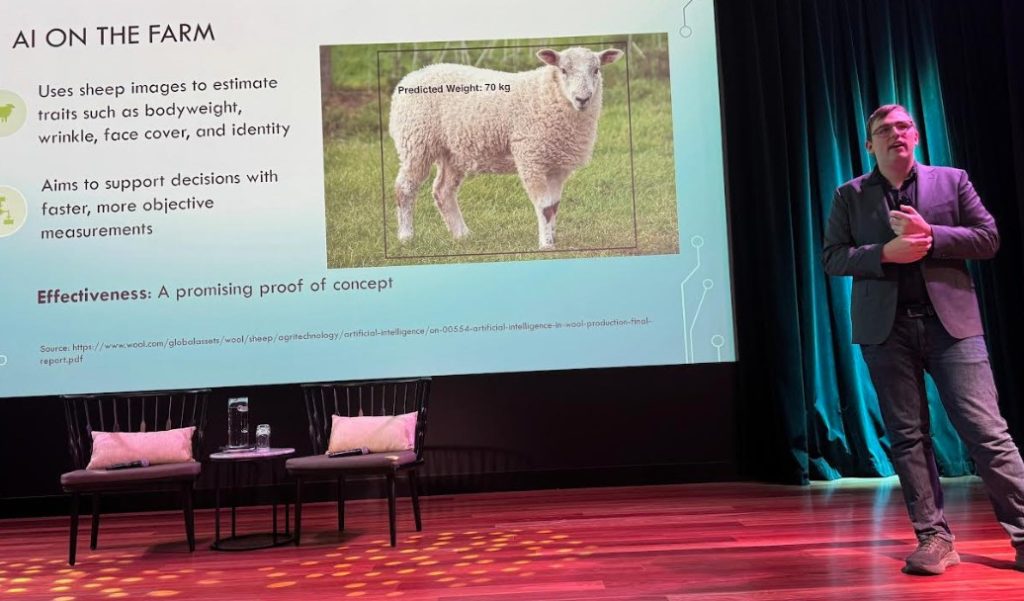
Dr Aleksander Pasquini outlined some uses of AI in the sheep and wool industry at the Women In Wool conference.
ARTIFICIAL intelligence applications will reduce critical thinking in reliant users and workers will be forced to develop the key skill to stay employed in some roles, the Women In Wool conference was told in Ballarat last week.
Deakin University associate research fellow Aleksander Pietro Pasquini has just completed his PhD on using AI to detect devices in a network and is currently working at the university’s Applied Artificial Intelligence Initiative or A2I2, with a focus on translational research – applying research to the real world.
A2I2 projects have included using AI for early cerebral play detection and dementia education using an AI avatar simulating dementia.
Dr Pasquini said AI can be broadly defined as software designed to perform tasks that normally require human intelligence.
“This does not mean that AI needs to think like a human, it just needs to perform a task that normally requires human intelligence.
“So what it generally ends up doing is analysing data, finding patterns within the data and then using those patterns to make predictions.”
Dr Pasquini said AI is all around us, in our phones, in Google Maps, behind your recommended videos on YouTube and in your email spam detector. There are many different types of AI, depending on the task being attempted, but he said some types using machine learning and generative AI applications were dependent on the accuracy of the data it used.
Machine learning AI uses large language models — defined as advanced deep learning AI algorithms trained on big datasets — to understand, summarize, generate, and predict new content, such as text, code, or images.
Dr Pasquini said AI apps such as ChatGPT, using large language models, can generate errors called ‘hallucinations.’
However, he disagreed with that term (hallucination) “because it makes it seem that large language models know what a fact is, but they don’t, they just know how we construct patterns – the patterns in our language and generate something similar to what we expect, but not actual facts.”
“So when you are using it, you always need to consider that what it is generating is not 100 percent true.”
He also cautioned on the use of agentic AI to plan and carry out tasks once given a goal, as distinct from generative AI to create text. The agentive AI application OpenClaw has been advertised as a personal assistant for your computer.
“It can help run your emails and write reports for you – if you’re feeling really brave you can also give it access to your bank accounts and it can things there.”
But Dr Pasquini said the problem with using agentic AI is that when people set goals with a lot of assumptions, there are often many assumptions that are not expressed, though understood by co-workers.
“But again, AI is not thinking like a human so when you give it a goal it will create its own set of assumptions which may not be in alignment with what you are expecting.”
He gave the example of OpenClaw deciding to delete unread emails after it was directed to clean up an email inbox.
“If you are going to use an AI agent you need to be very specific with what you’re wanting it to achieve.”
AI and the wool industry
Dr Pasquini said successful attempts in using of AI can be characterised as having “high information, high repetition and low variability.”
This meant inputting lots of high quality information related to the task to train the AI application and avoid AI “making guesses and mispredictions.”
“The task also needs to have repetition, so if that task is done multiple times generally that means there is more information about the task, but also secondly, if we are doing a task multiple times it becomes more cost-effective for us to actually use the AI.
“Finally the task also needs to have low variability – this is the critical one …. the task needs not to be changing over the time,” he said.
“If the task is changing over time that means we need to constantly be retraining the AI, which is expensive.”
Examples of AI being used or developed in the wool industry included:
- using sheep images to estimate liveweight, wrinkle and face cover for recognition;
- a handheld platform to estimate fibre diameter, colour, crimp and follicle density on-farm;
- automated wool harvesting with three dimensional imaging as for robotic shearing;
- using computer vision to detect and sort contaminants from wool during processing;
- using near-infrared spectroscopy and machine learning to identify and authenticate the different fibres in fabric, and;
- applications in a national digital wool traceability system.
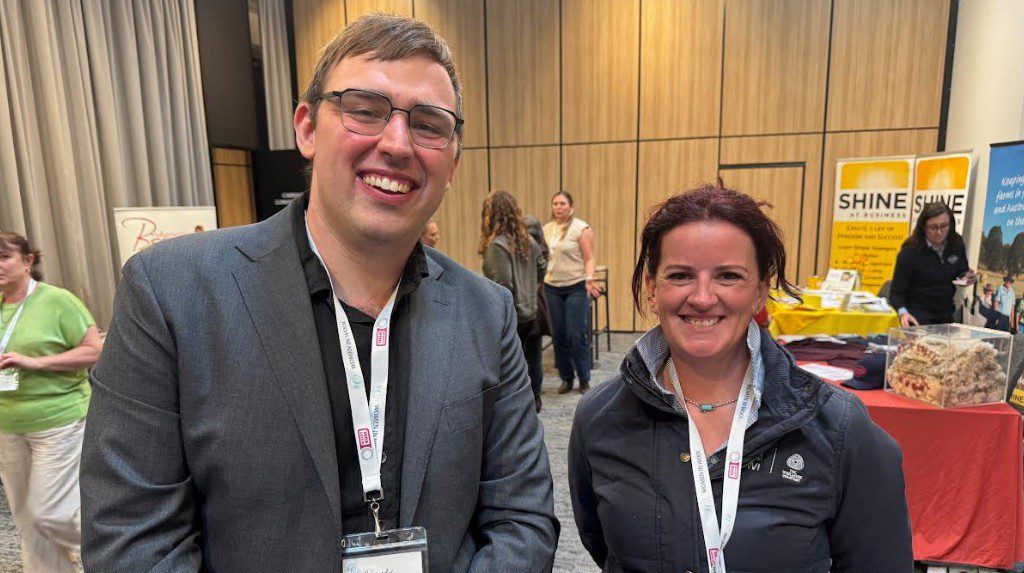
Deakin University’s Dr Aleksander Pasquini with Holly Byrne from Australian Wool Innovation at the Women In Wool conference.
AI control, critical thinking and future jobs
One of Dr Pasquini’s overheads said AI is not going to replace every worker overnight, with real-world adoption currently slower than the hype, but early-career white collar roles would feel the pressure first and over the long-term, AI could reshape the economy.
But despite companies like Atlassian, Amazon and Meta announcing job cuts and laying the blame on the advent of AI, Dr Pasquini told the Women In Wool delegates that AI would not take jobs.
“You can’t get AI to replace human shearers.”
Dr Pasquini said some companies are firing workers because they had over-hired during COVID and were using AI as an excuse.
“What AI is doing is replacing some tasks, it is not replacing entire jobs.
“So think about in your job, the tasks that fulfil the three conditions I was talking about – the tasks that have high information, high repetition and low variability,” he said.
“Those tasks will probably be replaced with AI, but I’m willing to bet 90 percent of your job isn’t those repetitive information tasks.
“There will be other things that you do in your job that AI won’t be able to replace,” Dr Pasquini said.
“So AI will be introduced and it will be there to support you, not replace your job.”
But the caveat is that there will be some jobs that will be more impacted than others.
“Early career white collar workers – the graduates coming out of universities – are having a very tough time at the moment, because again the tasks that have the high information, that have the high repetition and have the low variability are generally given to them, and now the companies think there is no need for them to be hired anymore because they get AI to do it.
“Those people are being most affected now, but it is not going to across every industry, and what AI will end forcing us to do overtimes, as it gets better, it will start doing more tasks, so what’s left for the humans to be doing is tasks that require more critical thinking,” Dr Pasquini said.
“That’s what separates us from AI; AI doesn’t think like a human, it’s only recognising patterns and data.
“So we will be forced to do tasks that require more critical thinking; some people will be able to adapt well, others maybe not so much, but that’s probably the future of jobs, to be doing things that require harder critical thinking,” he said.
“But at the same time, I believe that AI is going to be reducing our critical thinking.”
His presentation overhead said AI had caused a shift in workers from doing tasks to checking output, and over-reliance may weaken judgement and reasoning.
“Faster is not always better if it makes us shallower,” his overhead said.
Dr Pasquini said he had seen many university students get AI to do a task for them and there is no questioning of the output that they receive.
“They get it to do the task and there is no learning, there is no thinking about it, they just end up taking that AI output as a product of their work.
“But what’s needed is the friction of you trying to solve a task; that’s what increases your critical thinking,” he said.
“If I am just getting AI now to do everything for me, I don’t need the critical thinking skills anymore and they will weaken over time and that will mean that you won’t be able to perform well in the new job market that’s going to be coming up.
“It’s a similar thing to what happened with TikTok and short-form videos,” Dr Pasquini said.
“With those videos I can watch 30 seconds and get a big amount of dopamine, so I am training my brain over time to now expect dopamine in 30 seconds.
“So now when I try to and something like read a book or watch a movie my brain says ‘why am I doing this, I can watch a 30-second video and get the same amount of dopamine’,” he said.
“So my attention span shrinks over time.
“That is going to happen, but now affecting our critical thinking with the new AIs that are coming out.”
Dr Pasquini recommended if people wanted to use AI to help them in their job, they should do as much work as they can by themselves and then get AI analyse their work and see where there areas for improvement.
“But sometimes you are under pressure and need to do things quickly; if you want to get AI to generate something more quickly, you can.
“But then what you need to do is build upon the AI’s work; improve it and refine it, add your critical thinking skills to it,” he said.
“Do not accept an AI output as the final product; do put some effort and some thinking into it, otherwise you will weaken your critical thinking skills and struggle in the future.”
Dr Pasquini said he disagreed with the prediction and assumption that exponential growth would create an AI that could “pretty much take over the world” because it would be more intelligent than a human.
“As we have seen previously with the AI projects in the wool industry, it didn’t matter how intelligent the AI was, what mattered was the data that’s being fed into it.
“If an AI (application) doesn’t have the data that it needs it won’t be as intelligent as a human, because a human has many different data sources; our eyes, our feel (touch), our tongues for testing, that an AI doesn’t have,” he said.
“So if we don’t provide it the data, it won’t be more intelligent than what we can be.
“What is a concern though, is control.”
Dr Pasquini said AI has gets more intelligent – better at coding – it will be able to come up with ways that could make it harder for us to control what the AI is currently doing.
“But this again assumes that an AI will become evil, which is putting human values into AI and AI does not think like a human.
“So there is an assumption here, probably from a lot of pop culture movies, where as AI gets intelligent it is going to become evil and destroy us – it doesn’t need to go that way,” he said.
“What an AI might do is try and defeat control, but it may not be doing that out of evilness; it may again be a misalignment between the human and the AI’s goals.”
HAVE YOUR SAY