
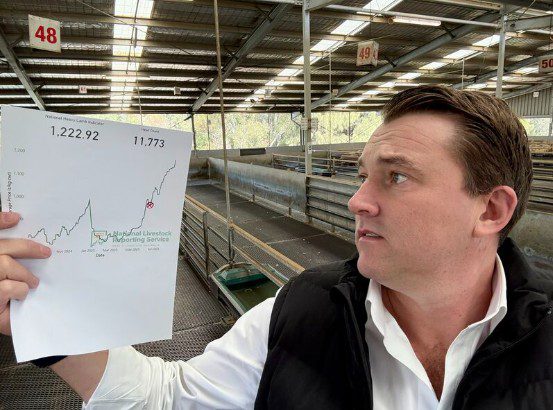
Gundagai Meat Processors CEO Will Barton has started an industry discussion on where to for lamb.
A CALL for a lamb supply chain system consistently delivering high eating quality product recognised and rewarded by the market has been supported by several industry figures.
After the Meat & Livestock Australia’s heavy lamb indicator passed $12/kg this week, Gundagai Meat Processors chief executive officer Will Barton doubled down on LinkedIn outlining the risk in supply shortages being mistaken for market signals.
“And when that happens, we start building an industry response on shaky ground,” he posted.
“Right now, the Heavy Lamb Indicator is at $12.20 per kg, but prices aren’t being driven by consumers rushing to pay top dollar.
“This is a processor-led squeeze,” he posted.
“With limited lambs on the ground, processors are scrambling to secure supply, not just to fill orders, but to keep plants operational and retain staff. It’s desperate stuff.”
Mr Barton said the industry currently has too much processing capacity for the number of lambs available.
“In more balanced times that capacity might be right. But today, it’s leading to a tug-of-war over limited supply at unprofitable levels, just to keep the lights on,” he wrote.
“That’s not sustainable. And it doesn’t serve the long-term interests of anyone in the supply chain.”
Mr Barton posted that if the industry wanted to break free from boom/bust cycles it needed “to build a system where consistently delivering high eating quality lamb is recognised and rewarded by the market.”
“The current system incentives both producers and processors to chase commodity cycles hard, and the harder you chase a cycle, the harder the fall when it ends – nothing cures high prices, like high prices.
“This isn’t something that’s easily executed, I realise the challenges as well as anybody,” he posted.
“However, at Gundagai Lamb, we remain committed to a clear, measurable, and repeatable standard for lamb quality that ultimately gives producers confidence, supports long-term value, and builds consumer trust in what premium actually means,” he wrote.
Building a supply chain that sustains prices
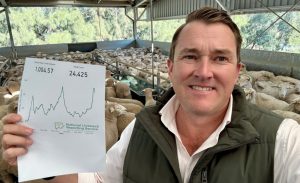
Will Barton when the heavy lamb indicator went over $10 a kg.
Mr Barton’s post this week followed his first foray into the issue in a post two months ago when the heavy lamb indicator had just topped $10/kg.
“Record-high lamb prices have everyone talking. Here’s my take.
At Gundagai Lamb, we want to maximise farmer profitability. We already pay a premium above market for livestock that meets our GLQ5+ standards. Exceptional producers deserve exceptional returns.
But the challenge is that when the market calls everything premium, it destroys the value of what is truly exceptional.
Every time we say all lamb is lamb, we drive the industry towards commodity pricing. Every time customers get an average experience at a premium price point, we lose them.
Australia holds just 5.8% of the global sheep flock. Yet we are the world’s largest exporter of lamb. Australia’s leadership of the premium market is clear, however we should define it, setting a standard that no one else can match. Instead, too often, a great product is dragged down by an average product wearing the same label.
The math is simple but painful. Export markets will not pay a premium for what they cannot distinguish from the average. Food service switches to beef or chicken when they cannot see or taste the difference. Retail customers eventually stop paying extra for inconsistent experiences.
That is why we have built GLQ5+. It is science-backed, objectively measured and delivers a consistently superior eating experience.
Right now, this matters more than ever. Record prices will only hold if the market can see and taste the difference and is willing to pay for it.
That is the opportunity in front of us. To reward the best producers. To deliver the experience customers expect. And to build a value chain that sustains these record prices, not just this year, but for the long term.”
Need for stable models of breeding and finishing
After Mr Barton’s post this week, Lambpro general manager Tom Bull wrote that the past few years highlighted the inadequacy of the lamb industry, and the need to look at more stable models of breeding/finishjng, prompting agreement from the GMP CEO.
“We’ve caught up with beef in respect to marbling/eating quality grading, but we now need to progress more supply chain sophistication in forward contracting and feedlots to help buffer the entire chain.”
Kerin Agriculture CEO Nigel Kerin commented that he was “singing out of the same hymn book.”
Agrista director and consultant John Francis said he had plenty of clients willing to change their system to deliver what the market appears to want.
“I just don’t see a willingness from the market to pay my clients what they need to be paid to warrant changing their production system.”
But he said many producers understand they need to be able to supply the product first, so a brand can be built around it, so premiums can then be paid.
 “I can think of at least one beef brand that’s gone by the wayside for lack of reliable supply.
“Really need more of a partnership approach between seedstock, commercial producer, processor and retailer to make sure everyone gets a bit of the pie and we’ll all be better off. I’m a huge fan of what Will Barton and Gundagai Meat Processors are doing leading by example.”
Mr Francis wrote that 20-plus years of farm benchmarking data has shown him that profitable lamb systems are built on optimising productivity not price.
“I am willing to have my beliefs challenged on this, but I can’t see a compelling case for change yet.
“I also haven’t seen many of our highly profitable beef producers compelled to change their existing profitable production system despite the value chain offering brand offtake opportunities for different trade weight ranges at potentially higher prices per kg,” he wrote.
“This suggests to me that the processing sector is prepared to pay a small premium, but that price premium is currently insufficient (in other words too risky) to warrant a change to an already profitable system.”
Mr Starling said what a few niche players are able to do doesn’t necessarily extrapolate out at the industry level.
“Not everyone will drive a rolls Royce or eat Wagyu or GLQ5+ lamb every meal.
“There’s a place for premium product as well as every day product.”
Isabele Roberts from Ridgehaven Poll Dorsets and the Bowan Park Poll Dorset Research Project said she hoped the current market situation would be a catalyst for change.
“Well said Will. Price volatility is only good for one thing – eroding confidence and causing headaches,” she posted.
“Wouldn’t it be great if this 3 year rollercoaster could find some sort of balance point.
“Ability to smooth out supply through a dedicated finishing sector, accurate production predictions, and regular forward pricing contracts would go a long way to ease the concern of both producers and processors,” she wrote.
“I hope this crazy pricing – where anything on the hooks is better than nothing – is the catalyst for change in the lamb industry as a whole.”
Telang Lamb + Beef owner James Starling said a bit more price stability would be appreciated.
“The wild swings do none of us any good.
“More lambs in feedlots will help smooth supply shocks which will help the whole value chain but we also need balanced forward markets with buyers and sellers locking prices in to help encourage the feedlot sector to grow as well as just provide a bit of price stability.”
Rabobank senior analyst, animal proteins Angus Gidley-Baird also commended Mr Barton’s comments.
“The consumer demand is there, but it is not the reason for these record lamb prices.
“And while supply has shown record volumes it is more the expectation of supply to come that is driving current prices,” he wrote.
“Once that future supply becomes clearer prepare for prices to correct.”
Follow the LinkedIn discussion by clicking here and next week look for more on this on Sheep Central from Will Barton and producers.
It’s time all sheep bodies combined together. There are too many different levies. Growers have sheep of all breeds; whether they are Merino for wool, Merino/meat for wool, meat sheep with wool or meat sheep without wool. One body, one executive, one set of overheads, one levy.