
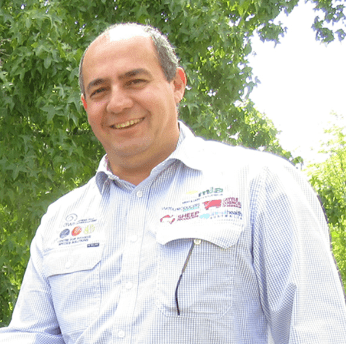
National Wild Dog Management Plan coordinator Greg Mifsud
WILD dog and dingo populations are increasing within conservation areas despite target control efforts on public land perimeters for conservation and livestock protection goals, according to National Wild Dog Management coordinator and ecologist Greg Mifsud.
While outlining the control program around the Namadgi National Park in the Australian Capital Territory, Mr Mifsud said wild dog management is not about wiping out populations.
“It’s about keeping negative impacts to manageable levels in specific areas.”
“It’s obvious that the rate of increase amongst wild dog and dingo populations across the country is far greater that those being removed by control programs or natural mortality, because the populations continue to persist across about 80 percent of the continent and are naturally increasing in other areas,” he said.
“If they were not resilient to this type of control, then wild dogs and dingoes would have been eradicated long ago.
“But that’s not the case: populations continue to regenerate.”
The National Wild Dog Action Plan has commended the targeted wild dog control efforts of the ACT Parks and Conservation Service along the boundaries of Namadgi National Park, focusing on managing wild dog populations that pose risks to adjoining properties.
A central aim of this control program is the ground baiting and trapping of wild dogs in conservation areas adjacent to rural lands, to reduce attacks on livestock, a NWDAP media release said.
The program occurs within identified buffer areas which are adjacent to conservation areas and not the whole park, Mr Mifsud said.
“Contrary to some recent media reports, dingo and wild dog populations continue to turnover through births, deaths, immigration and emigration, so control methods are an essential management tool,” said Mr Mifsud.
Namadgi National Park shares its boundaries with large expanses of wilderness such as Kosciuszko and Brindabella National Parks, which also support dingo and wild dog populations.
These wilderness areas are interconnected so the dingoes in Namadgi National Park should not be viewed in isolation, but as part of a larger population that spans the entire region.
NWDAP chair and Western Australian lamb and wool producer Chris Patmore said dingoes interact with a wide range of native, introduced and domestic animals, and not all interactions are positive.
“They are a formidable predator that can cause severe impacts to farmers and landholders by harming livestock, particularly sheep.
“These attacks cost the Australian economy upwards on $89 million per year, causing serious emotional and psychological damage to rural communities and families,” he said.
The NWDAP said it remains committed to evidence-based, humane, and targeted control measures like those around the edge of the Namadgi National Park, that support both conservation and livestock protection goals.
The NWDAP said it promotes a nationally coordinated approach to managing the negative impacts of wild dogs on primary production, environment and social assets throughout Australia and is supportive of existing focused wild dog control efforts such as those being utilised by the ACT Parks and Conservation Service.
For more information about the National Wild Dog Action Plan, visit www.wilddogplan.org.au.
Thank you for keeping us informed.
So, the NWDAPC are making these assumptions and sprouting it as fact from no actual research? Interesting.