
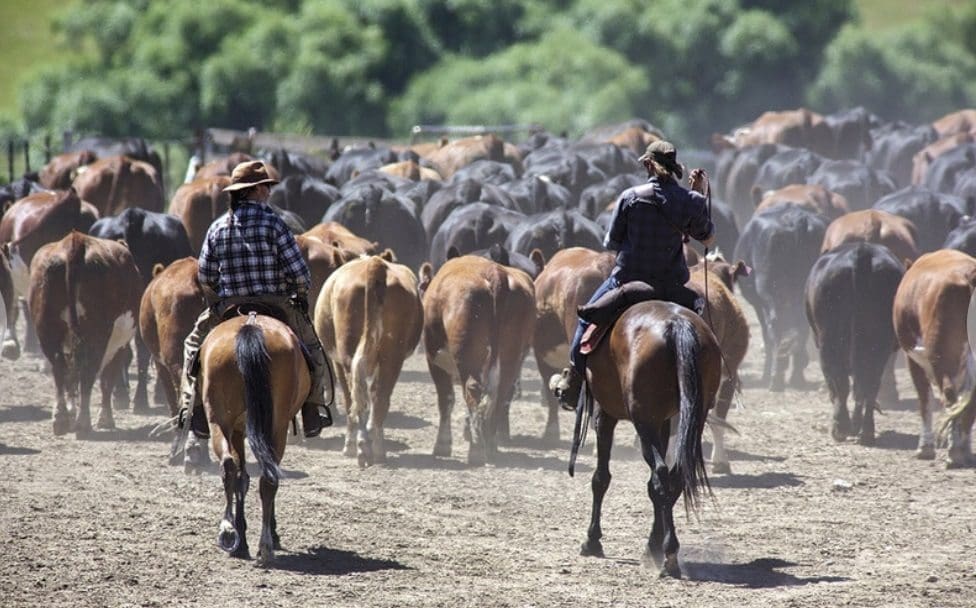
Cattle being moved on Cobungra Station, sold in July for $52.9m to Silva Capital
THIS week’s property review highlights six trophy livestock grazing assets that have changed hands in just six months, in a sales run described by a veteran marketing agent involved in the sales as unlike anything he has seen in three decades.
LAWD real estate specialist Danny Thomas has spent almost 30 years marketing rural properties but describes the past six months as the most extraordinary of his career.
Six years ago, the 50 year-old joined the then fledgling real estate firm LAWD. Since January, the agency has successfully sold six benchmark properties, with Mr Thomas hinting the deals are just the tip of the iceberg.
Many agents would consider selling just one of the assets as a career highlight.
The recent transactions include:
Cobungra, Victoria
In July, the standout Victorian high country grazing property Cobungra Station sold for $52.9m to Silva Capital – a joint venture between Roc Partners, the primary shareholder in Stone Axe Wagyu, and C6 Investment Management.
 The pioneering carbon fund and asset manager is planning to transition parts of the property from grazing into forestry.
Spanning 31,292ha, Cobungra is one of the largest contiguous rural holdings in Victoria, capable of running 50,000DSE.
Cobungra is located in the Victorian Alps region at the foothills of Mt Hotham, 9km from Omeo. It is a showcase grazing holding that also supports a lavish homestead and lifestyle complex, and grounds.
Rushy Lagoon, Tasmania
Also in July, the federal government approved the sale of Tasmania’s largest farm to UK investor Gresham House for a figure north of $100 million.
Comprising two adjoining properties (20,523ha Rushy Lagoon and 1221ha East Wyambi) in the state’s far north-east, Rushy Lagoon was offered with substantial water entitlements (12,548ML) and an estimated carrying capacity of 85,000DSE.
Under the new ownership, land use will transition from beef and dairy production and irrigated and dryland cropping into forestry over much of its 21,745ha.
Nappa Merrie, Queensland
Moree-based Antony Glynn, principal of Glynn Agriculture and Ottley Capital, and a prominent NSW beef processor who has smaller grazing assets closer to Thargomindah, paid close to $70 million for the blue-ribbon Queensland Channel Country grazing property Nappa Merrie.
Nappa Merrie is located on the South Australian border, 300km west of Thargomindah, and spans 727,700ha and runs around 14,000AE.
The heavy flood-out country from the Cooper Creek and Wilson River systems creates rich native pastures, acting as a natural green feedlot.
Rockybank, Queensland
In June, prominent Queensland Wagyu producer Laird Morgan and family purchased most of the Roma district backgrounding and breeding property aggregation, Rockybank.
The Morgans bought the 16,440ha Rockybank and the 4145ha Holyrood which were offered during the marketing campaign with a price guide of $35m and more than $12m respectively.
The adjoining 2082ha Maffra sold separately to a local grazing family for more than $8m.
Yarranbrook Feedlot, Queensland
In May, Toowoomba-based grainfed beef supply chain manager Allied Beef (backed by the Laguna Bay Agricultural Fund No. 1) paid around $55 million for the 13,439ha Yarranbrook feedlot near Inglewood on the Queensland/New South Wales border.
The feedlot was offered with a working capacity of 18,540 standard cattle units, it has approval to expand to 35,000 SCU.
It is supported by more than 3000ML of water entitlements from the Macintyre Brook and Coolmunda Dam system.
Pinegrove Feedlot, Queensland
Wagyu identities Peter and Jane Hughes alongside Queensland cattle producer Chris Shaw paid $53 million for the 882ha Pinegrove Feedlot between Millmerran and Cecil Plains.
The turnkey, modern feedlot was offered with 9698 Standard Cattle Units, with approval to expand to 21,100SCU.
It has 385ML of high-security groundwater and a licence to impound up to 234ML of surface water, supporting both irrigated and dryland cropping.
Demand, despite challenges
Despite uncertainty weighing on confidence, Mr Thomas said demand for premium cattle assets remains strong.
“In reality, these sorts of sales should not be happening. Money is expensive and costs have been difficult to manage since the Middle East crisis, but the market is doing the opposite,” he said.
“There is good inquiry evident for well-presented, productive assets with scale, water security and clear strategic value.”
Mr Thomas said the renewed activity was being driven in part by pent-up demand, after many buyers sat on their hands through 2024 and 2025.
“On the flip-side, much of the broader market is still catching up after the sharp correction that followed the rural property boom three years ago.”
Boom into cooling phase
In 2023, the Australian rural property market shifted from a historic boom into a cooling phase, marked by slower price growth, lower transaction volumes and rising interest rates.
At the start of the year, Mr Thomas predicted property prices would “bump”.
In February, he said Australia was entering a red meat boom, despite ongoing pressure in some parts of the market.
“While it remains tough in some market segments, Australia is in the midst of a red meat boom. Cattle and lamb prices are going exceptionally well and that will heavily influence the property market in 2026,” he said at the time.
He said that forecast was now proving accurate, with stronger livestock returns putting some producers in a position to move.
“At the upper end of the market, some producers are in a strong cash position. Those who run cattle or sheep and have benefited from recent livestock price gains are generating substantial returns,” Mr Thomas said.
He expected buyers with the capacity to act early in 2026 were likely to have the advantage, with available properties expected to be absorbed quickly and competition to intensify as supply tightened.
Buyers
Australia’s rural property market is attracting a growing pool of natural capital investors targeting environmental assets such as forestry, farmland and regenerative agriculture to deliver financial returns as well as ecological benefits.
Some of the largest investors active in Australia include Manulife Investment Management, Nuveen Natural Capital and New Forests, which manage extensive portfolios spanning farmland, horticulture and integrated forestry-agricultural landscapes.
Mr Thomas said large-scale irrigated agricultural assets continue to attract institutional interest from Australian companies and fund managers, while cashed-up impact investors and major emitters are also emerging as powerful buyers.
“They have hundreds of millions of dollars to spend on direct exposure to Australian carbon credits. They are a real and significant part of the market now and will be part of the buyer pool every time.”
He said many of these buyers are European family offices with a more forward-looking view of future carbon markets.
He said scale is a key driver of their investment decisions.
“To make a carbon project work, particularly if it involves planting some form of trees, it needs to be at a significant scale. That is why these assets are being secured, particularly those with reliable or high rainfall. They are location agnostic.”
Several major assets have already been bought by natural capital investors this year.
- UK-based Gresham House, which invests in Australian agriculture and forestry to capture long-term financial returns through natural capital, timber production and emerging environmental markets such as carbon and biodiversity credits, purchased Tasmania’s Rushy Lagoon.
- Victoria’s Cobungra Station was purchased by Silva Capital, which plans to transition parts of the property from grazing into forestry.
- Also in Victoria, the 278ha Strathayre near Broadwater was carved off a larger property and sold to a local natural capital group, while part of the Hilltop Aggregation was sold to forestry interests.
- Global nature-based investment manager New Forests secured the 1857ha Mt Hannibal and Kerrawarra, one of the largest contiguous grazing assets in the Southern Tablelands region of New South Wales.
Mr Thomas said market conditions are expected to strengthen through the remainder of 2026.
“There is a heavy weight of capital waiting to deploy in the rural property market. Traditionally, buying activity increases in the third and fourth quarters, and this should result in some big deals before the end of the year.”
Current LAWD listings of significant scale include:
Wyadra and Cowl Cowl, NSW
Adjoining Riverina assets carrying substantial water entitlements are expected to attract more than $200 million.
The 19,496ha Cowl Cowl and Wyadra Stations are divided by the Lachlan River but run as a single operation producing irrigated and dryland crops (cotton, canola, wheat and barley), alongside a 604ha almond enterprise (on Wyadra).
Beyond the irrigated footprint and almond orchard is extensive dryland cropping, grazing and support land.
Maxwell Ag Portfolio, NSW
Anticipated to make more than $33 million, the institutional-scale Maxwell Ag cropping portfolio is located on the South West Slopes of New South Wales.
It comprises seven holdings across 4177ha and is being offered for sale as a whole or in individual combinations.
Around 88 percent (3672ha) is considered arable, with the 2026 cropping program consisting of 1212ha of canola, 528ha of wheat, 1305ha of barley and 570ha of faba beans.
Gillenbah Aggregation, NSW
Situated on the Murrumbidgee River in the Riverina region of New South Wales, the Gillenbah Aggregation is expected to attract offers in the high $20 million range.
The 2806ha irrigated and dryland cropping asset is relatively flat and features fertile alluvial soils suited to growing cotton, cereals and oilseeds.
Around 81pc of the landholding is arable, including 656ha of laser-levelled flood irrigation.
The operation is underpinned by 4387ML of water entitlements, as well as 4km of Murrumbidgee River and 8km of Yanco Creek frontages.
Arrowsmith Portfolio, WA
In Western Australia’s Mid-West, the 11,288ha Arrowsmith Portfolio (3302ha Arrowsmith, 3677ha Eraramba and 4309ha Rainey Plains) is being offered with price expectations of more than $76 million, or about $8000 per arable hectare.
Across the 2024, 2025 and 2026 seasons, more than half of the arable area has undergone comprehensive soil testing and amelioration, including deep ripping, spading, delving and lime sand applications.
Over the past four years, yields have averaged 2.7t/ha for wheat, 1.32t/ha for canola and 1.44t/ha for lupins.
Inglestone, Qld
The 6445ha Inglestone is a Western Downs cropping and grazing aggregation, comprising three holdings, in southern Queensland’s feedlot corridor.
The open farming country is underpinned by chocolate to grey self-mulching cracking clays, with areas of red soils.
Around 4573ha (71pc) is used for dryland cropping (wheat, barley, chickpeas and sorghum). The 1872ha balance runs 580 Adult Equivalents or 1AE per 3.3ha.
HAVE YOUR SAY