
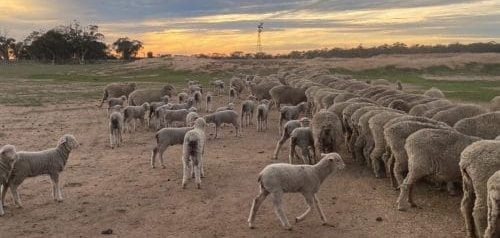
Mulesed Merino lambs with their mothers, Image – The Livestock Collective.
AUSTRALIA’S peak veterinarian body has advocated phasing out mulesing as soon as a sustainable transition to flystrike-resistant sheep can be achieved, recommending the sheep industry commit to a deadline to end the breech modification practice or that this be regulated by government.
The Australian Veterinary Association’s mulesing policy previously recognised the surgical practice as a necessary sheep husbandry procedure to prevent flystrike provided it is performed by skilled operators on young animals with pain relief and as part of an integrated flystrike management plan.
The new AVA policy ratified on 16 July states: “It is important that mulesing is phased out as soon as a sustainable transition to flystrike-resistant sheep can be achieved.
“A sudden ban is not advocated, due to the devastating effects and suffering caused by flystrike; it is essential that a phase-out period is established during which accelerated breeding for flystrike resistant sheep is prioritised,” the new policy says.
“Industry should commit to a deadline, or the government should establish one (to prevent the timeline being pushed out indefinitely).”
The AVA recommends that industry, veterinarians and government extension officers work together to achieve the phase out of mulesing in the shortest possible timeframe.
“During the transition period, non-surgical and non-painful procedures to reduce the risk of breech strike should be used in preference to mulesing wherever practical and effective.
“In cases where mulesing is performed during the transition period, the welfare impacts must be mitigated through use of appropriate technique and mandatory multi-modal analgesia,” the AVA policy says.
“The Animal Welfare Task Group should expedite the review of the Australian Animal Welfare Standards and Guidelines for Sheep, particularly the chapters on mulesing and other surgical husbandry procedures.”
The AVA has recommended that veterinarians and industry experts be consulted by farmers undertaking transition to a non-mulesed flock.
It has also recommended that Australian Wool Innovation’s flystrike extension program with group and individual sessions with accredited advisors be supported by government funding.
The AVA also believes all states and territories must mandate multimodal pain relief in their legislation for mulesing during any phase-out period and there must be training of contractors in appropriate surgical and non-surgical technique and multimodal pain relief administration.
Sheep veterinarians resisted a mulesing phaseout deadline
President of the AVA’s Sheep, Camelid and Goat Veterinarians Group Prof Peter Windsor said the main changes in the AVA’s stance on mulesing were recommendations that all states and territories mandate multimodal pain relief in their legislation for mulesing during a phase-out period, selection of plainer breech/low wrinkle rams and industry incentives to expedite the transition to flystrike resistant flocks.
Prof. Windsor said there is a very strong call from animal welfare groups to phase out mulesing as soon as possible.
“But there is strong recognition within the veterinary profession, identifying with the wool producers, that this is a very challenging thing to do, that it takes a long time.
“And whilst we have studs being able to achieve that, there is a predominance of commercial Merino flocks that will continue to mules for extended periods because that is the best form of flystrike management for them,” he said.
“So we are stuck in that had place between the call of the welfare groups and the need for producers to continue to mules.”
Prof. Windsor said the Sheep, Camel and Goat Veterinarians Group had been “quite strong” on resisting a specific timeline on phasing out mulesing “even though the policy does allude to that a timeline should be developed.”
He said the sheep, camelid and goat veterinarians recognised that the time needed to phase out mulesing would be variable between flocks.
Prof. Windsor said the new policy is a compromise between the AVA’s Animal Welfare Task Group and the Sheep, Camelid and Goat Veterinarians Group.
“Certainly the welfare group wants to phase it out as soon as possible, whereas the sheep group wants to maintain for the benefit of the welfare of sheep.”
Prof Windsor said despite the use of plain breech rams, two attempts to cease mulesing the University of Sydney’s flock had been unsuccessful and hoggets had to be mulesed because of unacceptable levels of flystrike during wet summers.
“I’m hoping that cool heads will prevail, clearly we have to be seen to be moving with the times … and the main take away message is that we support that eventually it will be phased out, but that mandatory pain relief is required in that extended period of the transition, but not agreeing to a timeline for that to occur at this stage.
“People want a timeline, but there isn’t enough evidence to support that; certainly the (research) papers that suggest you can achieve a mulesing free flock within ten years is applicable to studs, but that doesn’t appear to be the case for the majority of the commercial flocks.”
Animal protection bodies welcome AVA policy change
Australia’s leading animal protection organisations united yesterday to welcome the AVA’s new mulesing policy.
Humane World for Animals Australia, FOUR PAWS Australia, Animals Australia and the Australian Alliance for Animals described the policy as one of the most significant animal welfare policy developments on the issue in recent years.
Humane World for Animals Australia’s program manager for animal welfare, Georgie Dolphin, said the policy development represents a turning point for sheep welfare reform in Australia
“Australia’s peak veterinary body has made it clear: the future lies in breeding flystrike-resistant sheep, not cutting lambs,” she said.
Alliance for Animals director of policy, Dr Jed Goodfellow, called on the Federal Government and Agriculture Minister Julie Collins to act on the AVA’s recommendations.
“The need for an urgent review of the National Standards and Guidelines for Sheep to establish a practical phase-out timeframe could not be clearer,” Dr Goodfellow said.
“The industry has had over 20 years to agree to a pathway away from this archaic practice but is clearly incapable of doing so – it’s time for governments to act.”
Animals Australia CEO, Glenys Oogjes said effective flystrike prevention was essential, “but live lamb cutting (mulesing) is not, and never has been, an acceptable solution.”
“Flystrike is a serious welfare risk in the Australian environment,” Ms Oogjes said.
“But routinely subjecting lambs to an extremely painful procedure is not the answer.
“Breeding sheep who are naturally resistant to flystrike provides a practical, permanent way forward,” she said.
“The AVA’s policy underscores the growing expert consensus that genetic solutions provide the most effective and ethical long-term response to flystrike risk.”
FOUR PAWS Australia’s programs lead, Louise Ward, said the AVA’s position sends a powerful signal that Australia must move beyond this outdated, century-old practice.
“Australia is now the only country where live lamb cutting (mulesing) remains widely used as a primary flystrike prevention method, putting more than 10 million lambs through this torturous procedure every year,” Ms Ward said.
“The AVA’s call for a phase-out shows that breeding flystrike-resistant sheep is the economically sustainable and welfare-focused path forward, that will bring Australia into the 21st century and into alignment with global expectations.”
She said it is time for the government to develop a national transition away from the practice.
Ms Dolphin said the AVA’s position reflects growing international market expectations for more ethical wool production as well as consumer demands for better animal welfare. She said Australian wool producers are increasingly hearing from global markets that demand for certified non-mulesed wool is growing and supply is not keeping pace.
“The government should follow the AVA’s recommendations and accelerate reform of the national Sheep Standards and Guidelines and commence the review process without delay.”
The organisations have sent a joint letter to the federal and state agriculture ministers calling for an urgent review of the Australian Animal Welfare Standards and Guidelines for Sheep as a pathway to a mandatory national phase-out of mulesing.
Don’t repeat the previous deadline mistake – WoolProducers
WoolProducers Australia CEO Jo Hall said WPA’s mulesing policy is based on the following principles:
- Supporting the phase out of surgical mulesing only when there is a universally accepted alternative;
- Strongly opposing government regulation to ban the practice;
- Strongly opposing the setting of another deadline for the phase out of mulesing; and
- Advocating for the current definition of mulesing to be retained.
“The AVA has explicitly rejected a sudden ban, and they’ve recognised that flystrike itself is a serious welfare outcome.
“That’s an evidence-based position and we welcome it,” she said.
“Wool growers and veterinarians both want to address this issue in a responsible manner that result in good animal welfare outcomes for all types of sheep.
“The industry set a deadline once before without the science to back it, and the result was reputational damage and no welfare gain whatsoever, and we simply do not want to repeat that mistake,” Ms Hall said.
“There has been significant industry money, effort and resources dedicated to addressing the mulesing issue and we have seen definite progress in both genetics and management techniques in this space.”
Ms Hall said WoolProducers has called for pain relief to be mandatory when mulesing, and has been saying that publicly since 2018.
“The fact that nearly 90pc of growers who mules now use pain relief, shows how seriously they prioritise animal welfare.
“WoolProducers deliberately does not stipulate ‘multi-modal’, as the science indicates that when any form of appropriate pain relief is administered it leads to better welfare outcomes, than if no pain relief was used.”
Sheep Producers Australia to consider new AVA policy
Sheep Producers Australia CEO Bonnie Skinner said SPA has existing, publicly available animal welfare policy positions, including support for the use of pain relief for mulesing and encouraging producers to move away from the practice as soon as practical.
“Sheep Producers Australia’s Policy Council is responsible for considering and developing policy positions on behalf of Australia’s sheep meat industry, drawing on the views of producers and our State Farming Organisation members.
“The Australian Veterinary Association’s revised policy will be considered by the Sheep Producers Australia Policy Council, including any implications for sheep producers and the broader industry.”
I would like to know if Professor Windsor has ever managed a flock of Merino sheep. If he hasn’t, I suggest that he spend 12 months doing so. Then he would understand why we mules. As there is nothing more inhumane than watching a dying sheep with flystrike.
Whenever the mulseing debate arises graziers, like yourself, always make it sound as though flystrike can neither be prevented, or cured, by anything other than mulesing. You would have far greater credibility if you stated that all the other options are much harder and/or more expensive. It makes farmers sound cheap and lazy.
The biggest threat to the Australian sheep industry. It’s so disappointing we are still having these conversations.