
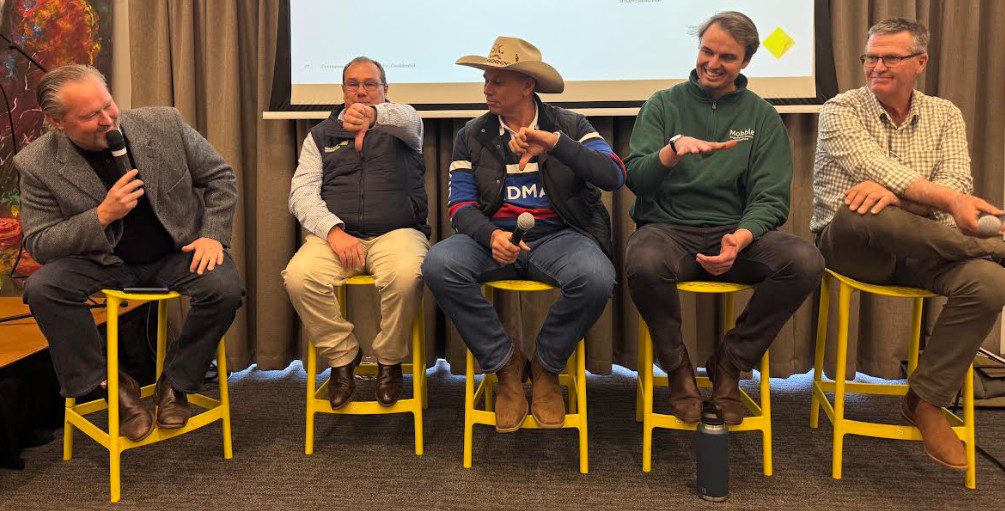
Banjo player CBA panel moderator Matt Dalgleish took the speakers though a thumb up thumbs down exercise to lighten the mood at the Sheepvention event, including their opinions of the instrument.
FROM contracting beef prices before the bulls go in to providing processing feedback to lamb producers and applying on-farm innovation, a Hamilton Sheepvention panel last week has given some key insights for successful cattle and sheep production and marketing.
A Commonwealth Bank hosted panel moderated by Episode 3 analysts Matt Dalgleish last week featured Thomas Foods International farm assurance program manager Mark Inglis, Mobble founder Jock Lawrence, Hancock Agriculture and S. Kidman Cattle Co chief executive Adam Giles and Kerin Agriculture principal Nigel Kerin.
Mr Kerin said his business is based purely on grazing sheep and cattle, despite being located in central west New South Wales in beautiful cropping country.
“I choose not to crop, mainly because I can’t control that and I’m a bit of a control freak.
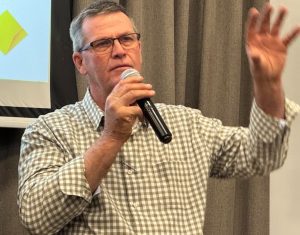
Nigel Kerin – pressure is privilege.
He said his sheep and beef business is based on “knowing your numbers, knowing what to invest in at the right time and that’s purely livestock, we’ve got no money off farm, everything we do is on farm.”
“And I think having some really good people … when you don’t know the answer, I can pick up a phone and always ask those people — I call them mentors – and they’re all spread across Australia,” Mr Kerin said.
“I’m very good at copying what people do really well – I sat next to the smartest kid in school and I got exactly the same marks as him because I copied everything, and nothing has changed.
“I’m 61 years old now and I went to a bloke’s place this morning – I picked up and copied some of the things he’s doing, his son happens to be working at home, so I’m really good at copying good things.”
When Mr Dalgleish asked him what are the key aspects that underpin a successful farm, Mr Kerin said “don’t listen to the noise and there’s plenty of it, more so every day,” advocating for dealing promptly with the things under your control.”
He said he listened to three radio stations while driving 1100 kms to Hamilton and then went to listen to podcasts.
“On the news of each one of them (radio stations) was how bad this El Nino is overseas and (for) Australia.
“I couldn’t give a shit what happens in Australia, we’ll manage it when it happens and we’ll gear ourselves up for when it happens, because we’ve been battle tested before, we came through that period of a three-year drought which was unheard of in our area and we came out of it with bells and whistles on … I know that because we are still here, that’s really cool,” Mr Kerin said.
“So that’s one of the things, I would just get that noise out of your business and I think anything that creates anxiety in your business, nip in the bud straight away and address it straight away.
“I was getting a bit of a pain in the gut from interest rate rises and I locked our money in the day before the last rise … so I had one more rise then I break even.”
Mr Kerin said “pressure is privilege, especially when you’ve got people working for you.”
“You’ve got to allow yourself to be stretched and get stretched and get stretched, because the human brain and body that gets stretched never returns to the same size, it just gets better and stronger.
“I think that is one of the key things all employers with their staff, pressure is privilege, put them under pressure and stretch them, because you build better humans.”
Top farmers are trying new things
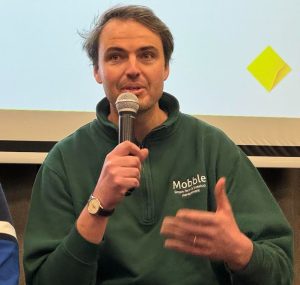
Mobble founder Jock Lawrence.
Creator of the livestock management platform Mobble Jock Lawrence said the top farmers are trying new things and technologies, looking for that next 2-3 percent productivity gain.
“And (they’re) solving the problems on their farm by looking over the fence and seeing what neighbours are doing and trying to get advice from them.”
Mr Lawrence said Mobble was involved with the management of 10pc of Australia’s sheep flock and 5pc of the cattle herd.
“Stagnation is a real risk in farming; we’ve got to keep pushing forward and trying new technologies and producing more food, because if we stay stagnant for too long we’ll fall behind.”
He agreed that farmers were more likely to listen to another farmer that they respect and trust.
He said Mobble was always to improve sales by listening to farmers and “pushing that software forward in the way that they want it to go.”
“It’s the same thing with building any business you’ve really got to keep looking to the next thing and pushing forward.”
Grow or die – Giles
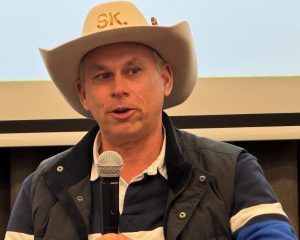
Hancock Agriculture CEO Adam Giles.
Mr Giles said from his experience, “you’ve got to grow or you die, you can’t sit still.”
He has a range of portfolios, including live cattle export from the Kimberleys, full blood Wagyus, FI Wagyus and crosses.
“Parts of the business where we sit still are the ones that don’t perform well and those where we do make changes is where we have better improvements.”
Mr Giles said he had been with Hancock Agriculture for 9.5 years and when he took over as CEO about four years ago he wanted to specifically change the business from a cattle to a beef business.
“I export beef out of Brisbane at the moment to 26 countries, nearly all chilled, with a bit frozen and I went around the world and I spoke to restauranteurs, to chefs … ‘what’s your biggest issue?’
“Their biggest issue is when they open the lid and they have inconsistent pieces of meat, for a range of different reasons,” he said.
Some of the chefs and restauranteurs told Mr Giles they were sick of the 2.4kg tomahawks (for four people) that only allowed them to turn a table over once, when they actually wanted four pieces of meat at 200gms that enabled them to turn the table over three times, instead of once.
“It helps the economy, helps their business… so I really took that onboard.
“So I’m running a full blood Wagyu on a 515-day feed program, so I decided to take that back a bit … so we’ve done a bit of math and it’s now on 450 (days), I’ve taken the F1 program from 350 to 225 (days),” he said.
“So I’m getting smaller pieces of meat and better managing the genetics that are going into it through a different program and I’m making sure there is consistency.”
Mr Giles said before making the production and lotfeeding changes he sold Kidman grain-fed Wagyu cross and composite cattle beef to four countries.
“I’m now selling to 18 countries and I can’t keep up with demand.
“And I know with the next F1 cycle … I don’t have any concern about that.”
S. Kidman Co’s F1 cycle refers to the company’s targeted production system of crossbreeding full-blood Wagyu bulls with commercial Angus cows to produce first-generation hybrid (F1) beef cattle.
A consumer focus works
Mr Giles he had a free-market philosophy, but wanted to take some of the market complexities out of his production business.
“I wanted to focus on the end consumer.
“So I’ve still got pastoral operations at Helen Springs Station in the NT and Morney Plains (in south-west Qld) and in the Darling Downs where fundamentally we’re more selling just cattle, only in the Kimberley we are just selling live export,” he said.
“But I’ve tried to move them focus on the beef, so that when I’ve got F1 cattle coming from Morney Plains and the channel country to Guyra to be backgrounded we’re making sure that they are coming in at weight.
“Because I know the feedlot gets the shits when the cattle aren’t coming in at 360kgs, when they’re coming in at 330 or 410 and they’re different size, because I know when you put them in a pen of 240 and they hit the truck and then the abattoir, they end up getting in a box at the wrong size.”
Mr Giles said he had to make his end consumer, the chef at a five star Four Seasons in the Maldives, happy. This meant ensuring his pastoral managers drafted cattle correctly for shipment.
“Because when he’s not drafting the right way the Maldives is not happy.”
Mr Giles said outlined how his business had continued to grow despite the Middle East conflict, the China restrictions and US president Donald Trump’s tariffs, and had no personal, professional or political concerns.
“I saw it as Trump standing up for his country, politically I don’t know whose standing up for Australia.”
He said the business is diversified across global economies, including into the United Kingdom under the free trade agreement, and was continued to access new markets for Kidman beef.
“In two week’s time I’ll be in the Greek Islands, I know that we are the biggest flue blood Wagyu suppliers to the Greek Islands, that’s diversification for us.”
Mr Giles said gas, iron ore or gold is sold under long-term offtake agreements where the sale price is known before it is mined.
“My endgame is to have offtake agreements with consumers of our product before I’ve got the bulls going over the cows, that’s what I want.
“Changing the culture of the business to do that is very hard to do, changing the culture of the end consumer is hard to do,” he said.
“So I might have 50 Four Seasons around the world …. coming to me to buy product, but I say no, you get all the Four Seasons in the world to buy my Wagyu – which I say is the best in the world – and I will guarantee it.
“You take the price at the top, I’ll moderate the top, I’ll moderate the bottom, so we take the pain out of both cycles and so I will actually know what I’m actually making at the start … I can’t get them there.”
National feedback to lamb producers is important – Inglis
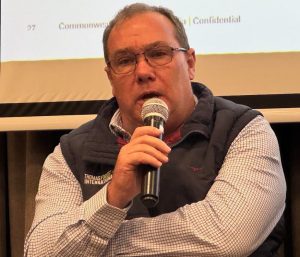
TFI’s farm assurance program manager Mark Inglis.
Mr Inglis said over his 20-25 years in the business and coming from a pig production background, but the eye opener for him was going to work for the customer-based Meat Standards Australia program for Meat & Livestock Australia.
“In meetings we always had an empty chair sitting in the corner and if we ever came to a standstill in the meeting, we always referred to the chair and though well what would the consumer think.”
He said the assurance programs he had helped roll out always had a customer focus.
“Even now in the sheep and beef business we are still looking for that feedback to get back to producers that produce that the customers and consumers want, and exactly right, consistency is always the key, the consistency throughout your product.
“And some operations do it well, and I suppose there a lot of different markets and some don’t necessarily want that consistency,” Mr Inglis said.
“But I can tell you most of them do.
“So having that feedback back to your customers is obviously important and it helps back on farm with your decisions.”
Mr Inglis agreed that the ability to hook track individual carcases via electronic identification within the sheep industry nationally for feedback to producers and consumers was “absolutely” important.
“Those that know me I’ve been on this EID stuff for a long time, and I probably see the benefits of it whether it is in the feedback side of it or at out the other end from a customer perspective, more and more so now and assurance programs are a part of that .. they are wanting know whether the animal has lived and breathed and how it was processed and lifetime traceability.
Not all customers are asking for it, but I can tell you there are more and more questions now than there ever was in regards to that lifetime traceability back to the farm.”
A great summary of the day’s discussion – thanks Terry Sim for covering it so extensively to give people that missed it access to some of the insights.