
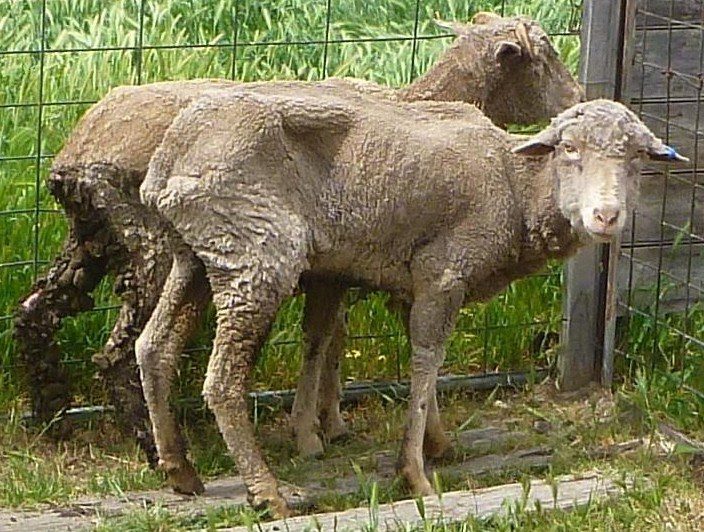
Some OJD infected Merino wethers. Image – supplied.
GUIDAIR vaccination against Ovine Johne’s Disease has been extraordinarily successful; it greatly reduces OJD deaths and the amount of bacteria shed in manure.
However, in recent years I have been seeing and hearing of more OJD. Most of the cases I encounter are in flocks that have stopped or delayed Gudair vaccination.
Some producers have stopped vaccinating because of the cost and because they have not seen clinical OJD for years. Others delay vaccination until they know how many ewe lambs they will retain. Wether lambs intended for slaughter may not be vaccinated, even though some are later retained or sold as wool cutters. These practices risk allowing OJD to become clinically important again.
After vaccinating every lamb drop for many years, a producer may rarely see an affected sheep. However, this does not mean OJD has disappeared from the flock or the property. Some vaccinated sheep can still become infected and shed the bacterium that causes OJD—Mycobacterium avium subspecies paratuberculosis.
The OJD bacterium can also survive in contaminated soil and pasture for many months—and, under favourable shaded conditions, for approximately a year. Because the bacterium may enter a dormant state and can be difficult to recover by culture, its maximum survival time in the environment is uncertain.
A producer who has not seen an OJD death for ten years may conclude that the disease has gone. More likely, the vaccination program is doing its job. When vaccination stops, successive drops of susceptible lambs enter an environment in which the OJD bacterium may still be present. They may become infected without showing any obvious signs.
Because OJD usually has an incubation period measured in years, the first indication of its return may be adult sheep losing weight and dying. By then, several unvaccinated lamb drops may have entered the flock, and infected sheep may be adding further OJD bacteria to the environment. Even after vaccination at lamb marking is reinstated, it may take many years of vaccinating every lamb drop to bring OJD deaths back to close to zero. Sheep infected while vaccination was stopped or delayed remain in the flock and may continue to develop clinical disease.
In my experience, Gudair vaccination at lamb marking is essential. It needs to be given before infection becomes too well established for the vaccine to contain it effectively. Young lambs can be exposed to OJD from early in life through contaminated pasture, soil and water, as well as manure contamination of the ewe’s udder and teats. After infection, the bacteria become established in the gut wall and multiply. The resulting inflammation thickens the gut wall and eventually interferes with the absorption of nutrients. Vaccination helps the immune system contain the infection, reducing the likelihood and severity of clinical disease.
Lamb marking, when lambs are commonly between two and eight weeks old, is the earliest practical opportunity to vaccinate the whole lamb drop while the lambs are already being handled. Some producers wean four to six weeks after lamb marking, while others wait much longer. Any delay gives infection more opportunity to take hold. If vaccination is delayed for several months—for example, until weaning or later—infection may already be well established and Gudair may be less able to contain it. Vaccination at weaning or later is therefore not equivalent to vaccination at lamb marking.
Gudair is a single-dose vaccine that provides lifetime protection. There is no annual booster. At about $4 per dose, the cost spread over the five- or six-year productive life of a ewe or wool-producing wether is equivalent to approximately 67–80 cents a year. Unlike an annual vaccine, however, Gudair only has to be given once.
Delaying vaccination until final retention numbers are known may prove a false economy if a valuable replacement sheep becomes infected before it is vaccinated. Not vaccinating wether lambs may be reasonable when they are certain to be slaughtered young. The problem is that plans change. Wethers intended for slaughter may later be retained or sold as wool cutters. Some are vaccinated only when that decision is made; occasionally as they are being loaded onto the truck. By then, they may already have well-established infection. Vaccination may not be able to contain infection acquired during their first months of life. These wethers may remain productive for several years before beginning to lose weight and develop clinical OJD. I have seen this happen many times.
Clinical OJD is now rarely seen in sheep under two years of age, and then only under very high-exposure conditions. However, infection and bacterial shedding can occur before clinical signs appear. My advice is that, unless producers are certain their wethers will be slaughtered before 18 months of age, they should vaccinate them at lamb marking. This reduces the risk that retained wethers will develop clinical disease and shed large quantities of bacteria, causing heavy pasture contamination.
Infected sheep shed the OJD bacterium in their manure. This contaminates pasture, soil and water and exposes future lamb drops. Reducing clinical disease and bacterial shedding through vaccination helps limit this contamination and reduce the continuing infection pressure on the flock.
It is difficult to overstate Gudair’s importance to the Australian sheep industry. Gudair became available to Australian sheep producers in 2002, when some severely affected Merino flocks were losing 10–15 percent of their adult sheep to OJD each year. Since then, it has transformed the control of OJD in affected flocks. Without Gudair, OJD would cause devastating and potentially unmanageable losses in many infected districts. The vaccine has allowed affected flocks to remain productive and profitable. Without it, some producers—and perhaps some sheep-producing districts—might no longer have a viable sheep industry.
Gudair is not perfect. However, it remains the foundation of OJD control in affected and at-risk flocks. Successful control should not be mistaken for eradication.
Disclaimer: This article was not commissioned or sponsored. Dr Jubb may recommend and supply Gudair to sheep producers as part of his ordinary veterinary work, but he does not have a financial relationship with Zoetis or any other vaccine manufacturer.
HAVE YOUR SAY