SHEEP industry concerns about the future impact of the European Union’s animal welfare policies on meat and wool imports remain despite finalisation of the recent Australia-EU Free Trade Agreement.
Sheep Producers Australia chief executive officer Bonnie Skinner has assured Sheep Central the animal welfare chapter of the FTA was dealt with some time ago, in previous negotiation rounds.
“It was agreed that the EU and Australia undertake to cooperate bilaterally and internationally to promote the development and implementation of scientifically-based animal welfare standards,” she said.
And WoolProducers Australia CEO Jo Hall said in her recent blog that “there is nothing in the A-EU FTA text, as summarised so far, that mandates alignment of animal welfare standards or provides the EU legal authority to impose such requirements on Australian wool.”
However, the FTA text also says that the parties recognise that animals are sentient beings and that there is a connection between improved animal welfare and sustainable agri-food production systems.
“The Parties shall cooperate in international fora to promote the development of the best possible animal welfare practices for animals farmed for food production and support the implementation of such practices.”
Ms Hall said concerningly, animal welfare is shaping up as an ongoing issue in trade agreements.
“Safeguard provisions exist, as they do in many trade agreements.
“Those applying to agriculture were reportedly softened late in the negotiations and are less stringent than those in the EU–Mercosur (Argentina, Brazil, Paraguay, and Uruguay) deal,” Ms Hall said.
“But trade agreements aren’t set in stone.
“They operate alongside other laws and regulations, and domestic political pressure in trading partners often leads to actions that go beyond what the agreement actually says, which is why vigilance on these types of issues matters.”
Concern over EU impact assessments
Ms Hall and South Australian seedstock and commercial producer and former Meat & Livestock Australia board member Andrew Michael remain concerned about the EU’s animal welfare requirements and how these might be acted on with regard to Australian sheep meat imports.
The FTA allows the EU to impose safeguard measures in case of a surge in EU agri-food imports from Australia when it causes or threatens to cause a serious injury to EU industry. And the EU has launched impact assessments to analyse potential alignment of production standards between domestic and imported products, notably on pesticides and animal welfare.
“The EU has very stringent standards to protect human, animal and plant health,” the European Commission has said.
The European Commission’s Vision for Agriculture and Food also signals a commitment to extend EU animal welfare standards to imported products.
Ms Hall said the FTA agreement text noting the launch of impact assessments “notably on pesticides and animal welfare,” was in itself is alarming.
“As it seems to reflect the very concerns that we have consistently raised with this deal.
“However, it is important to note that the current wording relating to animal welfare in the provisional text of the agreement is nothing more than cooperation and information sharing regarding animal welfare between Australia and the EU.”
Ms Hall said WPA is concerned about what the impact assessments might actually mean, and particularly if it could mean there was a risk that the EU could refuse the import of wool and sheep meat (lamb and mutton) consignments that cannot certify they are from non-mulesed flocks.
“Any talk of (animal welfare) equivalencies is a concern, that’s been our number one concern with this and probably any other trade deal.
“We don’t support equivalencies because we have unique geographic climatic conditions.”
Ms Hall said WPA had raised its concerns to the Federal Government and would continue to monitor the situation.
“We don’t know exactly what this will entail; however, at a principle level it is highly inappropriate for any trade deal to require equivalencies in production standards given Australia’s unique geographical and climatic systems mean our husbandry and production practices are tailored and specific to these unique systems.
“As mentioned, the provisional text only refers to cooperation and information sharing regarding animal welfare, which we are comfortable with, but the Australian government will need to remain watchful of any developments in this space, keeping in mind that the goal of FTAs is to ensure a level playing field between parties, which is the bare minimum that we expect our government to ensure.”
New call for greater traceability through the eNVD
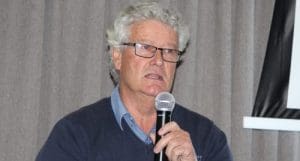
Sheep breeder and former MLA board member
Andrew Michael.
Dedicated industry animal welfare traceability advocate Andrew Michael said he was concerned about the exclusivity of A-EU FTA quotas “to ‘grass-fed’ sheep and goat meat, not raised in feedlots, with higher costs of production and higher sustainability credentials.”
Mr Michael said he interprets the agreement language as meaning the EU could refuse sheep meat imports that did not meet its grass-fed, sustainability and animal welfare requirements.
“And we have no traceability within our sheep meat system to actually justify what we are selling.”
Mr Michael said it indicates the EU is going to limit sheep meat imports that do not meets grass-fed and animal welfare standards. He has long argued that additional traceability components should be incorporated in Australia’s National Vendor Declaration to allow transparency on non-mulesing and pain relief for sheep.
“It’s been my argument all along that there is no traceability once an animal leaves my farm gate.
“So they can then say for any meat products, we will only take products that meet our animal welfare standards,” he said.
He is concerned that FTA language will be able to be used as an “out” or justification to limit Australian sheep meat imports. The EU has continually stated in recent years that Australia’s animal welfare standards on mulesing and pain relief are “basically illegal” in union countries, he said.
“It’s a real out for them.”
Mr Michael said he is not an advocate for banning mulesing. But he said additional animal welfare traceability components in the electronic NVD would drive the industry in the direction of meeting EU requirements and those of other markets.
“MLA and its Integrity Systems Company have let producers down by not introducing mulesing and pain relief status on the eNVD.
“They have been fully aware of the issue with animal welfare standard comparison differences with the EU for at least nine years.”
Ms Hall said WoolProducers has previously acknowledged and determined policy regarding that sheep are sentient beings that can feel and perceive the world around them through both positive and negative experiences.
However, she said legislation and regulation to safeguard animal welfare must be based on peer-reviewed evidence informing the scientific understanding of sheep sentience.
Ms Hall said in acknowledging sheep sentience, WoolProducers maintained that:
- Sheep do not have the same feelings as humans,
- Sheep can be owned for legally permitted activities (farming and associated permitted husbandry procedures as prescribed by relevant legislation).
HAVE YOUR SAY