
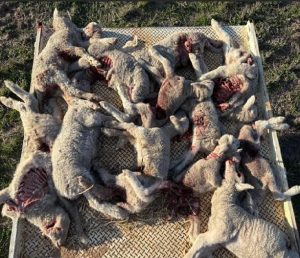
Lamb losses from a recent wild dog-dingo attack in north-west Victoria. Image – supplied.
NORTH-WEST Victorian sheep producers have united to collect DNA data to prove the source and extent of dingo attacks on sheep in the region.
Producers have suffered further attacks on their flocks from dingoes and claim the dogs are ranging further from park areas.
Dingo focus group leader in the West Wimmera Action Group, Marty Colbert, told Sheep Central said consultations have started with sheep producers adjacent to the Big Desert Wilderness Park after a recent spate of livestock losses that show strong indications of dingo attack.
He said as part of the ongoing verification process, mapping and collection of DNA samples from injured and dead livestock is being undertaken to ascertain the origin of the “attack species.”
Lawloit-based producer Alan Bennett said an attack on Thursday night last week killed 12 lambs and another 20 were bitten but will probably die. He is co-operating with the DNA project.
He said a neighbor, Murray Miller, estimates he has lost 480 ewes and lambs from wild dog or dingo attacks this year and has destocked a 1618 hectare (4000 acre) block.
“Then the dog has moved to another neighbor who has never had a dog attack and he lost 15 lambs in one go and a couple of ewes, and then moved his sheep away from there and he hasn’t had any further attacks.
“There are four landowners who have been heavily impacted,” he said.
“We are all south of the Big Desert (Wildnerness Park).”
Mr Bennett believed the dogs have now moved out of the park.
“They’re spending more time out of the Big Desert than in there and they’re ranging.
“They’re out of the Big Desert now and got no reason to go back in.”
Mr Bennett said he has been sent pictures of a dog print 19 kilometres from the park’s southern boundary.
“This is what we’re finding and we said this all along that the non-management of wild dogs will lead to them living in the open country.
“They’ve got no reason to go back into the Big Desert,” he said.
Mr Bennett said he had made the point when the unprotection order for dingoes in the north-west was removed in March last year that it was a management plan for dogs that came out of the park and caused problems.
Before March 2024, Victoria’s Wildlife Act (1975) Order In Council had removed protection for the dingo on private land, and on public land within 3km of the private land boundaries to public lands, enabling baiting and trapping.
“Now we’ve got dogs living and working the area causing massive livestock losses.
“The genie is out of the bottle and it’s not going to go back into the bottle, so it’s a lose lose,” he said.
“We’re getting whacked by these dogs and the dogs aren’t actually living in the Big Desert anymore.”
Mr Bennett said somehow the message has to get through to the authorities that “non-management of the dogs is not doing them any good.”
“The dogs won’t go back and live in the desert, they are going to be out in the open country and this is what is happening.
“The livestock losses are getting bigger.”
Mr Miller said he had lost 45 percent of the land he had previously run sheep on due to wild dog predation and was now considering appropriate fencing options.
“We’ve been there for 70 years and we’ve moved all of our sheep off that property.
“Our border fence is 20 years old, it’s a good fence, but it can’t keep the dogs out.”
He estimates that since the unprotection order was lifted he has lost “in the order of” 400 lambs and 80 sheep.
“I can’t verify that, they won’t listen to us, but that is what I believe it to be.”
Mr Miller said the Miller family have been farming in the desert area since the early 1900s.
I have serious concerns about the natural bias that farmers have to the dingo and this report is just more of the same. They are only calling them wild dogs because it suits the narrative. I tried to reasonably discuss dingo mating behaviours and the way they train offspring to avoid man on another page and was vilified by farmers who said they have no interest in the science or non-destructive methods of managing stock losses. One farmer advised me he had 20,000 acres and how he couldn’t do anything to mitigate his losses except through baiting trapping and shooting…and he spent a couple of hours arguing with me through the afternoon. He’s either not a primary producer or he isn’t doing anything to see to his flocks if he has that much time to spend arguing.
I’d like to ask the Victorian government how they think they going to keep these ‘dogs’ in the desert and away from farming land? Did they think this would not happen? It’s a senseless loss of livestock that would not have happened normally since this government decided that they need protecting. Who’s paying out their pocket to compensate for these losses?
400 sheep lost – 20 year-old fences?
Rather than looking for easy strategies like continuing to destroy Australian native wildlife their livestock welfare and management practices need far closer scrutiny. Perhaps the RSPCA should be involved to conduct a full investigation into the farming practices that have led to this sort of regrettable and tragic outcome.
Farming, broad acre pastoral grazing has changed the landscape to the continued detriment of the majority of our natives, those on foot and in the air. Farming livestock practices need improved practices to protect their money-making livestock. Is Australia to be ‘emptied’ of native animals so sheep can cover its landscape? Pastoral areas across Australia are devoid of a lot of natives. Livestock guard dogs, donkeys, dingo urine and improved care of livestock are proven ways of managing livestock without causing another extinction.
The farmers should get higher, better fences or have a dingo as a guardian animal for the sheep.
Simple.
I honestly think this approach misses the bigger picture — and risks reinforcing the same outdated narrative that’s helped push the local dingo population to the brink.
The truth is, sheep and lamb losses due to exposure, lack of shelter and inadequate animal husbandry far outweigh confirmed predator impacts. Groups like Sheep Advocacy Australia regularly visit properties and find large numbers of animals lost simply because they’ve been left out in brutal weather — not because of dingoes. It’s uncomfortable, but it’s real.
DNA testing won’t solve the problem. What are you hoping to prove — that dingoes exist in the desert? That a dingo/fox/eagle/raven may have scavenged on the sheep after they died due to neglect?
Dingoes have always been there. Long before fences, long before sheep. And in that time, they’ve played a vital role keeping ecosystems healthy and balanced.
The dingo population in the Big Desert is already dangerously low and under pressure. The real question isn’t whether dingoes are here, it’s how we can better support farmers like yourself to adapt — through non-lethal management, infrastructure, and fair support from government?
There are humane methods of protecting your stock. Why are they not being implemented?
DNA test is not going to prove anything as the animal could have already been dead from some other cause and should be examined by a vet. Foxes are the most likely predator of lambs and sheep.
The DNA data collection project is a positive step towards understanding the issue and finding a solution.
A comprehensive management plan that balances the needs of both producers and dingoes is essential to mitigate the losses and promote coexistence. We do have non-lethal alternatives.
How many sheep producers are transitioning with government assistance?
Biodiversity in Australia is going backwards. Distribution of 1080 is increasing and so too are pest species, foxes and cats, pigs and deer. They will be sorry if they continue to bait and shoot dingoes.
Why spend millions of dollars on “pest” control each year when they could be using this money helping to coexist with the dingo? Perhaps purchasing Maremma guardian dogs for graziers and using a combination of other non-lethal alternatives that work a treat? Perhaps reimbursement for any proven stock loss by dingoes?
Reimbursing graziers for proven stock losses to dingoes could be a vital step towards promoting coexistence. This approach would acknowledge the challenges faced by landholders, while also recognising the importance of dingo conservation.
Providing reimbursement for genuine stock losses would help to build trust and understanding between landholders and conservationists.
By sharing the costs and responsibilities of Dingo conservation, we can work towards a more collaborative and effective approach.
By supporting landholders and promoting coexistence, we can help to conserve Dingo populations and the ecosystem services they provide.
Reimbursement schemes could also foster greater engagement and cooperation between rural communities and conservation organisations.
In return Dingo populations recover and so too our biodiversity…
DNA isn’t going to prove how they died. Who’s to say they didn’t succumber to weather exposure? Or lack of feed? I hope you’re using SNPs testing and not wasting money on outdated microsatalite testing.
Also, Mr Miller has left out the fact that his Dad, Terry Miller, has been trapping dingoes in the area for over 70 years. So, you might say there’s another conflict of interest for him.
Dingoes*
I’d be far more concerned about what’s killing these animals, not just what’s eating them. Who’s to say they weren’t already dead and simply scavenged? It’s been bitterly cold lately, and one of the leading causes of lamb mortality is exposure to the weather.
With up to 40mm of rain forecast around Nhill this weekend, we can expect even more lamb and sheep deaths. But no doubt, those too will be blamed on dingoes.
And what protections are actually in place? I’ve seen the state of some of these fences firsthand. It’s telling that I’ve never seen a single sheep inside Alan Bennett’s exclusion fences. Yet paddocks bordering the State Forest are full of sheep and lambs, with fencing so poor I’m surprised it holds any stock in at all.
I’ve also seen donkeys roaming the State Forest, supposedly “escaped”, but they’ve been out there for nearly three years. When are farmers going to start taking real responsibility for the care and containment of their animals?
Ellisha good point….has anyone thought that these sheep could actually be tearing themselves apart and that it’s not wild dogs at all? Maybe we should be protecting these wild dogs from these killer sheep. Maybe we should fence the park to keep these killer sheep out of the park?
Maybe you should actually read what I wrote? I didn’t say the sheep were doing it themselves. There are plenty of foxes around the area; also well known to kill lambs.
It is not just the loss of numbers of lambs and ewes; it is also the emotional impact on self that is very depressing.
The wild dogs or dingoes don’t just kill to eat, they play with their prey and leave them badly injured and suffering a painful death.
We have changed the environment too much to be able to revert back to pre-European settlement, so we have to best manage to enhance for the common good…. not to appease political pressures.
What about the emotional toll on First Nations people? Wilkerr is a totem species for the Wotjobaluk Nations. Once again the community is ignoring their thoughts, opinions and rights.