
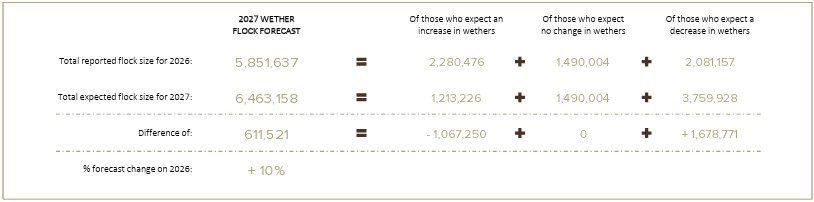
AUSTRALIA’S wether flock is set to rebound in 2027 for the first time in years, and seemingly ten times faster than the ewe flock, on the back of improved seasonal conditions and feed availability, according to the latest Sheep Producers Intentions Survey.
Among the producers with various breeds responding to the May 2026 survey, just over half (59 percent) expect no change to the size of their wether flock in 2027, with a further 21pc expecting more wethers and 20pc expecting fewer wethers in 2027.
However, the cumulative result is a forecast 10pc increase in wethers across producers responding to the survey conducted by Meat & Livestock Australia and Australian Wool Innovation in May. In the May 2025 survey, respondents indicated they would drop their wether numbers by 11pc in 2026.
Nutrien Harcourts Bendigo livestock manager Nick Byrne told Sheep Central he had not had an order to buy Merino wethers for “God knows how long”, but now had clients looking to buy some drafts in the spring.
“Wool is favourable again and if someone wants a low-cost easy operation well they can do it, and it’s worthwhile.”
However, he said one problem he had encountered was that many producers, especially in northern New South Wales, had not been mulesing their wether lambs because they were destined for sale as lambs.
“If you want to take them on as a wool grower, we will want them mulesed.
“From a store perspective, we won’t touch them if they’re not mulesed.”
The May 2026 survey found that improving sheep meat and wool market conditions are helping restore confidence across Australia’s sheep industry, showing producers are increasingly focused on retaining stock and rebuilding flock numbers. About 87pc of the wethers on the farms of the 2026 survey respondents were Merinos.
MLA senior market information analyst Emiliano Diaz said since the inception of SPIS in its current form in 2023, producers have consistently indicated an intention to reduce their wether flocks in the following year.
“This is the first survey in which producers have indicated plans to increase wether numbers, with a forecast expansion of 10pc.
“This follows intended contractions of 11pc in the previous survey, 17pc in 2024 and 14pc in 2023,” he said.
“The result represents a clear shift in producer sentiment and flock management intentions compared with the past three years.”
Mr Diaz said the survey data does not break down intended wether flock changes by breed.
“However, an indication of future flock composition can be drawn from ram purchasing trends over the past 12 months.
“Merino ram purchases increased by 20pc compared with last year’s survey, while shedding-breed ram purchases declined by 30pc year-on-year,” he said.
“While not definitive, these trends may suggest a strengthening preference for Merino-based production systems.”
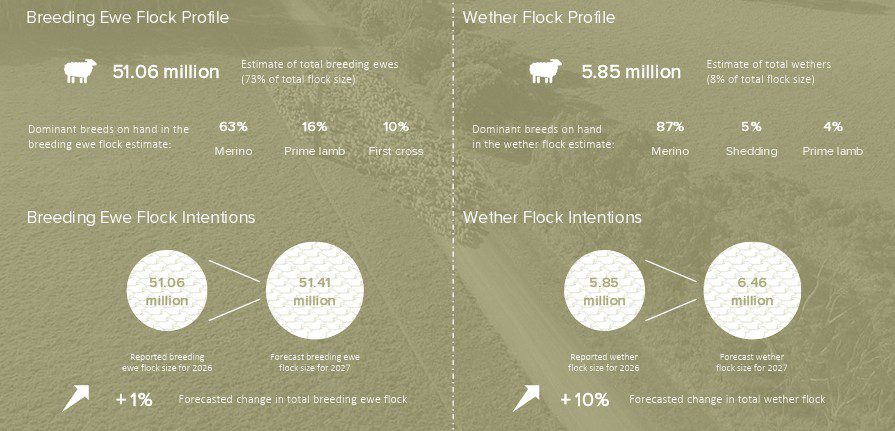
Mr Diaz said Merinos remains the backbone of the national flock, accounting for 63pc of breeding ewes and 87pc of wethers.
“Producers in WA, NSW and Queensland carry a notably higher proportion of Merinos than the national average.
“Prime lamb and first-cross breeds continue to hold a strong position in the ewe flock, particularly across Victoria and Tasmania,” he said.
“This enduring Merino base, paired with growing dual-purpose production intentions, positions the industry well to capitalise on strength in both wool and sheep meat markets at the same time.”
On whether higher wool prices were a factor in the higher wether flock intentions, Mr Diaz said the survey does not ask respondents to link their future flock intentions to specific drivers.
“So we cannot directly attribute planned wether flock growth to wool prices.
“However, all respondents were asked about the key factors influencing on-farm decisions,” he said.
“Seasonal conditions were by far the most significant factor, nominated by 56pc of respondents, followed by feed availability and cost at 31pc.
“Sheep prices and sales accounted for just 5pc of responses.”
However Mr Diaz later said producer confidence reflected strong market conditions and what producers are seeing in saleyards, with sustained high prices for lamb and mutton. Heavy lamb and mutton are trading above 1,000c/kg and 900c/kg, respectively. After two years of below-average rainfall, improved seasonal conditions, particularly across southern regions, have also contributed to the lift in confidence, he said.
He said wool sentiment is also supporting optimism across the industry.
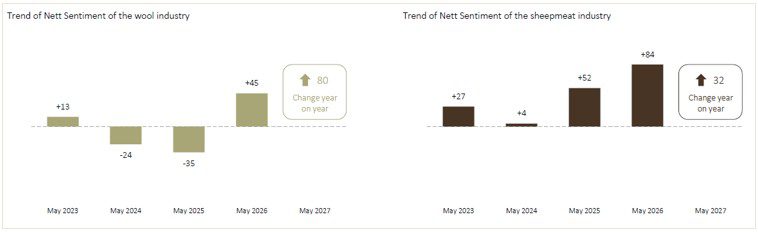
“After several years of subdued outlook, net sentiment for wool has climbed to +45, a remarkable 80-point increase since May 2025.
“More than half of producers (52pc) now hold a positive view of the sector’s prospects over the next 12 months,
Mr Diaz said.
“This improvement has been underpinned by wool prices, which have risen 57pc over the past 18 months and are currently sitting at a seven-year high.
“With both sectors (sheep meat and wool) now reporting strong positive sentiment, the outlook is likely to translate into renewed confidence in flock retention and on-farm investment.”
Ewe flock forecast to increase – by 1 percent
Last year, Australia’s sheep producers were considerably more likely to be planning breeding ewe reductions than expansions. In the latest survey, that trend has reversed, with 37pc intending to increase breeding ewe numbers and only 28pc expecting to reduce them, the latest May survey report said.
This shift is one of the clearest indicators that producers have moved from a defensive position to a longer-term production mindset.
“Breeding ewes are the engine room of the national flock, so intentions around ewe retention provide a strong signal about future industry expectations,” Mr Diaz said.
The survey indicated the national ewe flock would increase by one percent next year. About 37pc of producer respondents indicated they would increase their breeding ewe flock size (up from 23pc in May 2025), 35pc indicated no change and 28pc said they would decrease their breeding ewe flock size (down from 41pc in May 2025).
This represents a reversal from the more conservative, contraction-focused posture reported in May 2025. Analysis of the forecast intentions suggests a modest increase of about 350,000 breeding ewes (a 1pc rise) over the estimated 2026 flock size, in contrast to the 9pc fall forecast in last year’s survey.
This reflects the combined effect of producers forecasting an increase (adding about 2.94M ewes) and those forecasting a decrease (removing about 2.59M ewes), highlighting the importance of considering the reported changes in flock size rather than just producers’ disposition to change, the intentions report said.
Western Australia, which reported the strongest intention to decrease flock numbers in the previous two years, now shows a more typical pattern, with 38pc of WA producer respondents forecasting an increase and 28pc a decrease – broadly in line with the national average. All states are now reporting more balanced intentions, a notable change from the consistent downward skew seen in the May 2025 survey, the survey report said.
Good seasons and prices
Following improved seasonal conditions driven by widespread rainfall across southern Australia, sheep producers are increasingly looking to retain and rebuild flocks, supported by historically strong sheep meat prices, strengthening wool markets and a tighter national sheep supply, MLA and AWI said.
Mr Diaz said the May 2026 survey captured a notable change in industry confidence.
“What is particularly significant is that we are seeing confidence improve while many producers are still operating under difficult seasonal conditions,” Mr Diaz said.
“Twelve months ago, many sheep producers were focused on managing risk, reducing flock numbers and preserving cash flow.
“This year, the outlook is fundamentally different. Producers are increasingly looking at opportunities to retain stock, rebuild breeding capacity and position themselves for future production.”
The survey found confidence in sheep meat production remains exceptionally strong, with 86pc of producers reporting a positive outlook and net sentiment reaching +84.
Mr Diaz said the breadth of confidence across the sector was particularly encouraging.
The survey found confidence was consistent across states and flock sizes, suggesting optimism is being driven by industry-wide conditions rather than isolated regional factors.
“Strong sheep meat prices and tighter national supply are continuing to provide producers with confidence in the outlook for the industry,” Mr Diaz said.
“What stands out in this survey is that confidence is not confined to one region or one production system.
“Producers across the country are seeing positive market signals and responding accordingly,” he said.
Wool confidence rebounds
One of the survey’s most significant findings was the sharp improvement in sentiment towards the wool industry, with net sentiment improving by 80 points year-on-year.
More than half of producers now hold a positive outlook for wool, compared to just 7pc reporting a negative view.
Australian Wool Innovation’s head of domestic operations Scott Carmody says the industry’s mood is on the up again.
“It is a great time to be in the sheep game,” he said.
“An incredible improvement in woolgrower sentiment in just a year off the back of much better prices for growers and improved seasonal conditions for many.
“The significant recovery in price was overdue and a just reward for those who stuck with growing wool,” Mr Carmody said.
“The challenge now is to accelerate the rebuilding of the flock over the next few years while maintaining strong prices paid to growers.”
Seasonal conditions still shaping decision-making
The survey found weather and seasonal conditions continue to be the most important factors shaping decision-making, while feed availability, input costs and labour availability remain major concerns.
Producers also identified government policy, global economic uncertainty and geopolitical developments as emerging influences on their businesses.
The May 2026 Sheep Producers Intentions Survey gathered responses from 517 sheep producers across Australia and is conducted jointly by MLA and Australian Wool Innovation to inform national wool and sheep meat production forecasts and provide insight into producer sentiment and flock intentions.
Click here to read the May 2026 Sheep Producers Intentions Survey report.
Source – AWI, MLA.
HAVE YOUR SAY