
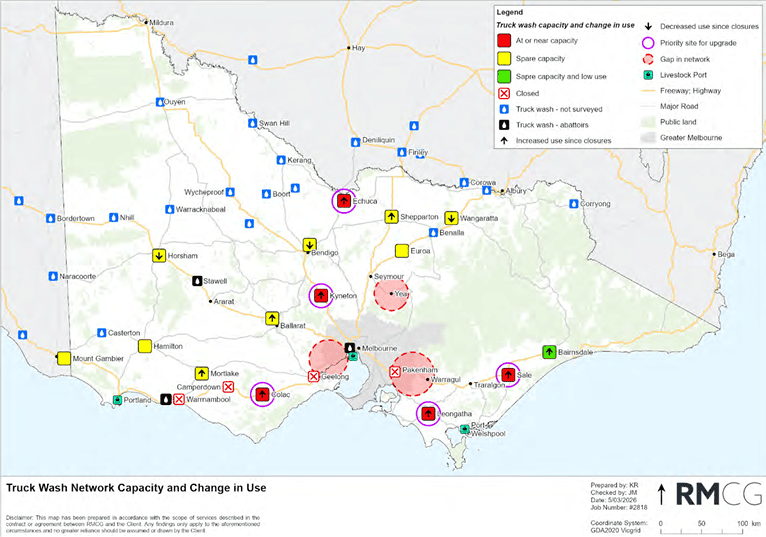
Victoria’s remaining truck wash network will get an upgrade.
VICTORIA’S sheep and cattle compensation funds will bankroll a major $5.2 million upgrade of the state’s livestock truck wash network.
Agriculture Victoria announced the funding as part of $13.78 million in grants through the state’s 2026 Livestock Biosecurity Funds Grant Program to strengthen Victoria’s biosecurity system and help protect livestock industries from pests and diseases.
The program will support 36 projects across the state, investing in practical initiatives that improve livestock health, strengthen biosecurity preparedness and support industry resilience.
The Livestock Biosecurity Funds Grant Program is funded through duties generated by the sale of cattle, sheep, goats and pigs and their carcases in Victoria, and through beekeeper registration fees.
The Victorian Farmers Federation has welcomed the $5.2 million investment in regional truck wash upgrades, alongside funding for critical livestock biosecurity projects, including the VFF Stock Sense and the new Farm Access Credential project.
Victorian Truck Wash Working Group chairman Stuart McLean said the cattle fund contributed $3.5m and the sheep fund $1.75m for the truck wash upgrade grant.
“It’s an upgrade program, it’s not building new truck washes.
“We want to have clean trucks to move livestock, because livestock are essentially food at the end of the day.”
Mr McLean said an expression of interest campaign would run to determine what upgrades were required.
Agriculture Victoria said the Regional Truck Wash Upgrade Program will improve biosecurity and animal welfare through targeted upgrades to the truck wash network. Improved access to effective vehicle cleaning will reduce disease transmission risks, improve animal welfare during transport and support livestock arriving at processing facilities in a clean condition.
VFF vice-president Scott Young said the VFF has been directly calling for action on regional truck washes for a long time, so this is a positive start with industry taking the lead and investing producer’s own levies into this critical infrastructure.
“We are calling on all political parties to back Victorian farmers who have shown they will invest in this critical infrastructure, now we want all political parties to commit to supporting and implementing these upgrades.”
“Livestock trucks move animals across Victoria, and without adequate cleaning facilities, there’s a massive risk spreading disease between farms, saleyards and processing facilities.”
“Prevention is always better than dealing with the consequences of a disease outbreak, which could be incredibly costly for farmers and the broader livestock industry. This is money well spent and a significant investment in Victoria’s biosecurity safety net,” Mr Young said.
The VFF also welcomed funding for key livestock biosecurity projects under the 2026 Livestock Biosecurity Funds Grant Program. These incude:
$415,000 for VFF Stock Sense – to help livestock owners, particularly peri-urban landholders, improve animal health, welfare, traceability and biosecurity, and;
$638,900 for Farm Access Credential to develop accredited biosecurity training for non-agricultural workers entering farms to reduce pest and disease risks.
Agriculture Victoria chief executive officer Beth Jones said the grants reflect the important role industry-led projects play in protecting Victoria’s livestock industries.
“Victoria’s strong biosecurity system depends on ongoing investment in research, innovation and preparedness across the livestock sector,” Ms Jones said.
“These projects will help strengthen our ability to prevent, detect and respond to pests and diseases while delivering practical benefits for producers and industry.”
Ms Jones said the diversity of successful projects demonstrated the breadth of opportunities to strengthen biosecurity across Victoria’s livestock industries.
“From improving honeybee health and strengthening farm access practices to supporting livestock transport infrastructure and animal health research, these projects will make an important contribution to Victoria’s biosecurity future.”
For more information on successful recipients, visit the Agriculture Victoria website here.
HAVE YOUR SAY