
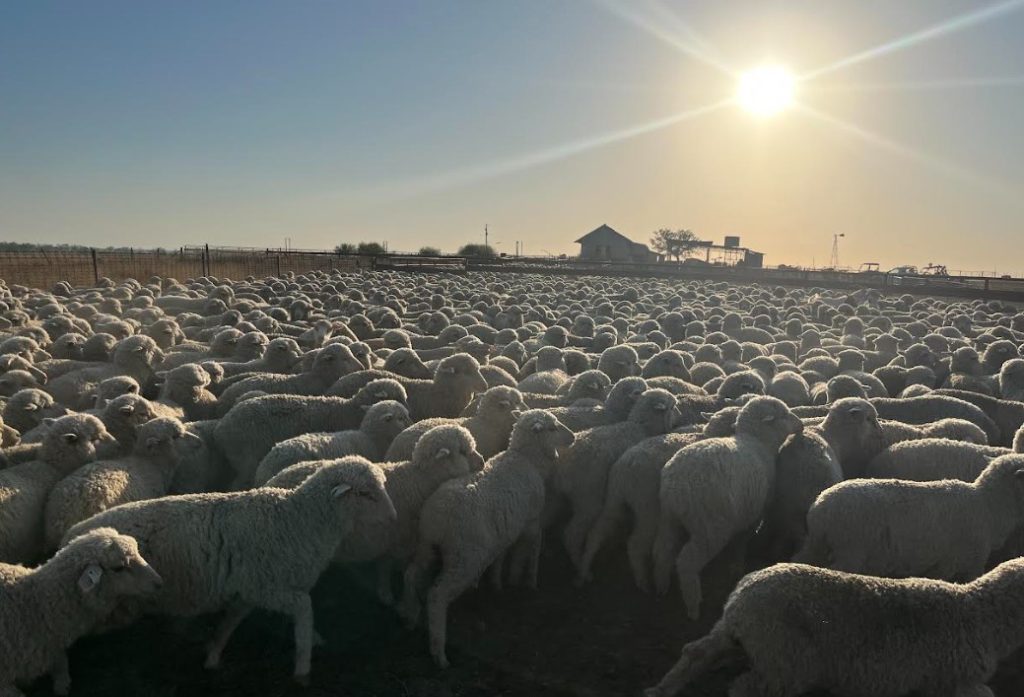
Changing joining date has helped boost the Beaconsfield flock productivity for the Thomases in central western Queensland.
CENTRAL western Queensland sheep producers Peter and Kimble Thomas are trialling later joining to avoid heat stress impacts on reproduction – a move validated by recent research.
The Ilfracombe producers achieved a 20 percent increase in lambing rate in 1000 Merino ewes that were lambed in September last year, compared to the previous year’s drop.
This year, they are expanding the trial to 4500 ewes joined over a five-to-six week period. Already, pregnancy testing rates have lift from an average 120pc to up to 145pc. Twinning rates have lifted from 20-30pc to 41-50pc.
The Thomases are changing their lambing to avoid heat loads of a longer, hotter spring. The move is validated from research at Adelaide University, and by University of Southern Queensland earth scientist Dr Mahdiyeh (Maddy) Razeghi, whose work with Desert Channels Queensland interrogated local climate data.
Peter said last season’s September lambs had good survival rates.
 “They just seemed a lot healthier.
“We aimed for a gestation over the cooler months,” he said.
Research suggests lamb birth weights are compromised due to excess heat stress over pregnancy.
“We are trialling moving our flock’s reproduction cycle away from the summer months,” Peter said.
“We’re certainly getting a lot more pregnancies.
“The compromise to the change is that we are lambing into our poorer pasture conditions.”
Lambing outside optimal pasture conditions has required supplementary feeding. Peter and Kimble are using a grain-based blend of sorghum, barley and faba beans.
“Yes, it increased the feed bill, but that’s why we’re trialling it,” he said.
“We believe we can keep on top of things by having a tighter lambing interval, a second scanning and earlier weaning.”
Peter added that earlier weaning should also boost ewe condition scores, which could also benefit future fecundity.
Producing lamb in this summer-dominant rainfall zone, in country where temperatures are regularly high, requires adaptability, he said.
“Dr Razeghi’s weather observations would suggest that the summer period is getting longer, which creates challenges to grazing animal performance.”
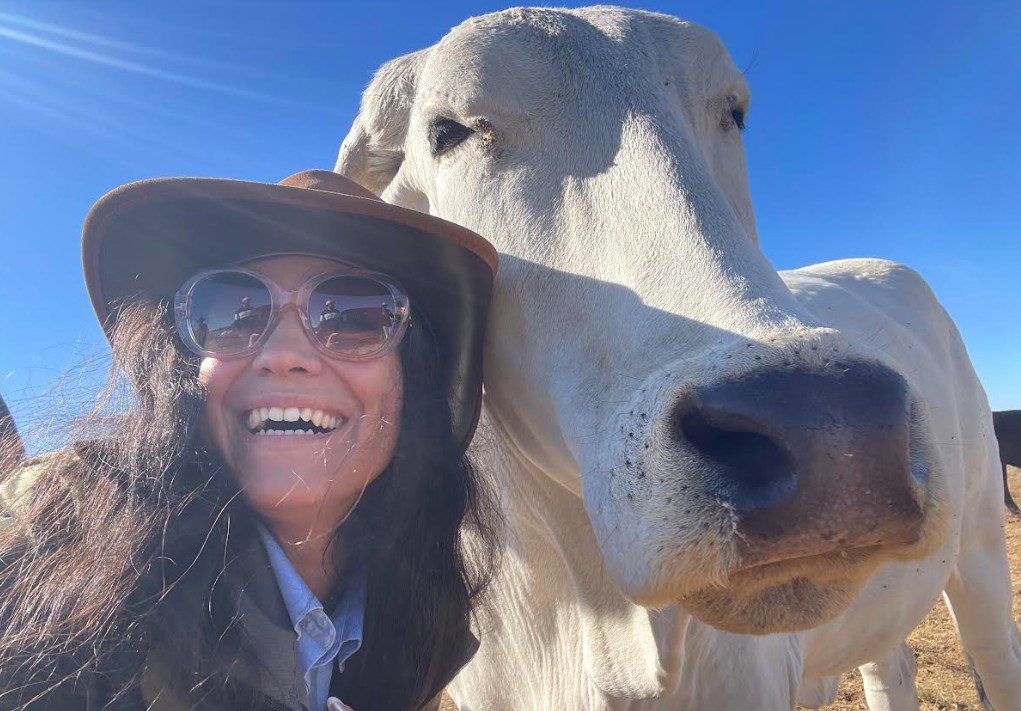
Earth scientist Dr Mahdiyeh (Maddy) Razeghi is a friend of white sheep and Brahmans alike.
The UniSQ researcher analysed 50 years of Bureau of Meteorology weather data for eight key towns in western Queensland: Boulia, Longreach, Barcaldine, Tambo, Birdsville, Blackall, Winton and Windorah.
Maddy looked at temperature, the number of hot days and cool nights, the timing of rainfall and the impact on evaporation.
Her update of the climatic conditions revealed more daytime heat, fewer cool nights and a definite shifting in the seasons – specifically in relation to rainfall timing.
“In some of the towns we can see that the summer is getting longer and spring is getting hotter,” she said.
Her findings validate the observations among locals.
“It aligns with the local knowledge, which will help producers adapt.
“They have to change their practices to adapt with the heat in the spring, and the reduced rainfall.”
Replacing guesswork with science is satisfying, she said.
“What makes me personally happy is that the science here is backing the deep local knowledge that landholders have.
“What we’re doing is backing their story, backing their guesses, backing their explanation about their land, with hard science,” Maddy said.
“That’s the beauty of this work.”
The results of her work were presented in a range of recent workshops across central western Queensland, attended by more than 50 sheep and cattle producers. Maddy said the effect of a changing climate on surface and groundwater supplies was uppermost in the discussions.
“That’s something they said is absolutely important to them,” she said.
“Wet season variation was discussed, based on what the data shows for each town.
“Again, the findings aligned with their observations.”
Her work was funded by Desert Channels Queensland, the Rural Economies Centre of Excellence, the Remote Area Planning & Development Board, UniSQ and Southern Queensland and Northern NSW Innovation Hub.
Hub director Bruce McConnell said there was already spin-off research underway.
“Scientists here at the UniSQ are looking at accumulated heat load on livestock.
“With the shoulder periods of autumn and spring increasing, and not having cooler nights to recover, livestock start accumulating heat stress over time,” he said.
Peter Thomas said the flock has been using Yalgoo genetics.
“Our most recent shearing averaged 17.4 micron; however, that includes some trade/purchased sheep of 19 micron.
“This recent shearing included some shorter shearing periods of 6-8 months to fall into the change in lambing date,” he said.
The long-term wool cut averages around 3.4kg clean kg/hd.
The Thomases are also strong users of data to guide decision-making in their Merino enterprise. They have been using electronic ear tags for several years to track production data across the ewe flock. They are active members of a production and benchmarking producer group, regularly contribute to local wether trials and use Sheep Genetics information in ram selection and flock profiling.
On the use of genetic strategies to increase the resilience of the sheep, Peter said he had been following the discussion about ImmuneDEX and genetic resilience tools and look forward to seeing any information on the economic benefit of incorporating these tools.
“It’s a complicated area balancing income generating traits with animal welfare/cost of production characteristics.
“We welcome anything that helps this decision making and incorporates different environments and systems.”
HAVE YOUR SAY