
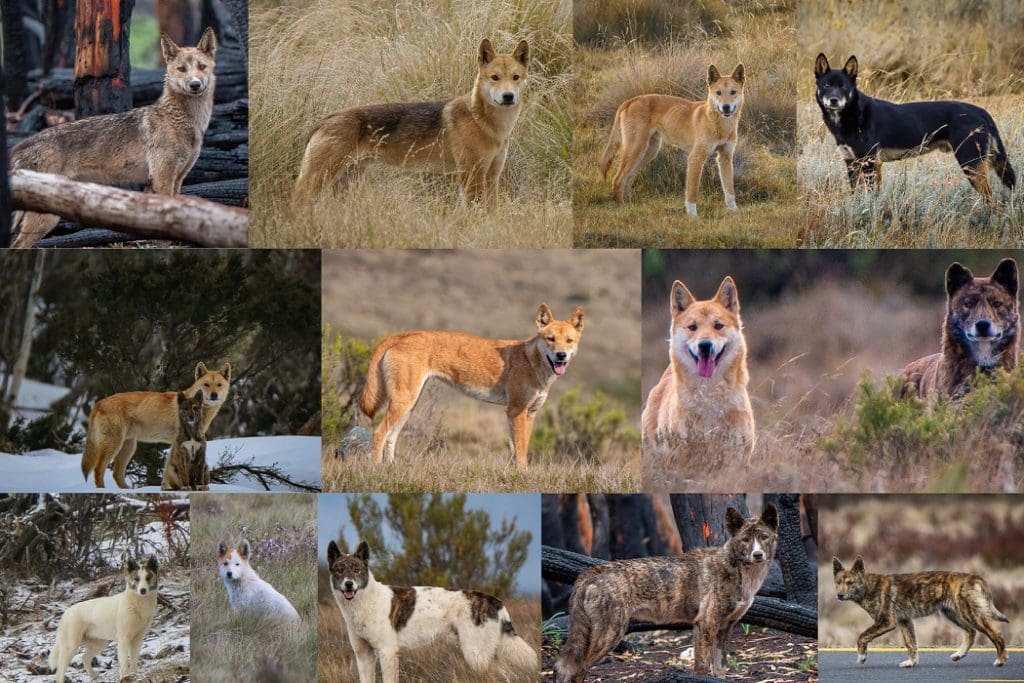
Dingoes or wild dogs, they come in all colours. Image – UNSW.
NEW research that shows eastern states ‘dingo’ populations have up to almost 30 percent domestic dog blood has sparked a call for a review of wild dog management and funding in Victoria.
An Adelaide University study and others analysed genomic data from contemporary wild dog populations and compared it with ancient DNA from fossil dingo specimens that pre-date European settlement.
The AU study has indicated previous research without an ancient DNA comparison by dingo researcher Kylie Cairns had overstated the level of purity of the state’s wild dog populations.
“While overall continent-wide admixture is generally low, Eastern Australian populations exhibit considerable admixture (20–28% European dog ancestry).
“This level of admixture aligns closely with human population density and access to domestic dogs, consistent with earlier findings (Stephens et al., 2015), and at odds with Cairns et al. (2023),” the AU researchers reported.
Dr Cairn’s research led the Victorian Government to end an unprotection order around public land in north-west Victoria in March 2024, leading to increased attacks on livestock. However, the researcher also recently co-authored two new studies that showed many dingo populations, particularly those from eastern and southern Australia showed significant crossbreeding with European dogs: Osuna‐Mascaró – Domestic Dog Introgression in Australian Dingoes and ‘Scarsbrook – The impacts of European arrival on Australian dingoes.’
Victorian Farmers Federation vice-president Peter Star said the research indicated that that the unprotection order in north-west Victoria should be reinstated and current controls in eastern Victoria need to be maintained. He said the research also showed that the north-west ‘dingoes’ were inbred and had interbred with domestic dogs.
Mr Star said the latest research has highlighted the dangers of basing public policy on limited scientific data that can have a significant impact on primary production.
“That’s what we have seen, we have seen this in the north-west.”
He said the Victorian Government now needs to rethink its wild dog management program, and especially in the north-west.
“The primary thing for us is to bring that unprotection order back in the north-west.
“They jumped the gun, the reality is what they did (in the north-west) is based on that one paper from Kylie Cairns where she said that all the dingoes in Victoria were pure – as we know she has been coming out lately and saying otherwise,” he said.
“We have to sit down with the State Government and have a conversation around wild dog management.
“It poses the question then, what are we protecting?”
Mr Star said he would like to think that the recent study spells the end of wild dog management policy based on agenda-driven research. He said the recent Victorian State Budget indicated current wild dog management funding would continue, but there was no increase.
Mr Star said the remaining unprotection buffer zone around public lands in eastern Victoria, allowing baiting and trapping, provides protection from dog attacks on sheep producers’ flocks and prevents domestic dogs interbreeding with the wild dogs or dingoes.
“So to a certain extent what you will find for the last 15 years in eastern Victoria, and even in the north-west, that the wild dog program has been stabilising the gene pool (dingo ancestry) of the dogs that are in there.”
Management buffer zones have protected dingo ancestry
The National Wild Dog Action Plan has welcomed the release of the new research, delivered through the plan, that provides a robust, accurate and cost-effective framework for understanding and monitoring dingo genetics in Australia. The findings indicate that many wild canids previously considered genetically pure dingoes contain varying levels of domestic dog ancestry, the NWDAP said.
The research also identified extensive historic interbreeding between dingoes and domestic dogs across large parts of the continent, with substantial hybridisation in some of Australia’s most productive agricultural regions of eastern Australia.
The research also found that this interbreeding was historic with the original interbreeding events dating back as far as 150 years.
NWDAP national coordinator Greg Mifsud said research has proven the extent of crossbreeding with dingoes across Australia meaning they are correctly described as wild dogs, “particularly in eastern Australia where the level of crossbreeding is substantial.”
He agreed the results indicated there needed to be a ‘rethink’ on wild dog management in Victoria and that programs should be designed on a regional basis.
“It also highlights that genetics is only one thing to consider when we are looking to manage the impacts of wild dogs and dingoes.
“It reinforces what landholders and in some cases traditional owners have said to us; that the dogs causing these (livestock) problems aren’t dingoes,” he said.
“These things are more bold and their behaviour has changed.”
Mr Mifsud said the buffer zones have protected the level of dingo ancestry in populations.
“And I think it (management) is going to be required into the future to limit the exposure to domestic dogs of those populations on public lands that we want to conserve, otherwise that level of (dingo) ancestry is going to be eroded further.”
Mr Mifsud said the findings were not unexpected, given Australia’s leading taxonomic authorities recognise dingoes and domestic dogs as belonging to the same species, Canis familiaris.
“Interbreeding between dingoes and domestic dogs has occurred across Australia for decades and confirms that some animals previously regarded as pure dingoes contain substantial domestic dog ancestry, particularly in eastern Australia” he said.
“The study reinforces that wild-living canids exist across a spectrum of ancestry, ranging from domestic dogs through to animals with high dingo ancestry.”
Wild dogs, not dingoes
Chair of the National Wild Dog Management Coordination Committee, Chris Patmore, said the results also aligned with long-standing observations from livestock producers and wild dog management practitioners across Australia.
“Landholders in eastern Australia have had the long-held belief that they are no longer dealing with dingoes, but crossbred wild dogs.
“The National Wild Dog Action Plan seeks to maximise the productivity and sustainability of livestock industries by reducing the impacts of wild domestic dogs, dingoes and hybrids,” he said.
Mr Mifsud said wild dog predation continued to impose substantial costs on livestock producers and regional communities.
“Wild dog attacks take a significant toll on livestock producers, their families and regional communities, while also causing considerable economic loss and animal welfare impacts,” he said.
Mr Mifsud said the National Wild Dog Action Plan remained focused on managing wild dogs, including dingoes, where they negatively impact primary production, environmental assets or public safety in accordance with state and territory legislation.
“Effective wild dog management remains essential to protect livestock industries, maintain regional livelihoods and support the coexistence of agricultural production and biodiversity conservation outcomes.”
The plan acknowledges the environmental and cultural significance of dingoes, including their conservation status and legal protection in several jurisdictions, and advocates for these considerations to be incorporated into local and regional wild dog management planning processes.
“The plan advocates for balanced, locally informed management approaches that consider livestock protection, biodiversity conservation, cultural values and community expectations,” Mr Mifsud said.
The National Wild Dog Action Plan noted that while the study focused on genetics and ancestry, broader policy discussions regarding wild dog management must also consider livestock protection, animal welfare, biodiversity conservation, public safety and regional economic impacts across diverse Australian landscapes.
Conflicts from go to woe here. Why attack a highly respected and world renowned professional scientist of the highest integrity? Why no acknowledgement of Andrew Weeks, the first male scientist’s intervening work which totally confirmed Dr. Cairns conclusions? The publication is incomprehensible, even to world expert geneticists, yet certain sheep heavies spout their opinions as though they had a hand in it all. Strange that the claimed conclusion is is almost word for word what one G. Ballard spouted two years back. In my humble opinion, this little effort needs close up investigation. The politics swirling around our native Australian keystone predator are utterly sickening when the truth is there for all the world to see these days.
It’s time we end all lethal control in Victoria.
Shifting the strategy toward non-lethal management allows Victoria to protect both livestock and native Dingoes. Livestock producers can safeguard their herds while preserving the apex predator through several effective alternatives:
Guardian animals: Deploying Maremma sheepdogs or donkeys to actively deter predators.
Smart fencing: Installing exclusion fencing paired with fladry (vibrant, moving flags) to create psychological barriers.
Visual and auditory deterrents: Utilizing motion-activated lights and sound devices to scare off approaching wildlife.
Co-existing with the Dingo ensures the ecosystem remains balanced without relying on lethal control.
Also, lets not forget where this research came from..
“Y.S. receives funding from the Centre for Invasive Species Solutions, and the Department of Primary Industries and Regions, Government of South Australia.”
“We are grateful to Dr. Peter J. S. Fleming (NSW Department of Primary Industries and Regional Development) and Greg Mifsud (Centre for Invasive Species Solutions) for their valuable feedback on the manuscript.”
“Our findings imply that the vast majority of modern dingoes only carry a small fraction of European dog ancestry, suggesting the usage of the term “wild dog” is unlikely to be appropriate for most free-living canine populations in Australia. Moreover, recent evidence suggests that European dog admixture may improve adaptive potential and help mitigate the effects of historical population decline (Scarsbrook et al. 2025). However, ongoing lethal control in southeastern Australia may continue to erode ancestral dingo diversity, likely eliminating important local adaptations that emerged over thousands of generations.” from Souilmi et al. 2026, the research paper itself.